Michel Gahier ‘07 Arbois Trousseau Grands Vergers

June 15th, 2010 | Leave a comment

Screen shot 2010-06-14 at 12.59.44 PM

I love the story behind a bottle of wine.

I quickly forget names, but I can visualize the taste of the wine with the story of the winemaker and the place…forever. The person and the taste are reminiscent of each other.

But with Michel Gahier, and this interesting bottle of organic Trousseau from the Jura region of France, we have only a faint fingerprint of information about the person and less details about the wine. The random photo above from a traveler in Arbois is all I could locate.

What do we know about Michel Gahier and his wine?

Not much. Folklore has it that he is the neighbor of the famous Pope of Arbois, Jacque’s Puffeney, in the small town of Montagney-les-Asures in the Jura region on the eastern border of France. Having an adjacent vineyard and the Pope’s tutelage, has obviously been enough to create a market for his wine and magically get it from the windy country roads of the Jura on the eastern border of central France…to my local wine shop in NYC.

I’m a big fan of Jacque’s Puffeney and his organic and almost perfect Trousseaus are weightless, elegant but remarkably full-bodied.

This bottle of ’07 Trousseau Grands Vergers from Michel Gahier, holds similar qualities to Puffeney’s Trousseaus, most likely from the hillside itself, but is unique. It is tangier, more full with berries and much firmer. Also a bit brighter, a bit more tightly wound and strongly mineral on the palate as it finishes.

Incredible really. As I’ve been looking for information on Gahier, I keep tasting this bottle and doing comparisons with Puffeney and Philippe Bornard and sharpening my palate. Maybe knowing a bit less about the person has sharpened my taste…if not my imagination ;)

At $28 a bottle, similar pricing to Puffeney, this is a must try for the Arbois aficionado if you can find it.

Available from Chambers Street Wines in TriBeCa, NYC.

Another huge thanks to Sophie Barrett, the Taste Princess of Jura (and buyer for Chambers Street Wines), for guiding me through this remote corner of France.

Share:
  • Twitter
  • Facebook
  • LinkedIn
  • del.icio.us
  • Digg
  • Google Bookmarks
  • Reddit
  • StumbleUpon
  • Slashdot
  • email
  • Print

Looking for community on LinkedIn

May 20th, 2010 | Leave a comment

Screen shot 2010-05-20 at 10.43.18 AM

LinkedIn…remember them? The uber Rolodex with breadcrumb connections?

Historically, we all used LinkedIn to see who is doing what on the long tails of our work world. A polite ‘Let’s connect’ once you meet with people at a conference or on a blog. Not much more.

As a marketing platform, or even a channel for messaging, LinkedIn always stopped way short of useful. This was never the first website I looked at when I started the day.

I decided to take a fresh look after writing a number of posts on Facebook fan pages as a platform for promotions and commerce. The world is changing minute by minute and LinkedIn always had a lot of useful material–(us!)– to build something interesting with.

Two new pluses on LinkedIn:

1. Twitter and Foursquare feeds are there

They are everywhere else of course. Context-creating, real-time wallpaper is something we expect and need now.

2. Subgroups have popped up

I really like these and they have some brand and communications potential. They add more specificity to the discussion platform with big growth numbers in my interest areas.

Kind of search meets information portal meets forums.

I like the groups as a subject-filtering device and in some instances, I’ve made new connections. This has been very true for me in the wine business. Not so within the more dispersed marketing and tech groups.

But with LinkedIn the wish-they-would-do-it list still far outranks the glad-they-did-it list.

Big five (still) missing links for LinkedIn:

1. I can find people but I can’t find community

I belong to 20 or so groups covering social media, social TV, some e-commerce and, of course, the wine groups and subgroups.

The more specific your interest, the better the discussion you can find. Wines from a particular region. Interactive TV widgets. Facebook fan page commerce.

And I’ve met some interesting people posting my blogs or responding to others. But invariably we immediately move the discussion to our personal websites or email or Skype.

It’s like speed networking at the recreation center. Find a match and leave to find a cozier place to talk.

People are the heartbeat of any community. LinkedIn has a lot of people but no clubhouse to foster community.

2. No sense of place

There is ‘no there there’ with LinkedIn.

Unlike Facebook or a blog community, there is just nowhere to hang out. If you are going to have a community, you need to have a place, a page, an ongoing conversation and somewhere to go. Otherwise it’s like a newspaper with headlines to scan. If something is interesting, you jump in, otherwise you leave. It’s disposable communications.

Oddly there is an emphasis on news and discussions, not on people and communications. Without a sense of place there is no community.

3. No conversation platform

Blog and community platforms, especially dynamic ones like Disqus, encourage kinship and conversation.

LinkedIn is about forums and groups, not communities. About exchanges, not conversations. About adding facets of dynamic conversation to a newspaper format, rather than encourage communications and make the comments, the content. This seems like a missed opportunity for them and for us.

Join a conversation string on Fred Wilson’s or Mark Suster’s blog and you will get in an instant what I’m talking about.

4. Closed platform to the open web

Take millions of professional people. Connect them together. Create discussion groups with comments and close this off from Google spiders and open web indexing tools.

Why?

LinkedIn hasn’t learned yet that conversations are content and the key to networking.

That is why bloggers use the discussion groups as free channels, grab readers and move them to more dynamic systems that can be indexed and searched.

5. No video broadcast channels

Education, training and business information seem key to LinkedIn. Why they don’t have channels within the network for shows on job related topics, or interactive video for interviews seems a misstep for them. Moving communications broadcast channels inside of LinkedIn just makes sense.

So…do I find LinkedIn valuable?

Yes..as a database with some clever dynamic components. Design wise though it is socially maladjusted.

Do I  find the discussion groups valuable?

Yes…they are useful filters of information but they stop way short. They are swapmeet-like in structure as there is no community to define the value of the content.

Do I recommend LinkedIn as a marketing platform?

Not really. Nor very useful to build new connections. The communications and community platforms are sparse and archaic.

I’ve always believed that given enough eyeballs you can create a runaway business. Rumor has it that LinkedIn is making money from our eyeballs but seems like an uninspired use of a great resource. And that resource is us.

Reblog this post [with Zemanta]
Share:
  • Twitter
  • Facebook
  • LinkedIn
  • del.icio.us
  • Digg
  • Google Bookmarks
  • Reddit
  • StumbleUpon
  • Slashdot
  • email
  • Print

Facebook fan pages: the new promotional websites for brands

April 12th, 2010 | Leave a comment

It’s the Wild West for brands and businesses figuring out how to use Facebook as a platform for marketing and promotions.

The potential is significant to move away from websites for movies, stars and retailers to Facebook fan pages where the fans are already congregating in mass numbers.

But somehow, so far, the social connector from most Facebook fan pages is missing. The fans are there and easy to aggregate. But the content and social campaigns that work within the Facebook ecosystems are still being discovered through trial…and a lot of errors.

This problem defines the next great opportunity for businesses on Facebook. Those who discover how to build a viral, social funnel with their fans on Facebook are mining a great new frontier. Truly opportunity abounds here.

Some background on fan pages

They have been around since 2007 and were created to clean up the confusion between people and companies on Facebook. People have profiles and brands have pages. Fan pages are basically a profile page for a business with some built-in marketing and search capability.

The numbers per Facebook on fan pages are starting to grow after a slow start.

  • More than 3 million active pages on Facebook
  • More than 1.5 million local businesses have active pages on Facebook
  • More than 20 million people become fans of pages each day
  • Pages have created more than 5.3 billion fans

Top 5 reasons why fan pages are such fertile ground

1. The fans are on Facebook and easy to round up.

Approximately 500,000 more people are migrating to the platform daily. And it is so much easier (and cost effective) to find your fans on Facebook then on the open web. Think of the pain and cost of PPC and SEM over spurring viral spread through friending.

2. Liking and Fan-ing are part of the Facebook community culture and powerful expansion channels.

People like to like and share those likes. This is a brand dream world. There are also some astounding facts that show that on Facebook becoming a fan actually drives buying behavior.

3. We live in a world of earned social respect.

Facebook is the sandbox for social behaviors, and the infrastructure and the culture for social sharing is already in place.

4. The fan page is free…well sort of.

You can buy widgets, build apps, port media but honest hard effort and connections with the fans is what really works. There is a democratization at work that levels the playing field and rewards honest and interesting communications.

5. Facebook advertising is a powerful tool to drive both fans and prospects.

Not only is the demographic targeting powerful but new abilities to target friends of friends redefines and expands earned support to a great degree.

The two problems to solve to make fan pages work

1. Boring content on the web makes unacceptably boring content on Facebook.

Most brands are simply porting over and reusing content from their open web URLs to their Facebook pages.

Photos, YouTube links to videos, Twitter and RSS feeds. Nothing new here. There is little or no acknowledgement that the social web requires social activities. No understanding that a brand is a personality and that on Facebook, and on the social web, people communicate with people, not companies.

A list of share buttons with some streamed video does not a community make. You may attract some fans but you are missing the bigger and more powerful connection.

2. The Facebook platform is more comment-based than conversational at its core.

The things we do on profile pages to deepen our relationship with our friends work less well on fan pages. Person to person communications is not the same as person to brand. There is a twist that is not fully understood.

And the Facebook platform itself makes it easier to link out to a conversational blog than to build a dynamic structure within Facebook on the fan page. This has created a void that is starting to get filled by new start-ups with a variety of approaches to social brand marketing.

Something is missing and it’s the authentic social connection

Think for a second about the power that the social web brings. It’s about connecting. About authenticity. And about transparency. Standard fare, even basic share channels aren’t enough.

I’ve blogged on the Star Connection. That magic on Twitter where millions of fans can connect and converse with a star like Shaq or John Mayer or your local politician. This one-2-many personal connection is what fan pages haven’t discovered how to accomplish yet. Sure you can chat but Facebook requires a face and real-time connections.

Fan pages need something new and fresh and social. Something different that takes advantage of the power of the social graph. Something that connects personally with the stars or the faces behind the brands.

One of the solution areas will be under the umbrella of what I’ve termed social video. I’m an advisor to Vpype, a start-up company who is innovating in this area on Facebook and providing commercial solutions to most of the examples I outline below for brands.

Other points of conversational video are starting to crop up all over the web, especially in the online dating world.  Most are pretty rough in format but social video without a doubt and a directional marker for what is to come all over the social web.

Some examples of what  ‘might be’ may stimulate some thinking

-Facebook variation of ‘video Twitter’ connecting stars to fans

A Twitter star like Ashton Kutcher broadcasting live to his millions of fans and having a video chat conversation. Impromptu, authentic and fun conversation that just happens on his Facebook page.

-Interactive reality-TV Facebook connections

Think of Survivor and Project Runway and Top Chef. Countless reality shows with weekly interactive conversations with the fans. Not boring chat, but a light as air conversation with the star that was ‘cast off’. There are scores of possibilities for these every week.

-Self chronicling star vblogging from Facebook fan pages

Ongoing video conversations to the fan page wall, interactive with any fans that happen to be around. Storable. Sharable. Reviewable. Think Miley Cyrus or John Stewart or Chris Rock.

There are innumerable options and solutions not yet thought about. Or even imagined.

My point…social media is authentic. Real. Interactive. And fun. Our relationships to our brands needs to be with real people in a new way that suits the platform it sits on.

Facebook is where the populations are. Brands need to find a way to communicate not just broadcast if they want to unlock the keys to a dynamic brand community.

This is a great challenge. A huge upside. And something new to be invented.

———————————-

For more information:

-See The State of Facebook for Business Report from the Hubspot blog.

-Check out Inside Facebook Pages from Sysomos.

My thanks to Tyler Willis, a smart guy and head of brand strategy at Involver.com for pointing me to some of these resources and being open to my questions and opinions. Involver is one of the innovative start-ups that is building solutions for brands on Facebook fan pages.

Share:
  • Twitter
  • Facebook
  • LinkedIn
  • del.icio.us
  • Digg
  • Google Bookmarks
  • Reddit
  • StumbleUpon
  • Slashdot
  • email
  • Print

Facebook’s growth explosion in developing countries

January 28th, 2010 | Leave a comment

Picture 1

Facebook has clearly tapped the Internet Café culture in developing countries and has created a global and socially flattened marketplace. Quite an accomplishment.

And app developers, brands and marketers should take notice of the game changing growth of Facebook’s penetration of the developing world. There is an intersection of global and social on this platform that creates an easily accessible global market for ideas and brands. Maybe for the first time.

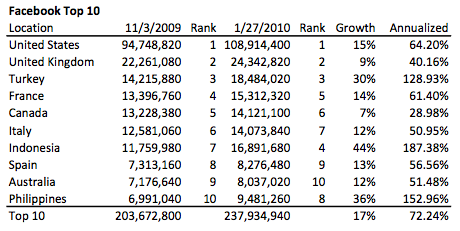
Back in December, just after Facebook’s announcement of the 250M user number, I blogged on the top 10 Facebook countries by user numbers and the part that having the app in the browser made to a global user base. The discrepancy between users and computer penetration per capita led me to conclude that the cloud based app allowed the Internet Café culture of developing countries to explosively adopt the platform.

I reran these numbers some 90 days later to see if this was a blip or a real trend. Thanks to Gary Klein, product maven and product lead at Vpype, a social video company I work with, for collaborating on this.

The results are astounding.

Picture 4

Let’s look at the facts over this very short period of time.

-Turkey, #3, is growing at 128% annually and will overtake the UK at #2 within 6 months.

-Indonesia, formerly #7 is now in the #4 spot and growing at a rate of 187%. It is larger than France, Canada and Italy.

-The Philippines, formerly at the bottom in 10th place is now #8, passing Spain and Australia, growing at an annual rate of 152%.

Growth of Facebook is occurring in spite of the lack of computer penetration. It’s happening at Internet Cafés and on phones and spurred by the need for social networking and the efficiency of the Facebook cloud-based app.

You can look at these numbers as the democratization of global markets. Or as the flattening of the world culturally where time and space get pushed aside to empower ‘friendship’ across geographies and languages.

From my perspective, two items jump out.

First that Facebook just gets and maybe defined the online social framework. Free storage and sharing of photos and videos and friend’s list is as pertinent to a family in NY with kids in Wisconsin as it is to a young entrepreneur in Istanbul with family in Ankara. Social frameworks work and if there is any doubt that Facebook will become the major advertising channel for both global and local brands, it is now gone. It is more targeted and more efficient than networks or cable. If you were Nike or Armani Exchange, where would you advertise?

And second, for app developers and marketers, this makes global markets an essential part of product and market discovery strategy. The cost of global marketing and customer discovery is for the most part, gone. Facebook has both proven that the social fabric is global and provided marketing and distribution access to it as well. The barriers to these markets are really ameliorated.

My sense is that Facebook and this easy access to global markets will spread as computer hardware becomes cheaper and more available. But numbers don’t lie. Whether you are Zynga with Farmville, or Pepsi, or an herbal supplement company in Colorado or a video blogger…the world is now accessible. To anyone. And in real time.

And we have Facebook to thank for this.

Share:
  • Twitter
  • Facebook
  • LinkedIn
  • del.icio.us
  • Digg
  • Google Bookmarks
  • Reddit
  • StumbleUpon
  • Slashdot
  • email
  • Print

Personal networks as the information highway on the social web

January 20th, 2010 | Leave a comment

Something very essential has changed in how we discover and share information on the web.

You remember the old marketing story that you need to plan your company’s growth as if you were throwing a stone to hit a speeding train at a trajectory in the future?

Not true nor possible any longer. We are the runaway train now and there are no tracks only breadcrumbs of ideas to guide us.

Web development platforms, distribution strategies, analytics and business models are constantly moving and making jumps to one side or another. Things are not in flux as much as they are growing in ways that no one can accurately forecast. We can surmise intelligently but the future is being created as we figure it out.

The day of the pundit and the grand expert is gone. Sure smart people can lay out the dots but there is no one right answer and there is no one opinion that connects and matters most of all.

And in the face of few undeniable truths, information and ideas and thoughtful opinions have never been more critical to figuring out what to do. The Yoda of today provide guidance and pockets of deep knowledge rather than complete answers and tightly held secrets.

Enter the real-time social web, communities of interest and the driving need forever expanding trusted networks.

Every day I wake up with some thought that demands discussion, be it around virtual currency or social data measurement or new way to discover an audience. And I reach out to find conversation threads that I can participate in and move to a decision or a better understanding. Conversations are the data points and content for new ideas and new ways to crop a thought so it becomes actionable.

Socialization is the fabric for a new kind of educational discourse that sits on top of dynamic connectors like Disqus and drives us towards blog communities of trusted friends. The curriculum is the banter we create around topics of interest. This process is inherently dynamic and reinvents itself continuously.

Authentic people, valued through their conversations and trusted because they are transparent and knowable in the real world are key to this. Hidden identities and unlinked personas are by definition not as valued. Socialization as a venue for community requires honesty and transparency. And I believe that this process makes folks both more civil and more unabashed, thus feeding the cycle of honest exchange.

Network growth is the offshoot of this process. The more you work to understand the kernels of ideas that drive growth, the more communities you search out, the more conversations with authenticated trusted friends you have and the more you become social and connected. And as well, the less isolated and more supported you become.

This process is quite remarkable and wonderful…but more importantly essential.

And this new reality leads to previously unheard of behaviors that really do work. Writing presentations and books live and collaboratively with your networks. The ideas of free (or Fremium) as channels for transaction. The reality that by sharing honestly, you are building a value chain for distributing your ideas and products. Many more are being created daily.

This process will not only continue but intensify. As ideas like social commerce take hold, tools for community and conversation will become even more dynamic and move to be as efficient on a mobile platform as at the desktop.

I already spend my days moving from laptop to mobile, moving from meetings, in and out of subways, and dinners with friends, following strings of conversations and thoughts and project updates. This is how I define work on a good day.

The unknowns will continue to surface and become more complex certainly. But there is a parallel development of social tools that make it possible for communities to continually iterate towards new conclusions just as the technology opens new frontiers.

Share:
  • Twitter
  • Facebook
  • LinkedIn
  • del.icio.us
  • Digg
  • Google Bookmarks
  • Reddit
  • StumbleUpon
  • Slashdot
  • email
  • Print

Beta as a state of mind

January 12th, 2010 | Leave a comment

I’ve been searching for someway to crystallize the sweeping changes that the social web is making in how we do business, develop new products and discover new markets. The concept of beta as a perpetual state of discovery and growth seems to capture this nicely.

In product release terms, beta is that state of ‘not-quite-done’ between a proposed spec and full functionality with some key customer acceptance thrown in. Usually the specs get reduced to eliminate bugs and meet sales cycles and then you start again.

Beta on the social web is always ongoing and a state of discovery where we are constantly moving forward to test our concepts and products against our developing market. And this concept is not just about products but extends to how we write our materials and discover our channels and markets. Beta is a state of being for how startups survive and grow in the face of unlimited unknowns and obstacles.

There is a synergy between the platform that new ideas are built on and the ideas themselves that speaks to this ongoing state of reinvention. The social web with its real-time data exchange and dynamic communications tools is building new solutions because…and I hate to say this…because it can. Flexible and inexpensive platforms, cloud-based architecture and mash-ups are enabling solutions that were unimaginable prior.

And on the other side, dynamic communications tools built on the same platforms provide community loops that fuel the conversations between developers and adopters that drive new growth and a constant state of new ideas.

A couple of examples jump to mind to illustrate this idea of beta as a state.

‘Slow roll’ is almost always the choice over ‘Big Bang’ for product rollout. On a social platform necessity and choice can become the same. Small companies can’t afford to build in isolation and create a market on launch. But more and more, even if they could, why would they? If you can have a flexible development platform and a community of early adopters, I challenge the wisdom of coming out bold before the users tell you you are ready. And by the time you have it right, the momentum is already there. Beta is the driver to always try and make it better.

Communities as focus groups for developing messaging and content are becoming a welcome norm. Many are writing books online, asking for input on presentations from the groups that are being presented to and questioning customers about product value in development blogs. Co-developing content with your community builds both rapport with your early market and a message that is already market proven. Our community platforms let us draft, share, gather feedback and iterate the message. This is a beta driven process and logical and continuous.

I’m a realist and the genius of companies like Apple who build in secrecy and have unlimited resources to market fall outside of this thought pattern. But for the entrepreneur and startup who are building from the ground up with only ideas and energy and chutzpah to make things happen, finding a model that works on flux is a good starting point to discover the value in the idea and the product.

For the startup, building on top of the social web and discovering a community is not a luxury but a necessity. And in the inevitable state of change that all startups work in, a state of constant beta is one way to think of a framework that allows for change as a solid building block to growth.

Share:
  • Twitter
  • Facebook
  • LinkedIn
  • del.icio.us
  • Digg
  • Google Bookmarks
  • Reddit
  • StumbleUpon
  • Slashdot
  • email
  • Print

Understanding social media performance

January 5th, 2010 | Leave a comment

Ahh… how much difference a few years make. The old world of e-commerce and transactional metrics are softening and social new world performance values are the developing realities for today’s businesses.

A short while back when the economy was booming, e-commerce was the word to describe the then new model and we learned how to navigate the world of click-to-transaction like scientists. The analytic systems from Google, FeedBurner and Omniture were our tools to get the job done. We measured everything and we optimized human traffic from a click to dynamically created content on a landing page to a transaction. This was harvesting at its most efficient. This was a transactional-based business reality.

But the world and the business model with it are changing slowly but dramatically. Old school e-commerce is changing and being modified by what some are calling Social Commerce.  Moving forward we are building an economics of social performance where community and commerce are tied together. Fred Wilson drove this home to me in his quote on social commerce from Rob Kalin, founder of Etsy.

The rising dominance of the social web appears to correspond with a questioning of the e-commerce model and created a new ecosystem for engagement with the customer. The focus today is the value of interaction and customer engagement first, the transaction later. The principal action is not harvesting clicks but building a place where conversations between the customers and the company, and between customers and other customers can happen openly in a seamless manner. The goal on the social web is to create a community. Sales and transactions build from interactions and from the community base.

Market makers and business owners know how to find the right click and how to measure every bit and action on the open web but when it comes to building and measuring the dynamics of a community with the goal of social commerce, for the most part, we are without clear guidelines.

This is fascinating because out of a period of e-commerce where everything was quantifiable, we seem to have few real datapoints to depend on. You can’t argue away the social web. You can’t deny the value of conversations between companies and customers. The rules of behavior and engagement are just being written now as we move from the crowd to the community and from harvesting clicks to building a social environment for commerce.

This is not an all or nothing reality. We have an arsenal of analytic tools and data. And we are experts at using them. We also have a bunch of new data points—posts, retweets, links, comments and Facebook Shares. All can be measured but no one really knows their value in the stated goal of creating a commercially viable community.

You can use logic and surmise the value of a post over a click, a retweet over a like, a Share over an embedded link but honestly, we don’t know how these gel to create that ineffable community formula. And if you think about it, all of these data points are superficial by themselves. You need to value the currency of the link, rank the reputation of the commenter, and understand the importance of the Sharer’s groups.

The basic issue underlying all of this flux is not counting and measuring but weighing the value of the information. Interestingly as we figure out the value scale of people’s proxies online we will also figure out commerce models that translate reputation into economics.

This is the Wild West and we are building groups and guiding them into communities with the intent of creating social commerce.

I think of this as good news. Uncertainty creates opportunities. Old systems falling means we get a chance to create the value system for the new ones.

And honestly, when commerce is not strictly a data harvesting activity based on price and match but a value system you need to establish a conversation with your market, it’s a lot more interesting and more like the real world rather than a grand catalogue of clicks and optimizations and transactions. People make it interesting and social commerce has put people rather than clicks at the center of the market where they belong.

Share:
  • Twitter
  • Facebook
  • LinkedIn
  • del.icio.us
  • Digg
  • Google Bookmarks
  • Reddit
  • StumbleUpon
  • Slashdot
  • email
  • Print

Facebook advertising moves towards ‘touch’ as the new ‘push’

December 23rd, 2009 | Leave a comment

Kudos to Facebook. They’ve stumbled on a redefinition of advertising that seems potentially palatable for the consumer and useful for big brands and small businesses alike.

On the social web, where we select our communities and our friends and expect conversant interactions, interruptive push advertising is basically spam, whether it be a video ad, a banner or an unsolicited email. What Facebook is doing is building an ecosystem where scattershot is unacceptable, generic is ineffective, and it is possible to match effectively seller and buyer in a near social manner. Successful advertising on Facebook will be focused on ‘touch’ as a point of interaction and conversation rather than ‘push’ as an interruption and distraction.

Let’s step back and look at what Facebook has done.

Facebook has created through a free social network what the print and TV industries have been trying to do for generations. That is freely acquired, detailed demographics on the background, interests, affiliations, and relationship status for 350M individuals. And with, this the idea of advertising, both agency and individual suddenly have a new direction. Companies can offer information and products to you when you are looking for something and talking about it to your friends in a venue outside of search and keywords.

For as long as there has been products and audiences, the seller has tried to know more about their customers so they can target messages directly to the right customer at the right time. If you are single, you are probably OK to see a dating ad or planning a trip, travel insurance, and so on. The best advertising venues delivered the largest audience with the most specific demographics, but the match was never precise.

Here’s the beauty of the Facebook ecosystem from a pure marketing perspective—everything we as users share with our friends to create relationships and community, are the precise data that advertisers want:

* where we live

* what we read

* where we travel and what we eat

* religion, political beliefs, movies, music likes

* schools, clubs, organizations

* links to outside sites

* basically everything we share

Wow. A goldmine of value.

And this information costs nothing to acquire. Goodbye survey companies. It is now self-selecting. When Facebook pushes keyword search to the top, another new paradigm will emerge as well.

No wonder that a large chunk of Facebook’s $1B in revenue is from advertising.

I’m not a big user of advertising in my businesses. Social tools are more precise, more delicate and more to my liking. But what Facebook has done unlocks new avenues for communicating in a social way. My markets are on Facebook and I’m open to ways to reach them.

Three ideas bubble up around Facebook’s paradigm of what I call ‘touch’ vs. ‘push’ advertising.

First, what Facebook is starting to solve, albeit in a contained network, is the authentification problem. Online, with search you are either an IP address or a cookie. With Facebook you are a person with a face. No longer does the advertiser need to ‘boil the ocean’. It’s possible that advertising is moving to a direct marketing or even moreso a personal conversation between a brand and a consumer.

Second, advertising is potentially more than a tool of brute force. No reason to yell if you are talking one-to-one or one-to-a-few that fits a chosen demographic. The self service ad tool lets you precisely target, set your spend and adjust your ad to your chosen group of individuals.

And third, this drives the need for more creative, more specific and a more participatory approach towards ads and campaigns. I believe that today the world is moving towards being 100% customer driven. If you can find me when I’m planning a trip, changing my residence, planning my movie watching for the holidays, then I will pay attention to offers and campaigns that are interesting and engaging and thoughtful. If not, I’ll just ignore or block them. Even in advertising under this model, the consumer can decide what they see.

Facebook makes these three ideas a reality.

Social media and the social web demand new business models. As socialization and democratic venues arise, how companies converse with us needs to change. There are entire new economies, like game microcurrencies, and affiliate networks, then there has always been…advertising.

What Facebook appears to be discovering is that with open demographics, data driven, self-service tools, advertising can be reconfigured to be a useful touch point and an offshoot to conversation rather than an intrusive push interruption.

Share:
  • Twitter
  • Facebook
  • LinkedIn
  • del.icio.us
  • Digg
  • Google Bookmarks
  • Reddit
  • StumbleUpon
  • Slashdot
  • email
  • Print

Is social gaming really just about games?

December 12th, 2009 | Leave a comment

Social gaming is the dream paradigm—develop inexpensively, let the market drive product direction and use your early adopters as your channel for growth.

Sounds too good to be true. Cool thing is that it is both true and not just for social games.  But also for all social applications and services that are being built on the Internet today. And it is fast becoming the option of choice rather than the exception.

Let’s back up a little here.

The real-time Internet created the fabric for the social web and opened up new avenues for marketing and distribution. But more importantly, it set strong expectations from the customer and community’s point of view.

Game play is nothing less than making web usage fun. Think of emoticons and birthday list apps on Facebook. I wrote about social design in a previous post and social game play is yet another component of that design construct. Commerce and information gathering and advertising should be fun and social. The infrastructure is here to make this happen; human nature has always been ready for this.

Static closed design and push marketing is out. Fun and social and evolutionary is in. And this is no fad.

We are in a customer driven, not a market driven world and customers, expect to have a community of interest to feel good about the products that we buy and the services that we use. If they don’t get that we simply click go somewhere else.

If you believe what Jeremy Liew lays out in his excellent post, that social games present a low-to-no-cost Development>Distribution>Discovery continuum, then what is true for games, should be true for information portals and apps and service on any of our online networks. And Beta is simply a state of mind, no longer the precursor to that abstract state of product release.

This doesn’t mean to imply that it is all easy now. Far from it. Success is hard and elusive and rare. But the social web allows anyone to prototype an idea, test it against a community, modify and evolve the product and grow the market and discover a business model if there is momentum. It’s easier to try, not necessarily easier to win but the math seems more slanted towards success than it used to.

A number of facets of ‘Social” are intersecting. Social as a perpetual state of development where the audience votes and designs with their interest. Social as game play where beyond pure social games, interactions as game play in even the most serious of venues, creates interest and engagement. And social as design which wraps development and game play into one.

This goes beyond the smart thinking in Wisdom of the Crowd. The markets themselves are in a way the source of the products that get built to service them. You launch your Beta with intention but the market will drive it where it needs to go…. if you are lucky and have the mechanisms in place to respond.

Kind of heady stuff but fast becoming today’s reality.

Share:
  • Twitter
  • Facebook
  • LinkedIn
  • del.icio.us
  • Digg
  • Google Bookmarks
  • Reddit
  • StumbleUpon
  • Slashdot
  • email
  • Print

Global markets, Facebook and cloud computing

December 10th, 2009 | Leave a comment

The cloud is one of the great equalizers for companies doing global business.

Whether its Amazon’s EC2 or another service, building your offering in the cloud is a game changer. I’m not talking about the obvious upsides of storage, scalability and the beauty of having both without sunk capital on servers and infrastructure. I’m thinking about marketing and the leveling effect that the cloud has across geographies and computer owners.

Facebook’s new plateau of 350M users prompted me to look at this from a distribution and marketing point of view.

Facebook users by country.

1. United States                    94,748,820
2. United Kingdom                22,261,080
3. Turkey                               14,215,880
4. France                                13,396,760
5. Canada                              13, 228,380
6. Italy                                   12,581,060
7. Indonesia                          11,759,980
8. Spain                                    7,313,160
9. Australia                              7,176,640
10. Philippines                         6,991,040

(numbers from Social Media Matters, Building Brands on Facebook”)

Turkey #3, Indonesia #7 and the Philippines #10 are the ones that catch the marketers and business modeler’s eye. Surprising high user numbers in countries that have low computer penetration.

When you match this list against the top 15 countries for PC and computer penetration per capita, Turkey, Indonesia and the Philippines don’t show on the list at all. These countries, as expected fall into the ‘Have Nots’ as regards to computer ownership. No surprise here but just checking.

The ‘why’ of this is simple actually.

If you stick all the computing power and storage in the cloud, and make your client-side download tiny or nil your market becomes infinite in concept. Yes, this can be costly to initiate, and surprisingly hard to set up and difficult to manage but possible if you are motivated enough to figure it out. Your users have PCs in ‘Have’ countries, phones and netbooks in ‘Have Less’ countries and in places like Turkey, Indonesia and the Philippines, some combo of phones and an Internet Café culture. So putting the weight and smarts in the cloud and little to nothing on the client side, lets your value be found and used regardless of the PC footprint. Likewise, an almost global market.

This is not true Democratization of access as it costs and separates out those without capital, but for Facebook and a host of other services and applications, this creates a one-world flattened marketplace.

I’ve been ranting for a while that marketing in today’s world, is not about add-on campaigns or line items, it’s about thinking through how to discover your market with the product or service itself, from inception. Whether for Facebook this was forethought or afterthought is irrelevant as it is the reality of their success.

Cheaper smart phones and netbooks will drive folks out of the Internet Café’s possibly to park benches and coffee shops across the world but the reality remains the same.

Draw three big circles: Global. Mobile. Social. And where they intersect is one universal market.

The cloud is the glue that can make them work from San Diego to Bangladesh to wherever if the offering is compelling enough. I like this. A flattened world engenders democratic access, at least in concept. As a marketer and businessperson, this is a powerful and empowering realization.

Share:
  • Twitter
  • Facebook
  • LinkedIn
  • del.icio.us
  • Digg
  • Google Bookmarks
  • Reddit
  • StumbleUpon
  • Slashdot
  • email
  • Print