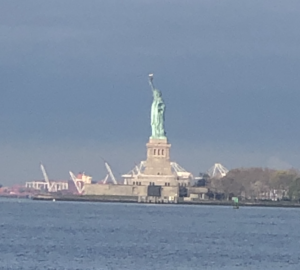
Walking the other morning along the river, I watched the early morning light wash across the lit torch of the Statue of Liberty.
This is the Lady Liberty of my early childhood.
Memorialized by the memories of my grandfather that ties me personally to this image, this city, this need for strength and resilience in this incredible time for the world.
Pop came into the harbor some 115 years ago after a long solitary journey by boat from Russia. As a small Yiddish speaking kid, I can only imagine going through the naturalization process at Ellis island under the then massive image of Lady Liberty.
Pre the bridges, the tunnels, the cargo cranes, pre everything except a mass of immigrant humanity pouring into this city.
He came from the shetls of of Eastern Europe to find something better. More so, he was sent to discover a new life unavailable to him in his homeland, to bring relatives over after him and to create something new.
Stepping completely into the unknown.
It’s hard not to romanticize this story and my profound love for this hard working, quiet, cigar smoking man so prominent at one end of the kitchen table in our home growing up.
But as the entire world has been brought to its knees by a tiny microbe and we sit at the era of something unknown, I stare at the statue wrapped in so many childhood memories and think about the uncertainty of that time.
Of his strength, of the innate connection between immigrant willpower and myself, still an entrepreneur at this stage in my life. Sitting and thinking of what the reality of the situation has for all of us that is positive.
It is now obvious to me that the order we build our lives and businesses upon is in a way, an illusion. I nor anyone could imagine that it could literally crumble in a few months and the idea that this is a phase, like a massive cultural cold, unlikely.
The thing of interest to me in this image of the statue, this slow motion black and white film of my grandfather and my earliest childhood is to say not only ‘buck up’ but to realize that normal was never really just that.
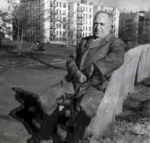 Sure Pop and my parents did things in a world completely unhinged from their own pasts. They stumbled forward and as a multi generational coalition of immigrants and 1st generation New Yorkers, gave rise to the working middle class and the basis of the boomer generation which I was, in retrospect, so fortunate to be a product of.
I didn’t start this post thinking of an equivalence between then and now, equating the building of NY then and the reimagining of it now–but maybe at a more primal level that is the truth of it.
Pop facing a new world with rules of humanity and family and little else, and all of us today facing something similar in a way that is not just metaphorical, holds some profound truth.
Waiting for patterns. Waiting for a new normal to surface and in between biding our time is a waste.
We need to realize that it’s an open book of change here to be rewritten.
There is a lot of really hard shit going down in the financial markets, the lack of coherence in politics and the painful dissolution of our health systems. I have my share of pain in some of this.
But today, at this extended moment in communal time, I’m thinking of Lady Liberty.
Once the largest thing in the harbor, dwarfing the very ships themselves. Immigrants as individuals miniscule in her wake.
Now physically a relic but as it appears to me, in spirit, in truth, in the reality of what my grandfather faced back then, just life how it is. As it always has been.
You can shuck it off and if fortunate wait it out I guess and bake bread, self observe to the point of inanity or respond and adjust and find something new.
And embrace the change that is ongoing that we don’t know yet. Embrace that we all need to do something to heal our relationship to nature. And embrace that what we build as business people or hypothesize as thinkers will certainly be in response to today, though not a waiting for it to be over.
Take from this what works for you.
For me, I’m going to take it as a lesson from the generations I came out of.
Be strong. Be creative. Make the world that you want to live in and do something about it.
It is always hard. It is always possible.
Big nod to my grandfather.
Samuel Rubin, horse drawn cab entrepreneur in the teens of last century, factory worker and union organizer in the garment district. Lover of family and a good man.
One of the coolest guys I can remember who after all this time, as I recreate him over and over in my memory is still is teaching me to work hard, be creative, and expect only what you can make yourself.
This morning at first light, New York felt very like a manufactured backdrop for one of those emotionally numbing scenes out of Westworld.
A pervading sense of underlying unrest coming at you through a slow motion lens lifted perhaps from the melancholic imagination of my childhood storytelling hero, Rod Sterling.
It feels all that dramatic as when NY is silent and still, it is either a sense of rare beauty like after a blizzard, or just unnerving and odd as it is today.
I am gratefully prepared for what’s coming with supplies, cat treats, wine, and a makeshift gym in the corner of the bedroom, as I had a heads up weeks ago as I work with people from Asia and Europe on Zoom often, and the reality of it on their faces was self-evident.
But in the last few days as I tightened self-isolation ahead of the mandate, spent a lot of time DMing with friends to get a pulse on their sanity and preparedness, it finally felt real.
Especially with yesterday’s poignant goodbye note from my friend Pascaline LePeltier, a partner at my local spot Racines that hit me with a deep sense of personal ennui.
She described the last supper of the team when usually they prepare for the evening guests, fold napkings, taste food and wine. A joyous time in the hospitality world played out in unison everywhere in every restaurant pre opening.
But yesterday it was truly The Last Supper, as everyone was being laid off and saying goodbye as they closed today.
Racines was my special spot, my Cheers, where I got hugged each time I stopped by, with my own reserved stool at the end of the bar. I’d been hanging there from before they were opened, lived through their trials and rejoiced after 3 years as they found their truly perfect poise of personality and unique version of their place in the community.
Gone now. Not at all bitter sweet, just very personally bitter.
Here’s the thing.
Everyone everywhere is living their own version of this story. While there’s solace in that building sense of community, I am letting myself wallow around the deep sense of loss this morning as I watch the surreal reality of this city I so love, literally close down.
There is humor and connection of course.
Texting and Zooming with friends realizing that whether they are an hour by train in Washington Heights or Park Slope or down the street, distance is flattened as it doesn’t matter. 100 yards, 4 miles is irrelevant if you are locked in.
Sharing banal life tips like that Whole Foods delivery restocks every morning at 6am and had gluten free Matzo, raw goat cheese, and organic chunky peanut butter this morning.
Tech readiness and the nature of this viral threat make it so different from our experience of 9/11. That was isolated, local, short lived, before the social web and blogging, and this one…well who the hell knows.
We are all in a conundrum of course.
Feeling the lack of governmental leadership but realizing that only they have the purse strings to make this workable. We will all head to our communities online to kvetch and console and support, but this will get fixed by science and the health care delivery system first, and requires capital beyond anyone or all of ours collective capability.
As well, it is clear that until there is a vaccine, the financial markets are simply going to stay crashed as even with a cash infusion, we have had a cultural societal shift, and until the health crisis is fixed, the markets will stay somewhat unhinged.
While I’ve been easing into this self-isolation, it’s only been a week since I stopped going to gyms, to stores—to anywhere there is a crowd.
And suddenly we are into this need for quarantine where it is unsafe, irresponsible to do much of anything but stay home. Go out before dawn to walk and that’s it.
Today’s world is in a time-lapsed waking dream that I’m letting myself explore for a while as after all, there is time.
As I know it will indeed pass and I’ll ride it out. Being one of the truly lucky and privileged ones, hunkered 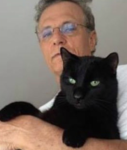 down with food and wine, and my wacky and wonderful Samthecat who has decided that I should never leave the apartment and is always on my lap, on the desk, following me around.
Lucky also that I have my family at hand, a network of people to kvetch with on demand and some truly interesting collaborative projects that create a pace for my days.
It’s easy to see where the pain of this will hit first for people and our culture.
How Twitter for all its crud is an essential part of our lives now for information.
The multitude of opportunities for creating new things of value that will make a difference and touch a new nerve in our populations post pandemic.
What is clear is that the other side of this could be quite different, so sci-fi in its possibilities, so raw that I for one have only a gut feel at this point.
It will make 9/11 and its entrepreneurial aftermath seem like a minor change agent.
So—
I’ll be writing often for myself, for work, for this community.
Be well and healthy please.
Take care of your own and your communities as best you can.
Most of us are going to be just fine and our resilience will find a way to make this a positive, as we always do.
I already feel more energetic and inspired just writing this post.
Think I’ll do something completely irrelevant and personally satisfying like write a bit about my personal journey discovering natural wine and why it has stuck with me for so long.
I’m here for you if I can help.
At the very least I will listen.
A key dynamic of early communities is that by empowering each and every individual, you create an environment where more often than not, compromise and loyalty to the whole happens as a sense of collective belonging.
From blog communities to artisanal markets to political movements, this is invariably present.
What’s telling is how this has been developing in the early communities and markets that are bubbling up around the NFT space.
Where cross conservation, digital art, blockchain gaming, metaverse-like virtual worlds, there is a rising tide of diverse communities, unfettered creativity, and a strong sense of conviviality and comradery.
While still a miniscule subset of the larger blockchain space, the NFT community and creative inclinations of this almost salon-like mashup of artists, writers, game creators, community builders is becoming influential beyond its small size and niche application set.
The reason is that while small, it is functional. While messy, it is directional, and pressing on in spite of what doesn’t work as yet.
I fell into this segment early, before I understood it, finding it an easy wrapper to leverage as a frictionless off/online ramp for community connections with a charity conservation project I was involved.
I’ve struggled a bit since to find a clear narrative for the why of it all.
Why something so simple has captured such passion and commitment, notably my own.
When I fall back on the dynamics of community and personal empowerment, not fiscal market design, it gels.
The more I start with the idea of personal agency and empowerment, and think of the blockchain, above everything else, as an organizing principal of these independent people and decentralized objects, the narrative just comes together.
The examples and use cases then flow easily.
Agency for the artist, when you can program into a digital artwork an annuity where every time it is sold cross any number of exchanges, part of the revenue can go back to the creator. True as well for a fine wine producer, any maker of a luxury goods in fact.
Agency for the planet itself in a wonderful way–if you think of a collectible tied to an endangered species or ecosystem, creating a perpetual, immutable annuity stream for the supporting conservation project around the NFT itself.
Agency for the exchanges themselves as leverage to build community with artists and causes, using social good to drive market demand.
As well, agency for small groups, even families who can mint NFTs, distributing them to their extended communities, trading on interoperable exchanges, driving education and financial benefit even at limited scale.
With new tech for unproven platforms, we are by definition future casting that the network will populate, the demand side exceed the supply, that this impossible all or nothing arrangement of forces come together and just work.
With NFTs as a standard, the game could change. Certainly you need to market the value and build want, but it’s not necessarily an all or nothing game.
Zero-marginal cost for artisanal non-scalable endeavors playing by the same rules of software at scale is a bold idea, and may just be possible here.
Making any one person a possible patron of the arts or conservation activist, regardless of their economic status, personal influence, or reach.
This idea of blockchain first as an organizing principal, as the superset preeminent value adding structure in new ways to atomically structured communities and markets may be the overarching secret sauce.
There is also a bit of a perfect wave here, made all the more possible as communities themselves have evolved over time. By definition now less closed and less siloed, more open and interlocking than every before.
I admit that while the excitement around NFTs is wildly contagious, the growth curves way up and to the right, the numbers are still small. Don’t look at this as size, look at it as the first place outside of currency exchanges where utility of the blockchain has met early market fit.
To close on this.
Traditionally communities form, grow, and combine, then morph into markets, most fading over time. The infamous Ob-La-Di, Ob-La-Da market exhaustion curve.
I wonder whether by rejiggering the building blocks with NFTs, using the blockchain as the organizing and decentralizing principal, we are turning an evolutionary corner and coming up with something new that beats to a different drummer.
With every tech advancement we are betting on a new and different world to bring the idea to economic fruition. Each and every platform that defines my life today–from how I shop, discover information, organize, and communicate are completely different than when I entered the work force. Full tilt change does and is happening.
So maybe my optimism is not that crazy.
This just strikes me as real because it’s about people and what they value, not strictly about currencies and market math.
Not an abstraction but something many can tangibly feel and intuitively understand.
I’m all in on this as it seems much less a gamble, much more an investment as I’m betting not solely on the tech but on the people and their communities first and foremost.
————-
Huge thanks to @SillyTuna and @YT for sharing their visions, their knowledge, and getting me to this place of understanding so quickly.
January 13th and 14th are the last days for businesses and citizens to make their voices heard on how the impending tariffs on EU imports will impact their livelihoods and the neighborhoods we live in.
The current administrations two-stage tariffs are scheduled to raise the import taxes on wine and select food goods 100%, meaning that the cost of imported wine, olives, olive oil and other critical components of the hospitality supply chain will double in landed goods price.
On a simple level, the wine that you buy today will cost twice as much. Yes, 100% more for that bottle or that glass.
On the human level, thousands of small businesses, tens of thousands of jobs, billions of dollars of income will be lost. And millions of consumers impacted in how they interact with the businesses that create the very personal fabric of their lives.
The backstory is well documented, and I suggest these three articles, one from Eric Asimov of the New York Times, one from Forbes, one from an importer here in NY.
And this post from myself that I sent the large subscriber base of my wine blog.
Tariffs from the current administration are driven to right the perceived inequities of EU countries giving tax advantages to their native companies over US concerns, especially the Boeing/Airbus dispute.
My very own tech industry has disturbingly been a supporter of these tariffs seemingly without understanding or considering the impact.
The social nets are filled with acerbic banter on this. For politic action, do your homework and vote this year to implement changes you believe in.
For today—actually for the next two days—if you have concerns that this change to very fabric of our hospitality business –from importers, distributors, restaurants, bars, food and wine shops, then spend a moment to have your voice heard.
Only the very largest of the players in these sectors will survive if this goes through.
But the small businesses will not, as the tariffs are levied not on Europe but when the product hits our shores. This means the products will be sent back, and some 70% of the inventory of wine being sold, and core components of our food business will simply be gone.
When thousands of containers are rejected at the ports, when hundreds of millions of dollars of goods are not ordered, stores will be emptied, and the results will ripple up and down the chain from consumer to producer.
Invariably eliminating jobs and business that deliver and depend on these supplies. From your favorite Italian restaurant to your local wine shop.
Do note that whether the tariffs last two months or two years, the market and these jobs will simply be gone.
On the community side as someone who had a business in this field, who has blogged on the wine culture for 10 years, and who very much relishes this global community of good people, working to share culture, I am doing what I can.
This is a nonpartisan call to action.
You can look at it from the perspective of the decimation of the culture that surrounds our artisanal wine and hospitality community that is so strong in this country.
You can look at it from the decimation of small businesses and the impact that has on people.
I look at both.
I made calls. I wrote letters. I did what I could and am hopeful that with logic will prevail and this actions will be reconsidered if not mollified.
I don’t want to be Chicken Little and run around screaming but indeed, if implemented the sky will have fallen on this important piece of our lives. And destroyed a way of life for many that will impact us all.
I’m being practical not dramatic.
I work my life to build markets and create jobs in sectors I care about, so I am sharing this threat as many outside of the wine world simply are unaware.
This article by my friend Christy Frank does a detailed job of laying out the details and how you can act.
If you are a consumer go here.
It is our responsibility to act on what we believe.
This is one that truly matters to me as it will impact the very life I live, and the community of shops and artisans that define the aspects of my world that I love the most.
I love NY the most at its moments of surreal stillness.
The sultry heat and humidity of mid-summer driving everyone indoors or to the roof tops.
The freezing cold and quietude of Christmas and New Year’s Day. The slowdown of everything in the last week of the year except for wine shops and bars, local restaurants and bodegas.
Sleepless yesterday on Christmas morning, I headed out just before first light, really brisk, walking across the empty Brooklyn Bridge, stopping mid-span remembering some words of Hart Crane. Then wandering around empty streets in Dumbo and Williamsburg for hours, ending with a ferry ride home.
Completely lost in thought.
Exhausted by the political uncertainly of the year. Excited by the pieces of my life that under control, felt just right and empowering.
Wondering, a walking meditation, of how life simply stumbles forward at times with such grace, at other times with such grating friction at all sides.
Remembering viscerally early mornings in my youth at the end of a night out, gathering at the Lucky Strike in Soho at 3am, eating breakfast with downtown friends. Noisy and exhausted, hungry and physical.
Now, waking before dawn, non-directional and cerebral, taking in the city in the unnatural quietness of a truly freezing Christmas morning. Looking forward to an unplanned day of whatever it brings—movies, friends, and some natural Pet Nats I had put aside.
Bookended by the weird reality that after almost ten miles of wandering, ended up in South Williamsburg, where the Chasidic community was just waking up and bustling. Yeshiva buses crowding the streets, picking up kids to go to school. Hebrew signs everywhere.
A disconnected parallel reality, through a keyhole into a world where Christmas, the quietude of my experience that morning, was completely absent.
I relish this time of the year.
The actual holidays mean little, but love the after impact of them. Especially when I choose to stay in the city and dig in to the momentary stoppage of time and purposeful action.
When things are mellow at my local spots. When people in the shops are so exhausted from it all, yet mellow and unshaven. More manifest of the city as a series of small towns, more reminiscent of the fragments of neighborhood life that pull it all together as a living diorama.
Having flashbacks to my father decades ago, musing over his retirement dream. Getting a small, ground floor flat in the West Village, adopting an old rescue dog, tutoring kids in Physics. Being that old neighborhood iconoclast that was always walking around aimlessly with his pooch, sitting on stoops, smoking his pipe, and ready for a chat.
I really like that so few are working, and many in my world quietly taking stock and planning for the new year.
I’m easing into decisions, getting rid of accounts that don’t satisfy or I can’t add value to. Doubling down on projects that truly matter to me. People I need to reconnect with face to face wherever they are.
Re-upping activities that drive more mental and physical health.
Buying nonrefundable tickets to places I want to visit.
A week in Tbilisi by myself working, exploring, and drinking Georgian natural wine. Regathering with a special group of wine bloggers in Lisbon, then wandering though the Douro together as soon as the weather gets warm.
Embracing the crazy diversity of the life I’ve lived. From the Dulcimer making, poetry-writing, off-the-grid, long-haired hippy, to me on a stage next month talking about the intersection of the blockchain and conservation for the social good.
Isolating what I can do that draws on the best of me, to make some small difference in the face of my place in life and the status of the world.
To everyone in my community of friends and colleagues, I wish you the quietude and wonder of this unique moment in time.
Whether at the top of an early morning mountain ski run with fresh powder for first tracks, that deep blue cold of being so alone and freakishly quiet in the snow drenched trees.
Or that breezy Caribbean warmth, sitting a dive boat ready to break the surface into the deep blue for a holiday dive into someplace you don’t belong.
Or whatever is your wish this year.
Meditation has taught me that it’s what I bring to the moment that matters. That is truly so for me.
I beg your patient indulgence for this plunge into the metaphors of my memory this morning. Feels quite wonderful to write this down, samthecat purring on my lap, the excitement of pushing Publish for the post still palpable some ten years into this blogging thing.
I’ll post my annual take on the trends I’m riding and what I’m taking into 2020 on New Year’s Day.
Till then and to all, Happy Holidays!