Austrian Wines…tasting notes and recommendations (Part 2)

October 29th, 2010 | Leave a comment

IMG_2861

Yesterday I posted on my new view of Austrian wines coming out of the European Wine Bloggers Conference in Vienna. Today’s post highlights a handful of remarkable wines that stood out from the scores that I tasted.

Let me first debunk somewhat the popular myth of the Austrian wine classification obfuscation.

I’ve been reading about the difficulty of understanding Austrian wine labels and classification system. Certainly Austrian wine terminology is complex with four main wine regions broken into 16 districts and covering some 30 varietals, with cuvees (blends) added to the mix. But like everything with wine you lead with your taste and your head follows. The more interest your palate initiates the more information you seek. Honestly, it’s not hard to understand once you have reason to.

And since 80% of Austrian wine is white and 35% of that Gruner Veltliner, it quickly breaks down to how you feel about the two main white varietals (Gruner Veltliner and Riesling) and the few niche but interesting reds.

I need to say that as a new convert to Austrian whites, they are something to be relished. Crisp and full bodied, dry yet aromatic. And beautifully mineral, reflecting individually on each vineyard where the grapes are grown.

I tasted over 50 different wines from maybe 6 or so regions during my five-day trip to Austria. A few really stood out. Although mostly white, there are a handful of interesting red wines in Austria. Not many. Small quantities…but unique and worth searching out.

Please see Part 1 of this post for my thoughts on organic and biodynamic Austrian wines. Thanks to Julia Sevenich from Austria for compiling this list of Austrian organic wines. She is an astute expert of wine and Austrian wine, specifically.

My top picks to check out. There are many more but this is a good place to start.

Gemischter Satz

This was one of my most pleasant discoveries. Gemischter Satz is an old Austrian tradition and fascinating. They are ‘field blends’ made from a group of varietals that are grown and harvested and vinified together. It is the idea of terroir over grape and I’m sold. Tasting a place as it grows naturally is my idea of pure wine.

The very best one I tasted was Buchertberg White from Gottfried Lamprecht of the Herrenhof Vineyards from the Styria region of Austria. Organic in the vineyard and in the cave.

Gottfried is 27 years old and a rising star in my opinion. Interesting individual, talented winemaker and an artist as well. Check out his blog.

Gruner Veltliner

Gruner Veltliner is Austria’s indigenous white wine footprint. And Gruner Veltliner, at it’s best, is full-bodied and a sponge for minerality and supporting acidity.

Most of the Gruner’s I tasted were from the terraced hillsides along the Danube. Rough, rugged, and deeply mineral terrain. As I moved from place to place, each Veltliner was unique, expressive of a micro-terroir.

Reasonable priced wine. Food friendly. Sipping easy. I’m sold.

The best Gruner Veltliner I tasted (and there were many good ones) was from Blauensteiner Leopold. It was an Essenthal 2009.

Riesling

I tasted many Rieslings, and many were excellent and showed the characteristic long-food friendly finish. As a group though, the Gruner Veltliner were superior to my palate.

The best Riesling I tasted was biodynamic and from Nikolaihof. It was the Steinriesler 1999. Stony. Pure. Alive in the glass. To my taste, remarkable.

St. Laurent

St.Laurent is a relative of the Pinot Noir. I fell for this variety hard. Compared to Pinot Noir’s from France, it is darker. Richer. More full bodied with clear tannins and good acidity.

Both of my favorites were from the Thermenregion and of the ‘Classic’ style. This is a grape worth getting familiar with.

-Heinrich Hartl Vineyard. St. Laurent grape. Classic style. 2008 vintage.

-Johanneshof Reinisch Vineyard. St. Laurent grape. Classic style “Vom Steinfeld”. 2008 vintage.

Blaufrankisch

A new-to-me red varietal. I’m enthusiastic about this grape It’s a cross between the Gouais Blanc and an unidentified/unknown variety.

The Blaufankisch is rich with strong tannins and good acidity to carry the fruit. It’s one of those varieties that while completely new, feels familiar. Winter is coming and Blaufrankisch is something perfect for cold weather and comfort food.

My favorite from this trip is below.

-Trapl Vineyard in the Carnuntum region. Blaufrankisch grape. “Prellenkirchen” (organic). 2007 vintage.

____________________________________

Photo is of ancient Oak barrels in the cellars of the Domane Wachau in Durnstein on the banks of the Danube. To see a photo of the ceiling of that cellar, click here.


Share:
  • Twitter
  • Facebook
  • LinkedIn
  • del.icio.us
  • Digg
  • Google Bookmarks
  • Reddit
  • StumbleUpon
  • Slashdot
  • email
  • Print

Social media…Few rules. Powerful tools. Endless opportunities.

October 9th, 2010 | Leave a comment

Social media has changed the face of how we do business…no question, and dramatically so.

At one level social media and its impact is easy to understand.

Take the age-old ideas of earned media and community dynamics…add to that the requisite poise of corporate and personal transparency and you have the outlines of the core social media building blocks. Very few rules and seemingly simple.

The bigger and more defining idea for businesses is the reversal of power…the change of center from the corporation to the consumer. This democratization of control turns traditional business models and the world on its head.

This power shift gives people like ourselves, with our blogs and Facebook Walls and Twitter feeds and a Yelp-ish world view, a global network for our thoughts and likes and dislikes. If you think that Nike or Nordstrom or Best Buy is in control…not at all. The customer is, more than ever before. And this is a key building block…maybe more so, the overriding superset of the core elements of a social web reality.

This social landscape coupled with a global marketplace puts the consumer very much at the center of their world and more in control than at any other time in history. Their opinion really matters because of the network effect and with unlimited purchasing venues to choose from, they are the alpha customer. They don’t like a company’s politics? CLICK… Find the shopping process too difficult? CLICK… The typo on the catalog page really annoys them?  CLICK…and gone.

This is transformational. One happy and connected customer can start a spiraling of praise which can hyper accelerate building a global brand. And one maligned (or maladjusted) unhappy customer can put the breaks on a multi-million dollar campaign and bring pain to a huge company.

Social media is over analyzed yet often misunderstood and reduced to a list mania of ‘do’s and don’ts’. In actuality, it is difficult to articulate its import and relationship to a business building a brand in language that is not too high in the stratosphere to become abstract nor too detailed where it becomes trivialized and often incorrect.

The power of the social tools and platforms themselves are confounding.

We all remember “The medium is the message” refrain from Marshall McLuhan. Marketers especially have confused the eras. We hear often that the answer is in the tools like blogs or Facebook pages themselves. The ‘Build it and they will come’ mantra.

Not so. These tools, powerful as they are, are the channels–vanilla envelopes demanding personality and message and personae that will spur the broader community conversations. Twitter streams. Facebook pages. Blogs. Tumbleblogs and more. Wildly disruptive tools in the right hands. But remarkably hollow and empty until the spark of a personality or a company voice is found.

We’ve all been through this experiment.

Build and launch the blog…and sit back and wonder, why no traffic? Bring in tried and true traffic aggregaters using scientific SEM techniques. Traffic comes then bounces and is gone.

Start over…find your voice. Find a personal or company point of view and post and post and post…and build credibility and reputation and traffic comes and hangs around. Add scientific methods to the traffic mix, maybe some public speaking by the ‘expert’ or Meet Ups with your fans on top of this and poof…maybe you have a brand in the brewing.

Tools are present galore but just mixing these with a few social building blocks usually amounts to naught. No surprise…look around and you’ll find that what is obvious for success, is also rare. Go to a bunch of websites. Most I bet will be brochureware or raw catalogs with commentless blogs or one-sided twitter feeds and sparsely ‘liked’ fan pages hanging off the site like unused appendages.

For brands this social change appears remarkably difficult to understand…and even harder to execute on.

“Build a community.”“Establish trust.” “Listen to your customers as if they are the company.” “Be interesting”….Non trivial endeavors. And they sound so general and basic they appear wrong. And herein lies the crux why a social approach is so difficult for businesses–because while there are basic building blocks there are no predetermined models nor templates or roadmaps. This is a relationship between a brand and its community of individuals. Each solution is unique…built of like materials but personal and dynamic at its core.

This conversation about community and the customer/company power shift is the start of every meeting at every company, little or big when they begin to think about how social media needs to be part of who they are, how they relate to their customer and how this impacts traffic and commerce and an enthusiast community.

So…what’s the why of this?

Never has the upside for companies been greater, market building economics less prohibitive and the potential to build true brand value and dynamic communities as within reach. The examples are all around us. From large social platforms to innovations in social commerce to an ocean of new start-ups popping up out of the crowd daily.

Companies often act as if the openness of social media–especially between company and customers–is messy and unnatural. Actually, it is just the opposite.

In the proverbial hometown brick and mortar world of shops and customers, successful businesses were built on relationships with the community. They supported their communities, listened face-to-face to feedback and in turn the community supported them with loyalty and their patronage. A two-way street.

Connections between companies and communities is nothing unnatural. It just went missing. Online businesses lost the sense of local, community and connection with customer when they became just a click. Social media is local on a global basis and community dynamics on steroids. Not unnatural, but hyper real in its intensity and ability to impact brand, reach and economic success. Core human and business values on a global and local and real-time stage.

Social media certainly adds a new layer of tools and capabilities but even more, it’s a change of perspective that is not at all subtle. For businesses, it requires that they put a face or a human voice behind their URL. It requires that they listen and respond and host their communities with a place they can interact with other customers and the company itself. The power of conversations and loyalty of a community can’t be underestimated.

Building a brand is hard work. Always has been.

Now it’s easier actually–brick and mortar businesses need to find that tie-in of their value to a real-time connected, often geolocated world. Online businesses need to find a voice, if not a person, who can talk to their customers and create that reality that an online community is not comprised of clicks…but of customers and people.

Share:
  • Twitter
  • Facebook
  • LinkedIn
  • del.icio.us
  • Digg
  • Google Bookmarks
  • Reddit
  • StumbleUpon
  • Slashdot
  • email
  • Print

Facebook and Skype…bringing community and communications together

October 4th, 2010 | Leave a comment

Community and communications are two parts of a social whole.

The Facebook and Skype merger rumors are a perfect backdrop to relook at the Facebook community paradigm and how it will change with Skype as a partner.

To hundreds of millions of people, Facebook is the web. The first place they go in the morning and their principal source of news information. What’s remarkable is that while Facebook has defined social, you can’t really have a conversation there. Share of course; talk not much. This has been a missing link.

Today, on Facebook, we can post and comment but real conversations are not possible. Comment strings get moved to email or blog posts or a phone call or to a coffee shop for a meeting. Facebook is a check-in portal to see what’s going on. To do anything beyond sharing, you need to leave.

Facebook wants “To mesh communications and community more tightly together and add more tools to allow users to do so.” According to Kara Swisher who broke the merger story. Adding deeper communications capabilities in voice, text, and video are naturally the next step for Facebook and an evolving need for the ever growing group of people who run their lives from their profile pages.

Facebook fulfils that unique promise of a place to hang out at the intersection of our off and online lives where you share…and to many, create your life.  It is the ‘homepage’ to the global and flattened mass market, the news source of reference to most, and fast becoming a merchant mall to most global brands. Google is where you go to work and look stuff up. Facebook is where you share it.

The merger would add a communications layer (Skype) to Facebook’s community network that makes sense on at least three levels:

1. Voice and text

Voice communications is a ‘gimme’ for the social graph. It’s been overdue in arriving.

Why say “I’ll call you”, jump off of Facebook…rather than make that call immediately? Having an integrated phone book built off of Facebook membership seems like a no brainer. Skype is great alone. Integrated without an extraneous Skype phonebook is considerably better.

No one likes the phone company. If we can make calls from our social homepage…we will. And since many of the Skype calls we make are international, this feature has the added benefit of accelerating international expansion to the Facebook network. And to the members, the more people on the network, the more useful it is.

Texting is an obvious missing link

Most notices from Facebook and my blog communities come through text.  Texts are our rapid alert system from our networks.…”At the store.” “Meet you at the movies.” “Sign on to Facebook to chat.” Why have a one-way text pipe? On Facebook, on my phone…I would simply send text from within my profile…so would hundreds of millions more.

With Skype integrated, this issue is resolved…and of course, from a single Facebook address book.  The sub 25 year-old, mini-millennium generation, would jump on this en masse as text on the phones is their principal communications jargon.

And with Skype’s partnership with Avaya (think VoIP PBS) it is possible to conceptualize a fan page as a business center with conference calling and call analytics. Powerful in its possibilities. Your fan page could become the portal into your VoIP-based, Facebook centric global BBS system.

2. Video chat and social video are the big promises that just haven’t materialized

Social video has been stumbling forward in fits and starts. I expected it sooner, but it has eluded the mass market’s momentum…so far that is.

Creative startups like Vpype, and even Facebook with video wall posts have tried to make it easy to use video as a new social form of communications. They’ve succeeded in making it easy; they’ve been unsuccessful so far in making this a mass market need…or want for that matter. All the pieces are there…cams, free usage, address books, but human behavior hasn’t made the leap.

Video Skype calling to friends and for business is already a well accepted behavior. Integrating this capability within the social graph from a branded and trusted provider like Skype could possibly push behavioral usage to fruition. Maybe we needed a communications brand to kick start this.

My sense is that if you add video Skype calling into the social ecosystem of Facebook, the dream of party-line video calling, interactive video presentations and distance learning just might take off. Social video may go from a good idea to an explosive reality…and drag along the work of start-ups who are verticalizing the video pipe for all of us, with apps from entertainment to business.

3. The Facebook social TV channel

Live conferences from Facebook corporate are streamed frequently, and free. Boring stuff but there is already the concept of TV within Facebook. It works pretty well actually on the small screen.

TV, the holy grail of home entertainment is a living room paradigm. Skype and Facebook are already built into millions of connected TVs and DVRs coming out this holiday season. Add Facebook Connect, Skype’s SDK, a connected TV broad footprint and Facebook may be the network for content consumption, including TV as a social medium. I’ve blogged on this here.

“Facebook is the equivalent for us to what TV was for marketers back in the 1960s. It’s an integral part of what we do now.” This comes from Davide Grasso, CMO from Nike. Facebook could well become the new social TV platform, where people watch and share video content in a brand new way.

A Skype and Facebook merger or partnership makes sense to me. Check out Om Malik’s piece on GigaOm for a positive view and Rick Aristotle Munarriz in The Motley Fool for an aggressive anti-merger point of view.

Regardless of the outcome of the Skype/Facebook saga, integration of community with communications will occur in the Facebook network and deepen a whole social reality that is greater than the sum of its community and communications parts.

Share:
  • Twitter
  • Facebook
  • LinkedIn
  • del.icio.us
  • Digg
  • Google Bookmarks
  • Reddit
  • StumbleUpon
  • Slashdot
  • email
  • Print

Thoughts on social networks and aging

August 25th, 2010 | Leave a comment

I’ve been thinking a lot about my mother lately.

She’s 91 years old. Healthy. Spunky with a large extended family of kids, grand kids and great grand kids. There are people all around in her retirement community. In spite of this she appears lonely and bored…achingly so at times.

I sense she feels isolated from her past and trapped in an ever-shrinking present. Not abandoned certainly–but friendships and networks outside of immediate family that come to visit are just not there. And there is little productive to do.

Her communities, once very large, are evaporating. Connections outside of the family are gone mostly. And to someone whose father drove a horse drawn cab in NYC at her birth, computers are just not truly a part of who she is.

And she is not unique, but an example of many who live between the extended family structure of the immigrant family and the social reality of a networked world that many of us inhabit.

For most of us, social networks have flattened the world and community has taken on new forms, providing a huge umbrella of support. We have Facebook walls, niche interest groups, blog communities, and offline/online connections. We have numerous lingering touch points with contacts and friends in a way that my mother never had.

This is not about richness of life…my mother’s life has been very rich. It’s about something new and extraordinary that the social web has empowered. This ability to create community as a hedge against location, a hedge against aging to some degree and certainly…a hedge against isolation as it engenders friendships in new ways.

My mother’s world has been one of astonishing change…world wars, the great depression, air travel, empowered middle class, electric powered everything, but for her, it stopped at the networked world. We spring off where she stopped and nothing is more compelling or revolutionary that what the social web empowers around people and friendships and community.

My mother sends (some) emails. Plays computer solitaire…so it is not simply technology where we spring beyond her generation. It’s networks and the social possibilities that are the great chasm here. And while we understand intellectually the power of social and community, my sense is that it is just beginning and its power is just getting tapped.

Maybe when I’m my mother’s age…when the baby boomers succumb to old age…the body will not hold us back as much. And will not create isolation or lack of productivity as our physical reality becomes less limber and more confined.

Science has extended our lives and made the middle of life longer, more productive and not much different from the decades preceding. I’m thinking that a networked and community driven, intertwined off and online world, will extend that even further, enabling connections, productivity and support for an even longer, richer period.

Add the science of health aging to the empowerment of community and socialization in a connected world, and we have something new and powerful. Technology usually evolves from one thing to another. The social web and community is a revolution in how we live better…for far longer.

Share:
  • Twitter
  • Facebook
  • LinkedIn
  • del.icio.us
  • Digg
  • Google Bookmarks
  • Reddit
  • StumbleUpon
  • Slashdot
  • email
  • Print

What’s left of the check-in space now that Facebook Places launched?

August 20th, 2010 | Leave a comment

The game has changed obviously…but, it’s certainly not over.

Facebook is becoming what Microsoft used to be back in the 90s…essential to everyone, impossible to beat and feeling a bit like the platform bully.

They are smart to leverage what they have to the hilt. It’s just good business and I would have done the same, but like Microsoft, they will lose  (if they have not already) the passion and commitment of those who have no choice but to use their platform, which today is everyone.  This is starting to sound like Windows to me.

You can’t beat Facebook at their game…but you can build great companies that can win around them. Anyone in the gaming or multimedia or peripheral add-on space in the 90s will tell you the same. I have personal scars from this and am a veteran of the birth of coopetition.

The announcement (I watched the livestream on Facebook) was like a webcam in a frat house. Nonetheless, Facebook Places will certainly be a monster product and hugely successful based on the massive leverage of of the platform obviously. Their reach and numbers are poetic in their size.

And yes, I’m a power Facebook user, a fan, consult on how to best use fan pages to my clients… and am excited about Places even though underwhelmed by their lack of originality. I’ll certainly use it because the Facebook platform is core to how I live, but I’m still checking in on Foursquare for now.

I’m just a big believer in the check-in space and rooting for the underdog today. I believe in people who are inventive and I think the Foursquare guys are… and with spunk, smarts and yes, a good chunk of luck can potentially carve out something that makes sense, has value to the users and the merchants.

What’s the answer? I’m not certain but here’s Foursquare’s response in SAI today. We do need more of a answer from them though.

I like the intersection of the check-in and coupon space a lot. That’s where I’m looking for the next great explosion on the streets with check-in. I’m searching for apps that are at the intersection of these because I believe that the social commerce component is key…as it creates an open market and value potentially for user and businesses alike.

______________________

Postscript thought

I’m starting to think that Om Malik may have it right that Facebook is after the local merchants and Yelp. His post is here. Thanks to @PS 98 for surfacing this.

Even though I still believe that the check-in space is embryonic, and even if Facebook’s focus is Yelp, the swishing of the giant’s tail still makes it a difficult place for Foursquare and the other players.

Share:
  • Twitter
  • Facebook
  • LinkedIn
  • del.icio.us
  • Digg
  • Google Bookmarks
  • Reddit
  • StumbleUpon
  • Slashdot
  • email
  • Print

What’s next for Groupon?

July 18th, 2010 | Leave a comment

Screen shot 2010-07-17 at 3.50.04 PM

When I blogged on Groupon and the social buying model, I was blown away by the newness and inventiveness of this smartly social approach to commerce.

I’ve been wondering where the company goes now that they’ve conquered the major cities of US and Europe (over 50 by their count) and have brand recognition far and above the hundreds of imitators. ‘Groupons’ are so well known and commonly acknowledged that they have become a new noun.

Do they go vertical and build Groupons for highly targeted groups like women’s sports, or golf or art aficionados?

Do they white label or co-brand their hosted offering and offer it out to newspapers and businesses as a new type of merchandise and a new coupon currency?

Do they move to behavioral targeting of the opt-in subscribers to personalize each offer ala a Facebook approach?

Do they go true local like Foursquare and target neighborhood by neighborhood rather than city by city?

The recent G-team announcement from Groupon, still mostly under the radar, is making me wonder whether they are moving to make possible more than the current two-deals-per-day-per-neighborhood. Logically, the more they can push the limits of scarcity, the more deals they have per-day-per-place, the more revenue they can generate.

To understand G-team in Groupon’s words, click here. They position it as a return to their roots and a way for causes to use their coupon currency model. I don’t question their altruism but these folks are as smart social marketers and business people I’ve seen anywhere and I’m thinking there is a clue to a broader business change in the play.

It appears (and the information is really vague) that causes or ‘fun activities’ are given the nod by Groupon as acceptable and then the Groupon machine is brought in…infrastructure to host, launch and manage the promotion. A vast vendor base to match a deal with a cause.

I see this as the beginning of a new commerce structure based on social coupons for the business world. And it will solve a major growth hurdle for them.

Besides gobbling up every city on the globe (which they are), they are a bit cuffed by the need to maintain scarcity of deals and a social buying core. My take is that G-team is the beginnings of their attempt to move more and more targeted deals into areas. That’s the clearest way to get more customers and drive more revenue.

So maybe what G-team is about is a beginning of a bunch of changes and expansions:

1. Provide the Groupon coupon currency machine to causes or businesses so that more deals can be addressed daily through niche and socially inspired community fundraising or events.

Maybe the niche is not moms or racquetball players, but people who support animal rescue or clean-up-the-river or parks for kids. People will tolerate more deals with specific targets if they are causes for good. Revenue splits aside this is logical.

2. Vertically segment the opt-in list. People who believe or chose various causes are both a subset of their massive database and an expansion. One of the ‘can’t do’s’ for Groupon is to thin out the audience so thresholds don’t get tipped and filled.

3. Behaviorally target the deal recipient. What Facebook can do with advertising, Groupon can figure out for behavioral matching of a deal with a personal profile. They have a lot of customer data now; probably enough. Or they can partner with (or sell to) Facebook to make this happen.

4. Redefine local as proximity as Foursquare has and figure out how to localize from city to neighborhood based on subscriber density per location.

5. Move to hard goods not just services. They can move from services like a dinner to goods like TVs or computers or clothing with a slight twist to their methodology.

I’m fascinated with social commerce and the simple breakaway model that Groupon defined and owns today. But they will get to the point where they’ve blanketed all the cities, then the larger towns on the planet where the model can work.

Then what? How do they grow when they have everyone as a subscriber and only two deals a day?

I think G-team is a clue and some variation of my list of five above will happen…and happen soon.

Share:
  • Twitter
  • Facebook
  • LinkedIn
  • del.icio.us
  • Digg
  • Google Bookmarks
  • Reddit
  • StumbleUpon
  • Slashdot
  • email
  • Print

Six ‘Commandments’ for connected TV

July 1st, 2010 | Leave a comment

Screen shot 2010-07-01 at 12.47.39 PM

With the Hulu and GoogleTV announcements, the promise of WebTV on the big screen seems within grasp of most TV watchers…which is basically everyone.

I’m in the market to buy a really big screen, connected with web apps so I searched on Amazon, the discount sites and made a trip to Best Buy.

Oy!

The promise is there but the mess of misinformation, lack of clarity, fear of buying proprietary hardware and overall feeling that this is still a geek’s dream, unfortunately seems still true.

I jotted down my Commandments as a guideline to help make this convergence a mass-market love fest with the least amount of pain. This is my wish list.

Six Commandments for a better connected TV world

1. Make it easy

It’s just not easy to display what you see on your laptop on your big screen TV. Even with GoogleTV, that need is not going away as to get real access, cabling to your laptop or desktop will still be necessary.

TV manufacturers are still somewhat clueless and shopping for a solution today is as confusing as home theater has been for a decade.

2. Make it multi-screen

Laptop. iPad. Smartphone. Big screen. All need to work together and share content streams from the big content cloud in the sky.

We need to be able to seamlessly move from TV to laptop to iPad to phone to watch a synced, stored, time-shifted program.

We need to be able to do different things on different screens around the same content.

3. Content is king; networks are history

The web is the metaphor for connected TV, not the other way around.

I want to watch True Blood and Entourage, not be forced to buy HBO. Being muscled to purchase network packages is TV legacy; being able to acquire content I want is the promise of the web.

I think that most of us will pay for value as long as we are in control. This is the iTunes learning. I will buy individual songs even if they add up to more than the original album…and be happy because it is my choice.

4. Search is a given

Searching for video content needs to be as simple as searching for info on the web.

We are almost ten years into the world Google powered and it is part of our nature. We demand information overload and search efficiency for video content for everything from TV shows to movies to YouTube to cam clips.

5. Community and social are essential

Friend referrals. Intelligent Facebook info streams. Checking in. Sharing.

The first screen most people use every morning to check on the day is Facebook. And we share our experience on our Facebook walls, Twitter streams, Foursquare friend lists, Disqus comments, Tumblr communities.

This needs to extend to the content we watch. If access to the open web is there, smart startups like Tunerfish are already figuring this out. Facebook will certainly play here even if FacebookTV doesn’t become a reality.

6. Every hardware purchase needs to feel good

We are going to have to buy things:

-We need to feel good about buying hardware…you know, like the iPad. Costs a bit but empowers and enriches life.

-We don’t want to worry about buying the wrong platform. The Betacam/VHS conundrum is just not acceptable as a rerun.

There are certainly other asks but this is my wish list of ‘must haves’.

This is a work in progress…what would you add?

……………………………………………………………………….

For additional blog posts on social and connected TV, please click here and here.

Share:
  • Twitter
  • Facebook
  • LinkedIn
  • del.icio.us
  • Digg
  • Google Bookmarks
  • Reddit
  • StumbleUpon
  • Slashdot
  • email
  • Print

WebTV is flourishing…will GoogleTV simply webify the big screen?

June 23rd, 2010 | Leave a comment

Everyone is abuzz over GoogleTV creating a paradigm shift in entertainment…. myself included.

What could be bad? All digital. Surfing from the couch. Social check ins. An easy-to-use time-shifted TV viewing reality.

I’m ready…but for those of us willing to live in the small laptop screen or geeky enough to hardwire the pieces together we have not all…but most of the promised goodness on WebTV today.

WebTV is well beyond its early stage already. With movies, TV shows, great new web content like ThisWeekIn… The web is fast becoming a digital video and TV frontier.

Whether you are on your laptop, wired from your Mac Mini to your large screen with Boxee, using Hulu…this is no longer a small niche by any standard.

New numbers on WebTV and TV watching online from eMarketer are enlightening:

  • 33% of the US Internet population watches full-length TV programs today; growing to 39% by years’ end
  • Hulu alone has 38.7 million unique monthly visitors. Largest video streaming site on the internet after YouTube.
  • 14.6 million-web devices that can run TV applications shipped in last 12 months, increasing to 83.4 million in 2014
  • 50% of everyone who watches any video online, will watch a full-length TV show

Mind-boggling actually…in the US, one in three connected people watch network TV shows online and one in two who use video in any way do some portion of their TV watching from the web.

In Geoffrey Moore’s Crossing the Chasm way of thinking, we are just this side of an Early Majority position with WebTV and the chasm-crossing leap is only a holiday season away.

So with GoogleTV and the Boxee Box and every TV for sale with an HDMI plug, what’s the difference between now and…then, when these solutions launch?

The obvious changes will be:

  1. It will be easy and inexpensive to purchase and install for everyone
  2. More big screens will drive more content
  3. Some built in widgets (apps) like YouTube, maybe Facebook and IMDB
  4. Browsing and searching via Google from the couch position

Honestly, this is great but not a revolution. The iPad was a revolution, this is a big iteration pushing the web to the big screen WebTV experience. I like easy. I like larger displays. I like apps. We need search. But I want what I can’t imagine which is more than just the webification of the big screen.

Richard Kastelein, a friend, blogger and founder of AppMarket.TV believes that one of the big gaps to bridge is ‘lean back interactive in your living room’ versus ‘lean forward at your desk or laptop’. It’s the remote versus the keyboard and the mouse. Content will come. But seamless control of the web interactive elements of search, community and social are the mountains to scale.

Hmmm…So according the industry and folks a lot more in the know than I, the intersection of the widgets on the big screen (like an embedded app), a consistent interface for search, social attributes and some cool device like glidetv for surfing are the formula for the future.

I’m missing something here.

If interface and usability are the kingpins, then why not Apple rather than Google as the architect of the best solution? Steve Jobs, more than anyone gets usability and the mass market. Google is search but certainly they don’t understand GUI or social or consumers.

And I can’t imagine connected TV to be a single screen solution. We are all sitting on our couches with iPads and laptops and phones. This is not going to change. So why isn’t the input one of these devices, like an iPad as the control and with special social content?

Maybe an anecdote might clarify my uneasiness at settling with GoogleTV as the answer.

Recently I was watching ThisWeekInVentureCapital with Mark Suster and Mo Koyfman talking about efficiencies on the web. Mo made a statement that when you take an old industry and bring it online, you don’t just webify it or make it more efficient, you take the core of the old and its value and find something new…something better. This seems right on to me.

So…what is that leap to something new with connected TV?

Maybe it’s just more efficient. Maybe it’s a standard interface with some widgets and open access to a gazillion apps. Maybe it’s a perfect and closed and controlled Apple world of ease-of-use and locked down. Or maybe it’s just what we have today but bigger.

I don’t buy into this.

A year ago, I couldn’t have imagined riding on the subway or sitting in the coffee shop, watching TV and working and tweeting on my iPad. Or building distribution systems for my clients that connected their Facebook fan pages to their e-commerce storefronts.

I’m a video and movie aficionado and ever so ready for connected and social TV. See my post on this.  But the web is still figuring out social video and socialization around WebTV. It’s not necessarily the model to copy. The jump from laptop to big screen is fraught with opportunities for new ways of entertainment and needs more than a redo of the current web reality, retooled for the digital living room.

You agree?

What will make you and the hundreds of millions yet to buy, do so and enjoy in a new and more interesting way?

—————————————————————————————–

Thanks to my friend Jennifer Fader for always finding interesting data before I do.

Share:
  • Twitter
  • Facebook
  • LinkedIn
  • del.icio.us
  • Digg
  • Google Bookmarks
  • Reddit
  • StumbleUpon
  • Slashdot
  • email
  • Print

Searching for ‘social’ in connected TV

June 10th, 2010 | Leave a comment

Screen shot 2010-06-09 at 6.09.40 PM

Everyone wants connected TV.

Whether it’s a Google or Apple solution or both, the upside to connected big screens in our living rooms hold enormous potential for everyone with a television and an internet connection….which is just about everyone, everywhere.

The time is overdue for this to happen. On the web side, video content and programming has exploded in quality and quantity, become easy to find and share, and mostly free to distribute and watch. Web video content is begging for more and larger displays.

On the broadcast TV side, we have great programming, thousands of channels on incredible displays that are locked inside of disconnected networks, frustratingly archaic search methods and a seemingly uncrossable gulf between the TV content on the screen and the laptops and iPads on our laps on the couch.

I’m really anxious and excited about impending connection between the big screen on the wall and the real-time web. It’s a game changer.

And I’m really curious about where social and community is going to play into this whole new  TV paradigm.

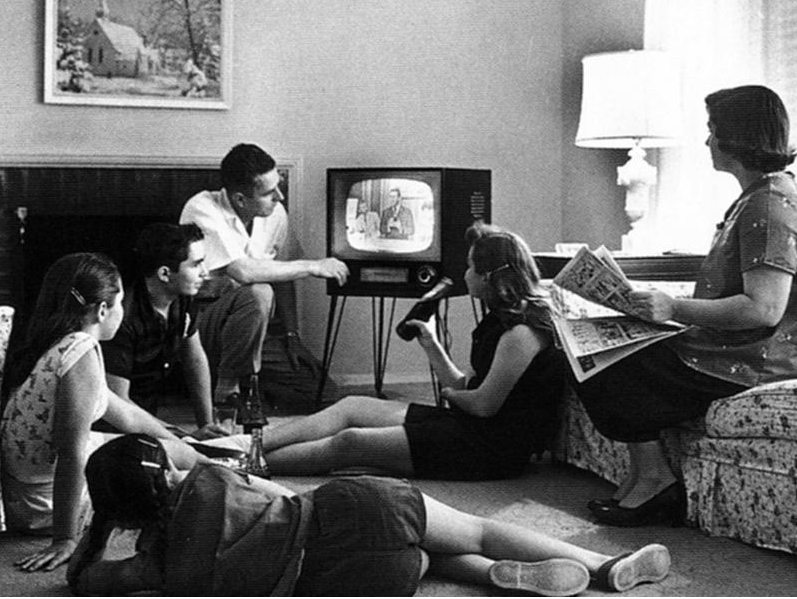
I remember early TV and it was distinctly a social experience. In fact, I recall my grandfather’s first TV set in our house. A very small screen with large groups gathering around to watch, chat and connect with each other in front of this early technology with funky programming. And this social activity went on for years!

Now with quality and varied TV programming, huge displays, HD and 3D…the immersion of viewing has gotten movie theatre quality but the experience, at least to me, more solitary and disconnected.

On the web, social platforms and community are the core of how we find and share information and ideas. Even commerce has become a referral-based economy and at its best, is social in nature. The social metaphor is predominant in entertainment, gaming, information networks and business.

So with the TV screen connected to the real-time web and content digitally distributed, at the very least we will be getting  a flood of more content which is easier to find, and finally, friendly and seamless control over what we watch and when. At a minimum.

But will TV as a social experience come full circle?  Will the connected TV experience mirror, with a modern twist, what  it was at its outset way back in the 50s and 60s?

I’m thinking… yes, but in a totally new way of course.

It takes little imagination to see a Facebook iframe on the TV screen to share and chat with friends. And it’s easy to see social commerce with a click to purchase on the TV screen just like a click to purchase on your laptop or phone.

And why not sports book-like communal gambling over a basketball game? Or real-time video chat with friends across the country while watching an episode of True Blood? Or some yet-to-be-invented social game that let’s you Foursquare-like check in and find your friends watching the same show and connect with them?

Google and Apple and Sony won’t  be the doers here. But game developers, social widget designers, and smart entrepreneurs will be rising everywhere to help us take connectivity from the couch and make it social for those around us in the living room and my friends across the globe.

Social platforms and online communities transformed information sharing  on the social web. Connect it to the big screen and it has the potential to lend its dynamics to the connected TV platform and make watching more active, shopping a bit more collective and natural and entertainment just more fun….with friends.

Move over George Jetson! Your cartoon future may just have started to get real!

Share:
  • Twitter
  • Facebook
  • LinkedIn
  • del.icio.us
  • Digg
  • Google Bookmarks
  • Reddit
  • StumbleUpon
  • Slashdot
  • email
  • Print

Social commerce on Facebook gets real with Disney and Diesel

June 2nd, 2010 | Leave a comment

Screen shot 2010-06-02 at 1.18.28 PM

A lot has changed in 30 days.

A month ago, I searched the open web and Facebook for examples of social commerce where community activity drove measurable transactions. Outside of social buying, ala the Groupon phenomenon, there was little of interest. My post on that experience is here.

But things are changing quickly.  Two global brands with innovative commerce initiatives are starting to get traction and attention.

Two examples of social commerce on Facebook fan pages that work

1. Disney Tickets Together Facebook application

The idea is built around sharing your movie going experience with your Facebook friends from the movie’s promotional fan page.

Tickets for Toy Story 3 are on sale only the Facebook fan page, weeks earlier than anywhere else. You let your friends know you are going and when, invite them to come along…and if you want, buy tickets as a group for the movie.

This provides a special incentive…and reward…to the movie’s Facebook fans as they can pre-buy early and participate in raffles for free tickets.

This is clever social selling and fun social buying wrapped into one. Reports of groups of 80 people buying this together indicate this is potentially the beginning of a trend that really works.

Tickets Together is the best example of social or community commerce I’ve seen. You are literally buying collectively with your friends on the Facebook fan page. Finally… something to do on a fan page that makes sense! And this is the first and best example of empowering a naturally social activity like shopping online in a community setting.

Disney’s market phrase for this is “…no friend gets left behind,” according to Oliver Luckett, general manager of DigiSynd, that manages Disney’s social networking presence.

It’s just social commerce to me, taking fan interest online and moving them to an offline event together, then back online to re-socialize it. An oft-repeated cycle of social proof.

2. Diesel-cam in-store Facebook runways

Live in Spain, Diesel has a fashion runway with a Facebook cam inside their stores.

Shopping is a core social activity, globally. You shop with friends and what your friends think influences what you buy. This is true for everyone; probably more true for teens and 20-30-somethings, the core audience for Diesel.

There is a Facebook runway just outside the dressing room. Customers try on jeans or an outfit, and stream a short video to their Facebook walls to show their friends what they are thinking of buying. Questions like…“Like it?” “Should I buy it?” are natural and this conversation drives sale’s decisions.

You can see a video of the Diesel-cam here.

Note that I’ve seen chatter online that the Diesel-cam is ‘stupid’ or ‘voyeuristic’. For Diesel and for the meaning of the brand, it couldn’t be more perfect.

It’s just smart commerce, matching brand to customer to commerce…and social and fun to boot.

Why I  think social commerce is a solution for Facebook fan pages

  • It just works. Disney is selling tickets while building community favor. My bet is Diesel will be successful as well.
  • Shopping is what we do with friends offline. It’s logical, when done with intent and creativity that it will work online.  Facebook fan pages are replete with community potential but are usually dull…maybe commerce is an answer.
  • Social proof as a transaction based on the encouragement of your community is the first approach to social ROI that makes any sense to me.

Why Disney and Diesel as global brands are being socially astute

  • They are taking commerce to where the fans are. Facebook becomes a channel.
  • They are building commerce that matches the channel to the customer behavior…that is social commerce for a social platform.
  • They understand that boring and dull doesn’t sell, and doesn’t fit their brand image. Fun and creative and social does.

    I think that Disney and Diesel will benefit from a deeper connection with their fans, from a new strata of social proof to their image and, of course, from commerce.

    How does Facebook benefit?

    Having a fan page is free for brands and data storage and bandwidth cost real dollars. Maybe these brands will advertise more? Maybe not.

    Facebook wins whenever anyone uses, returns, sticks around or invites friends to do anything at all on the platform. The more traffic they get, the more sharing happens and the more demographics are collected. And of course, then the value that Facebook can sell to advertisers and partners increases proportionately.

    For Facebook and the brands and I think, the consumers…this is all a win.

    Share:
    • Twitter
    • Facebook
    • LinkedIn
    • del.icio.us
    • Digg
    • Google Bookmarks
    • Reddit
    • StumbleUpon
    • Slashdot
    • email
    • Print