It is helpful to think of ethics as the values we believe in and virtues as the actions we take to create change around them.
I am optimistic as there is a wave of awareness in the market, cross generations, cross social demographics, cross borders around the growing need to act against climate change and the decimation of endangered species and ecosystems.
A broad ethical underpinning in place.
Yet when I ask myself what I can do to deepen awareness and initiate positive actions to mitigate environmental change, I invariably come up way short.
When your kids or employees ask where they can get reliable information, where do you point them? Where can they join groups in school or at work to learn more and truly make a difference?
This is the largest issue and the biggest opportunity we have today. Moving the mass market along the continuum from a broadly shared ethic to actionable collective virtues.
This question has been nagging at me for over a year as I run headlong into it with projects building new economies at the intersection of the blockchain, collectibles, and games.
As well, I’ve been inspired into action by the tireless work of my friends Bill Tai and Gigi Bresson and their respective non-profits ACTAI Global and Ocean Elders. They work at the highest level–with corporations and governments, with the United Nations SDG initiatives, with large donors. Hosting events globally to bring attention and rally resources around the plight of our oceans.
My thinking is at the mass market level, challenging the status quo with new ways to organize and act specifically suited to the times we live in.
Where we need real-time platforms that connect the experts and luminaries with the curious and active mass market, making it frictionless to find positive actions for everyone. From grade school students to each and everyone of us.
Every action helps of course, but not everyone has the expendable income to donate or feels satisfied with crowd funding solutions. A small percent of people are inclined to march and carry signs.
Coalescing this multitude of concerned people is where true change can happen. History has proven that profound reconfiguration of culture occurs only when unstoppable pressure comes from the bottom up, driving top down actions that impact laws and funding.
I’ve been trying to figure out how we leverage mass good will into some form of active participation.
Back at the beginning of the social nets, we looked to Facebook and Twitter for community building, information, and engagement. We thought incorrectly that posting was an action and a benefit.
We know better now, understanding that they may part part of the problem itself. Or maybe simple the wrong motivation foisted on an ill-structured platform.
With every change in culture, communications and community are always the frontier to crack anew for every era. Finding a pulse that fuses the need, the pent up energy with community structures using whatever capability for scale tech has to offer.
This is the missing link today.
Stories and their active impact and the episodic relationship between individual thoughts and cultural evolution is a never ending process of discovery. Always tough to harness, always powerful once you get it right.
This approach to incentivizing change from the bottom up is timeless, dating back to the birth of the Agora in ancient Greece some 2500 years ago.
I imagine Socrates on a stone dais in a public square, challenging the moral status quo with Plato listening intently in the crowd. Later on Plato himself on a dais with Aristotle the neophyte, then his disciple in the circle of engaged debaters.
From there on across the world, through time in some Alice’s Restaurant type of movement to a younger version of myself as a student, to me today.
It’s always how we tell the story and how we build community to engage around it that matters. Medium is not the message but it is the thread that brings community and communications together.
After 9/11, pre the social web, in every park in NY there were circles of people talking, crying, and arguing. We had email and cell phones of course, but building memory was a physical act that people did together in the flesh.
The world was smaller then as were our communications tools. Today we need something for our times.
I have a solution in development, and will send links for early users in the new year.
But one idea, one platform for today’s world is not enough.
The situation is too dire, the need too great, the world too large, and the possibilities for innovation around this truly endless.
If you have ideas to share, pushback to offer, or projects underway, this is something worth talking about.
In the tech world, the most impactful changes often come from the simplest and most incisive innovations.
Non-Fungible Tokens (NFTs) have a good shot at being one of those.
They derive from ERC-721, a free and open, now de facto standard on the Ethereum blockchain that let’s you mint unique and programmable objects or tokens. They are not cryptocurrencies, but can accrue commercial value, can be sold or traded across any number of venues or exchanges.
Adoption and experimentation with NFTs has been bubbling up since CryptoKitties hatched its first kitten late in 2017, giving this powerful technical construct a visceral, emotional, and metaphorically furry wrapper that in the early months grew explosively, then leveled.
Proving along the way that potentially these objects can be a valuable asset (like a piece of art) that can as well dynamically incentivize communities and potentially create new markets as they grow in popularity.
What’s fascinated me since I first waded into this world early in 2018, working with the Honu the Cryptokitty team was that NFTs power and reach has little to with ETH, or any of the speculative cryptocurrencies.
In fact, besides sharing a common blockchain with ETH they are not driven by the same market forces. Dependent not on the scarcity of currency but on peoples’ beliefs and drives to own and share iconized stories that touch them in some way.
We are in an interesting phase honestly, still very early, still a growing, vibrant and passionate community yet messy and chaotic at the same time.
We are pre vocabulary, figuring out whether NFTs will matriculate as a category in themselves, or will be subsumed as a software standard cross a variety of use cases, cross a multitude of vertical segments that will morph over the coming years.
Experimenting broadly in collectibles, digital art, gaming, and stitching together experiments to see how all this could work, behaviorally and market wise.
Whether collectors as an example, might relate to an object being able to own others as a group subject to the same programmed behaviors (ERC-998). Whether economic theories like Harbinger Tax which seem plausible in a philanthropic approach could work for art collectors where purchase and hold is traditionally a natural response to scarcity.
There is a tendency today though, to reach for market fit before it is a reality. To use the metrics of transactional value from the cryptocurrency markets as the same quotients for market traction which in my opinion are incorrect. This is jumping the gun and exemplifies little except impatience.
I sincerely believe that NFTs are a gateway tool for developers and in some near future incarnation will indeed be an onramp for mass market usage of the blockchain.
Just not quite yet.
I am unabashedly pulled in by the possibilities here.
I see in NFTs what I’ve felt in other simple and powerful data types or protocols from my past companies where we built broad communities and deep markets. What in my career I’ve built with sound and graphics, with uptime on web performance, with connections and shareable scales of value.
Where I’ve won, where community has formed and exploded into markets, there were similar characteristics.
I’m doubling down in a few directions.
Going deeper into the mashup of conservation, gaming, collectibles, and community building in new ways. There is a handful of exceptional new projects in this space, the best moving away from philanthropic giving to an impact business where environmental support can be wrapped in new for-profit models.
Stepping lightly into the economy of digital art and looking at how with NFTs we can insure that the artists can participate in the ongoing value of their work not just at one early point of sale. Using scalable technology to support unscalable artistic pursuits.
Considering whether I can bring value to the broader, all or nothing projects building entire new ecosystems using NFTs to wrap not objects but contracts and data sets to power decentralized hybrid power grids or recalibrate farming with a regenerative value scale.
Search NFTs on my blog to see more of my thinking.
I’m honored to be presenting on these topics at NFT.NYC in February, bringing some exemplary projects to the show.
If you are in the space, considering getting involved, and these ideas touch you in some way, do reach out.
I sat down before first light on Thanksgiving morning to list out the people and plentiful good fortune I’m so thankful for.
My gratitude honestly knows no bounds.
But Thanksgiving to me, everything else aside, is about my Mom’s raw cranberry mix and the special bond that over decades she, my son Asa, and I developed as we ground this to perfection, laughed unabashedly, and noshed on this scrumptious rough and simple holiday fare.
Three people spanning three generations hanging around the refrigerator with spoons in hand shaking their heads in the pleasure of the moment.
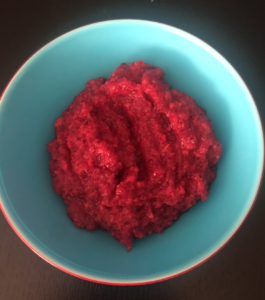 It’s beyond simple to make.
Get a couple of bags of organic cranberries, three or four oranges, and grind them together with the orange peels, adding wild flower raw honey to sweeten. Mix and let it steep for a few days in the frig.
I can’t remember when I first started making it with her or even its importance on the holiday table growing up, though family folklore is that she learned from her mom when they lived on the Grand Concourse in the Bronx from the 1920s till after WW2.
Our family story inexplicably connected to this condiment in now unknowable ways.
For decades as my son Asa grew up, he and I made the trip from California where we lived to Jersey to see my mom.
Taking her ancient, green enameled hand grinder and putting this together, making a monumental mess, just loving the whole process.
Granny’s Raw Cranberries are so rich, so natural, so tart and sweet. So wonderful and so much this special thing for the three of us.
The goal is to make it a few days before the holiday and snack incessantly.
On well browned toast or a bialy. On Matza. On anything or basically nothing. Adding a bit more honey as needed and constantly, endlessly, dipping table spoons in the bowl to taste.
I’m tempted to take the easy and poetic holiday narrative here. That’s the romantic license of memory.
Talk about how it’s a palimpsest for my life, pulled back layer by layer, over endless family changes and experiences and today a bond that my son and I share. Some truth there.
Or lay a Proustian veneer on it, making the deep red rich cranberry the stuff of his Madeleine, unlocking a past life that wafts across the memory of mine and my son and my mother’s life. Feels less my story.
It’s simply something special that is uniquely our own.
This past week while Asa was in Colorado, I in NY, we exchanged calls and texts as we both made Granny’s Raw Cranberry mix.
I used a food processor, he a Vitamix this year. Pics and yummy self congrats went back and forth a plenty but this is neither a metaphor for life, nor a knotted rope of memories.
It’s way better.
A shared personal memory that we renew year after year.
My son and I just doing this little thing–apart or together–thinking of my mother in this act of eating, of remembering, and tradition.
Our way to reenact and reify our love of this amazing women.
This is the great stuff of life.
It doesn’t make me want to mourn for my mom, but be happy that we had this thing together. She lived long and well.
To all of my friends, I wish you a great holiday.
This is my personal ditty that defines the day.
The power of food as a source of tradition and an eternal edible moment in time as something to relish.
Something truly worth eating.
This has turned out to be a happy homage to my mom’s passing so I’ll end with a few pics.
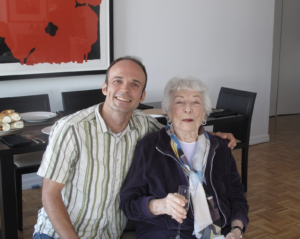
Granny and Asa when she was probably 90.
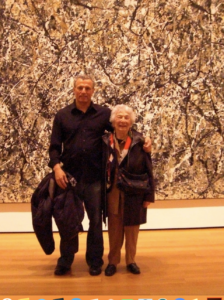
Our favorite spot with Jackson Pollack at MoMa around the same time.
Whenever you try to fit offline, traditional business models and cultural perceptions into online economies with new behaviors, you invariably come up short.
The biggest upside, the largest shifts happen when you work with the innate potential of technological capabilities where they mashup with changing cultural behaviors and individual consumer reflexes.
This will play out to be true in the blockchain collectibles, digital art, and gaming segments.
A year and a bit ago, everyone was abuzz how with Non-Fungible Tokens (NFTs), we would move the massive, dusty, legacy collectibles market onto the blockchain. How economies are just better in games with tokens as the currency.
Felt like the rationale that since we can, we should. That somehow market potential was an expanding mirror of what is happening offline.
I don’t see it that way.
Strategies like ‘Everything that can be tokenized will’ are good for T-shirts, poor for most everything else, especially describing market potential.
When you work within your vision of a different future, when you create out of what is innate and native, you invariably speak to something fresh, something new and visceral, and just maybe, something market changing.
If our concept of digital objects are static NFTs, unique and secure things that can bounce around the web and have value because they are scarce, this is not very interesting.
The most user-friendly wallets and easy to use NFT exchanges will not make them any more so.
When you look to what Axiom Zen is foreshadowing with CheezeWizards, and what brilliant, scrappy, early startups like Wildcards and Last of Ours are moving towards, you get a glimpse of something quite different.
What was previously a centralized platform or service becomes a series of atomic, programmable, dynamic objects, carrying their own active behaviors, touching others, and reconfiguring cross this new Web 3 landscape.
I like that Axiom Zen is obsessed with the idea of interoperability of the ecosystem, letting developers add to objects, accessorize them, engendering a cascade of new connections, emotions, and value in pop-up niche communities.
I love the idea of composability, where you can code the concept of extended ownership into a unique object, building value by creating a new composite set of objects and pools of currencies that comprise a reshaped, reorganized extended whole.
I’m fascinated by the possibilities of objects carrying their social and economic personality through an annuity of support for an artist, a cause, extended game play.
And I am impossibly stuck on the idea that these objects, the companies that build them, the communities that support them, can be environmentally impactful by nature, though for profit from the start.
That through this stack of dynamic, programmable qualities, we are able to create new business models. Ones that are decentralized by nature, socially beneficial by design, emotive as their allure, and profitable by their very fiscal DNA.
Just maybe, if we look into the nature of NFTS as a malleable and codable wrappers of storified things, we don’t see baseball cards or static art, but a community thread of new connections and reemerging unique communities with organic commerce as part of its backbone.
Similar to the way a great idea, spreads across the web creating flash communities as it goes. Or the core essence of a Kickstarter campaign even, where there is a collecting point for the funds, but no platform except everywhere cross the web for the supporting communities themselves.
Possibly what we have here in the object world of non-fungible things on a burgeoning Web 3 is a reality where what we thought of static collectibles, and what we experienced on game platforms, merges into something brand new.
Where the distinction between a collectible and a game, simply evaporate.
True with a twist for what we want from native digital artists and collectives, as well.
More dynamic. More atomic. More malleable. More personal and emotive. And more powerful.
This is a market to get behind.
I’m seeing inklings of it happening as unencumbered thinkers, out-of-the-box artists, and creative developers learn to grab these new possibilities, iterate, and mold them in open, excitingly messy, and impossibly rich markets.
This, unlike so much of the crypto and blockchain world, is not waiting for infrastructure to be real. It’s more like a new art form or music genre, incubating in small projects, in an infinite number of places cross the world.
All bubbling up.
This to me is a thought worth mulling over, to work with, to invest in, to build communities of support around.
I’ve never considered myself a writer.
Though for as long as I can remember I’ve been obsessed with words and the craft of storytelling.
As a kid, hanging out in the park reading novels or sitting in empty movie theaters watching the classics over and over when I was supposed to be in school.
Scribbling self-indulgent thoughts on paper, typing them up in my parents basement.
In retrospect, the endless stream of activities that anchor my career were similarly bolstered on my ease with words and my obsession with a story well told.
From fiction and poetry to journalistic columns as a stringer. From innumerable grant proposals and environmental impact reports, to the brevity of video game box copy. From onscreen prompting schemas for new OSs, to software manuals, to web sites, to radio scripts. From proofreading for publishers to word stacking for SEO. From academic journals, to blogs, to ghostwriting books and speeches.
As my career moved along and the jobs got larger, taking on owning brands and communities, new market segments and product launches, marketing, customer service, and sales orgs, still it was words and stories, wrapped in ever larger strategies and audiences.
It’s always been a process of getting the words aligned, and the story ready before jumping on a stage, into a board meeting, or heading out to visit partners and customers. Or simply pushing Send or Publish.
I mapped this out on a flight recently, thinking about how the means of expression and the intent morphed as the tech platforms have changed.
How as a pirate radio entrepreneur and late night radio host, as a builder of companies on the web from the earliest incarnation to the mashup of environmental activism, blockchain, gaming, and philanthropy that I play in now, it simply keeps evolving.
Not quite that the medium is the message, but more so, the medium lets us be creative in new ways in how the message is internalized by the ever changing publics we speak to.
And then there was blogging.
For the very first time, expression became all about me, my thoughts, and my opinions.
Writing about whatever I wanted to, from obscure topics like NFTs, or the memorial on the passing of my mother. My exultation of my hero Chuck Close, or my true love affair with wine regions like Marsala or Mt.Etna.
I never realized the true depth of this impact on me till recently on September 11th when I republished my memorial post.
The memory was about the days following 9/11/2001 of course but in actuality, the story truly came alive when I wrote it on my then new blog in 2010. To me, that is when it created a bridge to something formless in the past taking shape annually on that date in the present.
As if it didn’t exist in a personal way till I wrote and shared it.
At this stage of my career, I lean harder on myself as a strategist and listener, thinking less about what I write or conjure up, but of what is heard and internalized by the reader, viewer, or listener as their own.
Harks back to how I was in awe of the market, when I was given my very first opportunity to create the words for games like Ballblazer and Rescue from Fractalus, lifetimes ago as kid starting out in the then new computer gaming world.
Or the extreme humbleness I felt on my very first marketing job, sending a message out into the BBS of 1+m Atari enthusiasts in my then office, basically a desk in a server room.
I’m tempted to wax poetic here, talking about how over time the distance between the thought in my head and the expression on paper gets closer and closer, like two lines verging towards each other on the horizon but never touching.
But I’m not a poet, more a practitioner of the story, a launcher of narratives into the world.
Been doing these unique projects the last few years where I dig in deep into a company, over months, seeing where the product, the vision, the markets, the possible customer emotional reflex all come together.
And create not a report, but a dynamic, living short document as a draft of their company language. The vernacular that teams can take out themselves, make their own, and in every variation, be on mark even through the lens of different situations, and themselves, each unique.
Not talking points but a a shared story as a lexicon of dynamic thoughts.
At one time I wanted to be a Charles Olson academic, a Faulkner like storyteller, a visionary poet like Guillevic, an artistic revolutionary, emasculating common perceptions like Antonin Artaud., a masterful spinner of daily meanderings like Kerouac.
Now I’m quite content to call myself a storyteller as a vocation, being part of bringing possibilities to new ideas, to new markets in different ways.
It’s still words and expression and stories.
And I still don’t consider myself a writer.
But discovering language that can be shared and owned by broad communities is a craft that has served me well.
Just really fortunate to be good at something I love to do that continually changes and forever inspires.