Facebook and Skype…bringing community and communications together

October 4th, 2010 | Leave a comment

Community and communications are two parts of a social whole.

The Facebook and Skype merger rumors are a perfect backdrop to relook at the Facebook community paradigm and how it will change with Skype as a partner.

To hundreds of millions of people, Facebook is the web. The first place they go in the morning and their principal source of news information. What’s remarkable is that while Facebook has defined social, you can’t really have a conversation there. Share of course; talk not much. This has been a missing link.

Today, on Facebook, we can post and comment but real conversations are not possible. Comment strings get moved to email or blog posts or a phone call or to a coffee shop for a meeting. Facebook is a check-in portal to see what’s going on. To do anything beyond sharing, you need to leave.

Facebook wants “To mesh communications and community more tightly together and add more tools to allow users to do so.” According to Kara Swisher who broke the merger story. Adding deeper communications capabilities in voice, text, and video are naturally the next step for Facebook and an evolving need for the ever growing group of people who run their lives from their profile pages.

Facebook fulfils that unique promise of a place to hang out at the intersection of our off and online lives where you share…and to many, create your life.  It is the ‘homepage’ to the global and flattened mass market, the news source of reference to most, and fast becoming a merchant mall to most global brands. Google is where you go to work and look stuff up. Facebook is where you share it.

The merger would add a communications layer (Skype) to Facebook’s community network that makes sense on at least three levels:

1. Voice and text

Voice communications is a ‘gimme’ for the social graph. It’s been overdue in arriving.

Why say “I’ll call you”, jump off of Facebook…rather than make that call immediately? Having an integrated phone book built off of Facebook membership seems like a no brainer. Skype is great alone. Integrated without an extraneous Skype phonebook is considerably better.

No one likes the phone company. If we can make calls from our social homepage…we will. And since many of the Skype calls we make are international, this feature has the added benefit of accelerating international expansion to the Facebook network. And to the members, the more people on the network, the more useful it is.

Texting is an obvious missing link

Most notices from Facebook and my blog communities come through text.  Texts are our rapid alert system from our networks.…”At the store.” “Meet you at the movies.” “Sign on to Facebook to chat.” Why have a one-way text pipe? On Facebook, on my phone…I would simply send text from within my profile…so would hundreds of millions more.

With Skype integrated, this issue is resolved…and of course, from a single Facebook address book.  The sub 25 year-old, mini-millennium generation, would jump on this en masse as text on the phones is their principal communications jargon.

And with Skype’s partnership with Avaya (think VoIP PBS) it is possible to conceptualize a fan page as a business center with conference calling and call analytics. Powerful in its possibilities. Your fan page could become the portal into your VoIP-based, Facebook centric global BBS system.

2. Video chat and social video are the big promises that just haven’t materialized

Social video has been stumbling forward in fits and starts. I expected it sooner, but it has eluded the mass market’s momentum…so far that is.

Creative startups like Vpype, and even Facebook with video wall posts have tried to make it easy to use video as a new social form of communications. They’ve succeeded in making it easy; they’ve been unsuccessful so far in making this a mass market need…or want for that matter. All the pieces are there…cams, free usage, address books, but human behavior hasn’t made the leap.

Video Skype calling to friends and for business is already a well accepted behavior. Integrating this capability within the social graph from a branded and trusted provider like Skype could possibly push behavioral usage to fruition. Maybe we needed a communications brand to kick start this.

My sense is that if you add video Skype calling into the social ecosystem of Facebook, the dream of party-line video calling, interactive video presentations and distance learning just might take off. Social video may go from a good idea to an explosive reality…and drag along the work of start-ups who are verticalizing the video pipe for all of us, with apps from entertainment to business.

3. The Facebook social TV channel

Live conferences from Facebook corporate are streamed frequently, and free. Boring stuff but there is already the concept of TV within Facebook. It works pretty well actually on the small screen.

TV, the holy grail of home entertainment is a living room paradigm. Skype and Facebook are already built into millions of connected TVs and DVRs coming out this holiday season. Add Facebook Connect, Skype’s SDK, a connected TV broad footprint and Facebook may be the network for content consumption, including TV as a social medium. I’ve blogged on this here.

“Facebook is the equivalent for us to what TV was for marketers back in the 1960s. It’s an integral part of what we do now.” This comes from Davide Grasso, CMO from Nike. Facebook could well become the new social TV platform, where people watch and share video content in a brand new way.

A Skype and Facebook merger or partnership makes sense to me. Check out Om Malik’s piece on GigaOm for a positive view and Rick Aristotle Munarriz in The Motley Fool for an aggressive anti-merger point of view.

Regardless of the outcome of the Skype/Facebook saga, integration of community with communications will occur in the Facebook network and deepen a whole social reality that is greater than the sum of its community and communications parts.

Share:
  • Twitter
  • Facebook
  • LinkedIn
  • del.icio.us
  • Digg
  • Google Bookmarks
  • Reddit
  • StumbleUpon
  • Slashdot
  • email
  • Print

Flash communities, time-shifted media and connected TVs

August 3rd, 2010 | Leave a comment

With 45M internet-ready TVs shipping this year, there’s a minor land rush in process adapting the building blocks for community and social commerce from the web to the largescreen TV and communal setting in the living room.

There’s a lot of buzz around EBSNs (Event Based Social Networks), bridging web-proven viral loops and social commerce to live connected sporting events and network premieres. This is an obvious direction for flash community gatherings around live broadcasts but doesn’t address the majority of legacy media content available to viewers.

I visited with Scott Varlard (co-founder and CEO) and Philippe Pierre (CFO) of SocialBomb, a NY-based social technology company that is figuring out how to build community and bring social value to the mostly time-shifted reality of TV and webTV content. These guys are betting that brands and fans are both interested in social viewing and sharing around their favorite shows and movies.

SocialBomb, if you don’t know them, is the company that provided the community and technology platform for the HBO release of True Blood Season 2 Blu-ray DVD. This HBO release pioneered scene sharing, social incentives and on-big-screen controls for the Blue-ray release of the blockbuster hit series.

Scott and Pierre walked me through the demo…cool stuff to be able to easily pair your Blu-ray to Facebook and Twitter, share scenes and engage with a bunch of social incentivized activities. I’m a bit geeky and a huge True Blood fan so maybe I’m an easy sell for this but there is real potential here especially as this paradigm moves to streaming catalogs as well as DVD-based content.

This was a gutsy leap of faith for HBO to try this even as a ‘quiet launch’…big win for SocialBomb to pull it off so crisply. Connecting a DVD and TV to the Internet is still the domain of the few and DVDs, in my opinion, are a legacy format looking for some additional life. But…rumor is that fans liked it, scene sharing was very active (the coolest part) and both the fans and HBO have deemed this a success.

My take is that this is a small but important proof point on how to create community events around time-shifted content. DVDs are a second tier choice after streaming for many, but if this provides social proof in the small, hard-wired world of DVDs, it should work well for the mass market as a streamed, built in and easy to set up media in millions of living rooms this holiday season.

Let’s imagine the not so distant future.

Take what SocialBomb has done and apply it to streaming content and connected big screen TVs with, as well, 2nd and 3rd screens on the couch and mobile devices thrown in wherever they may be. And where every title on Netflix or Hulu or Boxee is able to connect to Facebook and Twitter with scene sharing, some social gaming and merchandizing built in. You can watch and rewatch and share media content in a social setting on any screen anytime.

This means that every time I view Godfather II or Hustle and Flow, or Entourage, I will be able to create a flash community event, share scenes and participate in extending my passion for movies, a particular movie or TV show down to the scene level. And most likely, this will inspire others to download and view and share as well.

I think there is something here…maybe not exactly as I’ve described it or precisely as SocialBomb is working with HBO. But something…significant.

People on the social graph, 500M on Facebook and millions on Twitter are hungry for content to share. On Facebook alone, an average user generates 90 pieces of shared content equaling 30B shared pieces monthly (mostly photos). With a tangible connected TV footprint coming and flash community capabilities being developed by SocialBomb and others, there will be a lot of scene sharing and social gaming around what we all do a lot of…that is watch TV. Scene clips could be the next step beyond photos as shareable objects. And everyone has movie and TV scenes that they would want to send as a video invitation to their friends and communities to join in the fun…or watch later.

This is also an innovative solution on how to take the real-time community of the social web and our social networks and connect it with time-shifted movies and TV and sports media that we love and watch and rewatch over and over again.

I can’t see this as any other than a win for everyone…including of course the content owners.

I’m very positive about a real-time social environment on the big screen around legacy content. Certainly more questions than answers exist today, but having all media content available all the time and platforms like Facebook or Twitter seamlessly tied into my ability to share…just makes sense.

Sharing in a Facebook-powered world is a common bond across all networks. Daily and by the billions of posts, we let each other know where we’ve checked in on Foursquare for the best expresso and where we are traveling to and the restaurants we frequent. It’s a natural (and significant) step forward to share movie and TV content we deeply identify with at a scene level, plugged into the social graph and shareable across all of our communities.

______________________________________________________

Thanks to my friend Jeff Blackman for introducing me to the SocialBomb team.

Share:
  • Twitter
  • Facebook
  • LinkedIn
  • del.icio.us
  • Digg
  • Google Bookmarks
  • Reddit
  • StumbleUpon
  • Slashdot
  • email
  • Print

Six ‘Commandments’ for connected TV

July 1st, 2010 | Leave a comment

Screen shot 2010-07-01 at 12.47.39 PM

With the Hulu and GoogleTV announcements, the promise of WebTV on the big screen seems within grasp of most TV watchers…which is basically everyone.

I’m in the market to buy a really big screen, connected with web apps so I searched on Amazon, the discount sites and made a trip to Best Buy.

Oy!

The promise is there but the mess of misinformation, lack of clarity, fear of buying proprietary hardware and overall feeling that this is still a geek’s dream, unfortunately seems still true.

I jotted down my Commandments as a guideline to help make this convergence a mass-market love fest with the least amount of pain. This is my wish list.

Six Commandments for a better connected TV world

1. Make it easy

It’s just not easy to display what you see on your laptop on your big screen TV. Even with GoogleTV, that need is not going away as to get real access, cabling to your laptop or desktop will still be necessary.

TV manufacturers are still somewhat clueless and shopping for a solution today is as confusing as home theater has been for a decade.

2. Make it multi-screen

Laptop. iPad. Smartphone. Big screen. All need to work together and share content streams from the big content cloud in the sky.

We need to be able to seamlessly move from TV to laptop to iPad to phone to watch a synced, stored, time-shifted program.

We need to be able to do different things on different screens around the same content.

3. Content is king; networks are history

The web is the metaphor for connected TV, not the other way around.

I want to watch True Blood and Entourage, not be forced to buy HBO. Being muscled to purchase network packages is TV legacy; being able to acquire content I want is the promise of the web.

I think that most of us will pay for value as long as we are in control. This is the iTunes learning. I will buy individual songs even if they add up to more than the original album…and be happy because it is my choice.

4. Search is a given

Searching for video content needs to be as simple as searching for info on the web.

We are almost ten years into the world Google powered and it is part of our nature. We demand information overload and search efficiency for video content for everything from TV shows to movies to YouTube to cam clips.

5. Community and social are essential

Friend referrals. Intelligent Facebook info streams. Checking in. Sharing.

The first screen most people use every morning to check on the day is Facebook. And we share our experience on our Facebook walls, Twitter streams, Foursquare friend lists, Disqus comments, Tumblr communities.

This needs to extend to the content we watch. If access to the open web is there, smart startups like Tunerfish are already figuring this out. Facebook will certainly play here even if FacebookTV doesn’t become a reality.

6. Every hardware purchase needs to feel good

We are going to have to buy things:

-We need to feel good about buying hardware…you know, like the iPad. Costs a bit but empowers and enriches life.

-We don’t want to worry about buying the wrong platform. The Betacam/VHS conundrum is just not acceptable as a rerun.

There are certainly other asks but this is my wish list of ‘must haves’.

This is a work in progress…what would you add?

……………………………………………………………………….

For additional blog posts on social and connected TV, please click here and here.

Share:
  • Twitter
  • Facebook
  • LinkedIn
  • del.icio.us
  • Digg
  • Google Bookmarks
  • Reddit
  • StumbleUpon
  • Slashdot
  • email
  • Print

WebTV is flourishing…will GoogleTV simply webify the big screen?

June 23rd, 2010 | Leave a comment

Everyone is abuzz over GoogleTV creating a paradigm shift in entertainment…. myself included.

What could be bad? All digital. Surfing from the couch. Social check ins. An easy-to-use time-shifted TV viewing reality.

I’m ready…but for those of us willing to live in the small laptop screen or geeky enough to hardwire the pieces together we have not all…but most of the promised goodness on WebTV today.

WebTV is well beyond its early stage already. With movies, TV shows, great new web content like ThisWeekIn… The web is fast becoming a digital video and TV frontier.

Whether you are on your laptop, wired from your Mac Mini to your large screen with Boxee, using Hulu…this is no longer a small niche by any standard.

New numbers on WebTV and TV watching online from eMarketer are enlightening:

  • 33% of the US Internet population watches full-length TV programs today; growing to 39% by years’ end
  • Hulu alone has 38.7 million unique monthly visitors. Largest video streaming site on the internet after YouTube.
  • 14.6 million-web devices that can run TV applications shipped in last 12 months, increasing to 83.4 million in 2014
  • 50% of everyone who watches any video online, will watch a full-length TV show

Mind-boggling actually…in the US, one in three connected people watch network TV shows online and one in two who use video in any way do some portion of their TV watching from the web.

In Geoffrey Moore’s Crossing the Chasm way of thinking, we are just this side of an Early Majority position with WebTV and the chasm-crossing leap is only a holiday season away.

So with GoogleTV and the Boxee Box and every TV for sale with an HDMI plug, what’s the difference between now and…then, when these solutions launch?

The obvious changes will be:

  1. It will be easy and inexpensive to purchase and install for everyone
  2. More big screens will drive more content
  3. Some built in widgets (apps) like YouTube, maybe Facebook and IMDB
  4. Browsing and searching via Google from the couch position

Honestly, this is great but not a revolution. The iPad was a revolution, this is a big iteration pushing the web to the big screen WebTV experience. I like easy. I like larger displays. I like apps. We need search. But I want what I can’t imagine which is more than just the webification of the big screen.

Richard Kastelein, a friend, blogger and founder of AppMarket.TV believes that one of the big gaps to bridge is ‘lean back interactive in your living room’ versus ‘lean forward at your desk or laptop’. It’s the remote versus the keyboard and the mouse. Content will come. But seamless control of the web interactive elements of search, community and social are the mountains to scale.

Hmmm…So according the industry and folks a lot more in the know than I, the intersection of the widgets on the big screen (like an embedded app), a consistent interface for search, social attributes and some cool device like glidetv for surfing are the formula for the future.

I’m missing something here.

If interface and usability are the kingpins, then why not Apple rather than Google as the architect of the best solution? Steve Jobs, more than anyone gets usability and the mass market. Google is search but certainly they don’t understand GUI or social or consumers.

And I can’t imagine connected TV to be a single screen solution. We are all sitting on our couches with iPads and laptops and phones. This is not going to change. So why isn’t the input one of these devices, like an iPad as the control and with special social content?

Maybe an anecdote might clarify my uneasiness at settling with GoogleTV as the answer.

Recently I was watching ThisWeekInVentureCapital with Mark Suster and Mo Koyfman talking about efficiencies on the web. Mo made a statement that when you take an old industry and bring it online, you don’t just webify it or make it more efficient, you take the core of the old and its value and find something new…something better. This seems right on to me.

So…what is that leap to something new with connected TV?

Maybe it’s just more efficient. Maybe it’s a standard interface with some widgets and open access to a gazillion apps. Maybe it’s a perfect and closed and controlled Apple world of ease-of-use and locked down. Or maybe it’s just what we have today but bigger.

I don’t buy into this.

A year ago, I couldn’t have imagined riding on the subway or sitting in the coffee shop, watching TV and working and tweeting on my iPad. Or building distribution systems for my clients that connected their Facebook fan pages to their e-commerce storefronts.

I’m a video and movie aficionado and ever so ready for connected and social TV. See my post on this.  But the web is still figuring out social video and socialization around WebTV. It’s not necessarily the model to copy. The jump from laptop to big screen is fraught with opportunities for new ways of entertainment and needs more than a redo of the current web reality, retooled for the digital living room.

You agree?

What will make you and the hundreds of millions yet to buy, do so and enjoy in a new and more interesting way?

—————————————————————————————–

Thanks to my friend Jennifer Fader for always finding interesting data before I do.

Share:
  • Twitter
  • Facebook
  • LinkedIn
  • del.icio.us
  • Digg
  • Google Bookmarks
  • Reddit
  • StumbleUpon
  • Slashdot
  • email
  • Print

Searching for ‘social’ in connected TV

June 10th, 2010 | Leave a comment

Screen shot 2010-06-09 at 6.09.40 PM

Everyone wants connected TV.

Whether it’s a Google or Apple solution or both, the upside to connected big screens in our living rooms hold enormous potential for everyone with a television and an internet connection….which is just about everyone, everywhere.

The time is overdue for this to happen. On the web side, video content and programming has exploded in quality and quantity, become easy to find and share, and mostly free to distribute and watch. Web video content is begging for more and larger displays.

On the broadcast TV side, we have great programming, thousands of channels on incredible displays that are locked inside of disconnected networks, frustratingly archaic search methods and a seemingly uncrossable gulf between the TV content on the screen and the laptops and iPads on our laps on the couch.

I’m really anxious and excited about impending connection between the big screen on the wall and the real-time web. It’s a game changer.

And I’m really curious about where social and community is going to play into this whole new  TV paradigm.

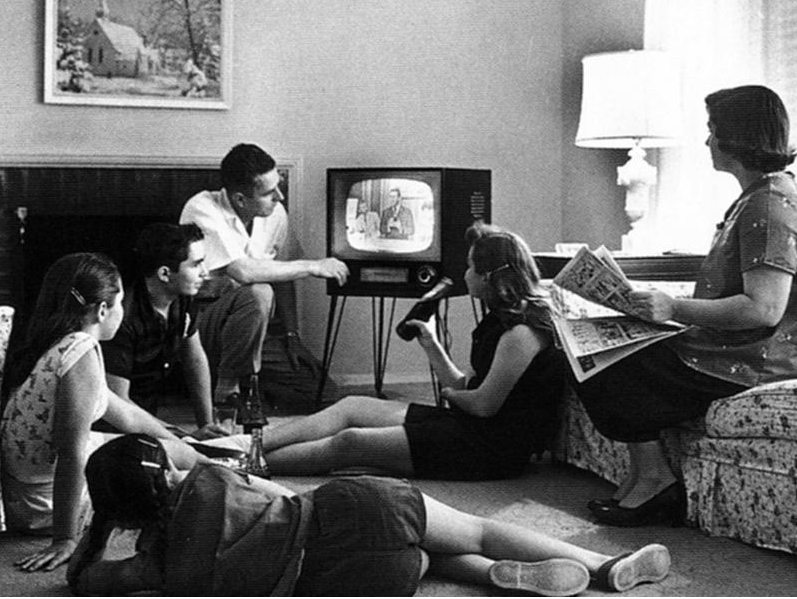
I remember early TV and it was distinctly a social experience. In fact, I recall my grandfather’s first TV set in our house. A very small screen with large groups gathering around to watch, chat and connect with each other in front of this early technology with funky programming. And this social activity went on for years!

Now with quality and varied TV programming, huge displays, HD and 3D…the immersion of viewing has gotten movie theatre quality but the experience, at least to me, more solitary and disconnected.

On the web, social platforms and community are the core of how we find and share information and ideas. Even commerce has become a referral-based economy and at its best, is social in nature. The social metaphor is predominant in entertainment, gaming, information networks and business.

So with the TV screen connected to the real-time web and content digitally distributed, at the very least we will be getting  a flood of more content which is easier to find, and finally, friendly and seamless control over what we watch and when. At a minimum.

But will TV as a social experience come full circle?  Will the connected TV experience mirror, with a modern twist, what  it was at its outset way back in the 50s and 60s?

I’m thinking… yes, but in a totally new way of course.

It takes little imagination to see a Facebook iframe on the TV screen to share and chat with friends. And it’s easy to see social commerce with a click to purchase on the TV screen just like a click to purchase on your laptop or phone.

And why not sports book-like communal gambling over a basketball game? Or real-time video chat with friends across the country while watching an episode of True Blood? Or some yet-to-be-invented social game that let’s you Foursquare-like check in and find your friends watching the same show and connect with them?

Google and Apple and Sony won’t  be the doers here. But game developers, social widget designers, and smart entrepreneurs will be rising everywhere to help us take connectivity from the couch and make it social for those around us in the living room and my friends across the globe.

Social platforms and online communities transformed information sharing  on the social web. Connect it to the big screen and it has the potential to lend its dynamics to the connected TV platform and make watching more active, shopping a bit more collective and natural and entertainment just more fun….with friends.

Move over George Jetson! Your cartoon future may just have started to get real!

Share:
  • Twitter
  • Facebook
  • LinkedIn
  • del.icio.us
  • Digg
  • Google Bookmarks
  • Reddit
  • StumbleUpon
  • Slashdot
  • email
  • Print