Facebook’s growth explosion in developing countries

January 28th, 2010 | Leave a comment

Picture 1

Facebook has clearly tapped the Internet Café culture in developing countries and has created a global and socially flattened marketplace. Quite an accomplishment.

And app developers, brands and marketers should take notice of the game changing growth of Facebook’s penetration of the developing world. There is an intersection of global and social on this platform that creates an easily accessible global market for ideas and brands. Maybe for the first time.

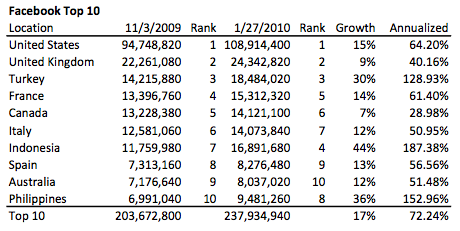
Back in December, just after Facebook’s announcement of the 250M user number, I blogged on the top 10 Facebook countries by user numbers and the part that having the app in the browser made to a global user base. The discrepancy between users and computer penetration per capita led me to conclude that the cloud based app allowed the Internet Café culture of developing countries to explosively adopt the platform.

I reran these numbers some 90 days later to see if this was a blip or a real trend. Thanks to Gary Klein, product maven and product lead at Vpype, a social video company I work with, for collaborating on this.

The results are astounding.
Picture 4

Let’s look at the facts over this very short period of time.

-Turkey, #3, is growing at 128% annually and will overtake the UK at #2 within 6 months.

-Indonesia, formerly #7 is now in the #4 spot and growing at a rate of 187%. It is larger than France, Canada and Italy.

-The Philippines, formerly at the bottom in 10th place is now #8, passing Spain and Australia, growing at an annual rate of 152%.

Growth of Facebook is occurring in spite of the lack of computer penetration. It’s happening at Internet Cafés and on phones and spurred by the need for social networking and the efficiency of the Facebook cloud-based app.

You can look at these numbers as the democratization of global markets. Or as the flattening of the world culturally where time and space get pushed aside to empower ‘friendship’ across geographies and languages.

From my perspective, two items jump out.

First that Facebook just gets and maybe defined the online social framework. Free storage and sharing of photos and videos and friend’s list is as pertinent to a family in NY with kids in Wisconsin as it is to a young entrepreneur in Istanbul with family in Ankara. Social frameworks work and if there is any doubt that Facebook will become the major advertising channel for both global and local brands, it is now gone. It is more targeted and more efficient than networks or cable. If you were Nike or Armani Exchange, where would you advertise?

And second, for app developers and marketers, this makes global markets an essential part of product and market discovery strategy. The cost of global marketing and customer discovery is for the most part, gone. Facebook has both proven that the social fabric is global and provided marketing and distribution access to it as well. The barriers to these markets are really ameliorated.

My sense is that Facebook and this easy access to global markets will spread as computer hardware becomes cheaper and more available. But numbers don’t lie. Whether you are Zynga with Farmville, or Pepsi, or an herbal supplement company in Colorado or a video blogger…the world is now accessible. To anyone. And in real time.

And we have Facebook to thank for this.

Share:
  • Twitter
  • Facebook
  • LinkedIn
  • del.icio.us
  • Digg
  • Google Bookmarks
  • Reddit
  • StumbleUpon
  • Slashdot
  • email
  • Print

Facebook advertising moves towards ‘touch’ as the new ‘push’

December 23rd, 2009 | Leave a comment

Kudos to Facebook. They’ve stumbled on a redefinition of advertising that seems potentially palatable for the consumer and useful for big brands and small businesses alike.

On the social web, where we select our communities and our friends and expect conversant interactions, interruptive push advertising is basically spam, whether it be a video ad, a banner or an unsolicited email. What Facebook is doing is building an ecosystem where scattershot is unacceptable, generic is ineffective, and it is possible to match effectively seller and buyer in a near social manner. Successful advertising on Facebook will be focused on ‘touch’ as a point of interaction and conversation rather than ‘push’ as an interruption and distraction.

Let’s step back and look at what Facebook has done.

Facebook has created through a free social network what the print and TV industries have been trying to do for generations. That is freely acquired, detailed demographics on the background, interests, affiliations, and relationship status for 350M individuals. And with, this the idea of advertising, both agency and individual suddenly have a new direction. Companies can offer information and products to you when you are looking for something and talking about it to your friends in a venue outside of search and keywords.

For as long as there has been products and audiences, the seller has tried to know more about their customers so they can target messages directly to the right customer at the right time. If you are single, you are probably OK to see a dating ad or planning a trip, travel insurance, and so on. The best advertising venues delivered the largest audience with the most specific demographics, but the match was never precise.

Here’s the beauty of the Facebook ecosystem from a pure marketing perspective—everything we as users share with our friends to create relationships and community, are the precise data that advertisers want:

* where we live

* what we read

* where we travel and what we eat

* religion, political beliefs, movies, music likes

* schools, clubs, organizations

* links to outside sites

* basically everything we share

Wow. A goldmine of value.

And this information costs nothing to acquire. Goodbye survey companies. It is now self-selecting. When Facebook pushes keyword search to the top, another new paradigm will emerge as well.

No wonder that a large chunk of Facebook’s $1B in revenue is from advertising.

I’m not a big user of advertising in my businesses. Social tools are more precise, more delicate and more to my liking. But what Facebook has done unlocks new avenues for communicating in a social way. My markets are on Facebook and I’m open to ways to reach them.

Three ideas bubble up around Facebook’s paradigm of what I call ‘touch’ vs. ‘push’ advertising.

First, what Facebook is starting to solve, albeit in a contained network, is the authentification problem. Online, with search you are either an IP address or a cookie. With Facebook you are a person with a face. No longer does the advertiser need to ‘boil the ocean’. It’s possible that advertising is moving to a direct marketing or even moreso a personal conversation between a brand and a consumer.

Second, advertising is potentially more than a tool of brute force. No reason to yell if you are talking one-to-one or one-to-a-few that fits a chosen demographic. The self service ad tool lets you precisely target, set your spend and adjust your ad to your chosen group of individuals.

And third, this drives the need for more creative, more specific and a more participatory approach towards ads and campaigns. I believe that today the world is moving towards being 100% customer driven. If you can find me when I’m planning a trip, changing my residence, planning my movie watching for the holidays, then I will pay attention to offers and campaigns that are interesting and engaging and thoughtful. If not, I’ll just ignore or block them. Even in advertising under this model, the consumer can decide what they see.

Facebook makes these three ideas a reality.

Social media and the social web demand new business models. As socialization and democratic venues arise, how companies converse with us needs to change. There are entire new economies, like game microcurrencies, and affiliate networks, then there has always been…advertising.

What Facebook appears to be discovering is that with open demographics, data driven, self-service tools, advertising can be reconfigured to be a useful touch point and an offshoot to conversation rather than an intrusive push interruption.

Share:
  • Twitter
  • Facebook
  • LinkedIn
  • del.icio.us
  • Digg
  • Google Bookmarks
  • Reddit
  • StumbleUpon
  • Slashdot
  • email
  • Print

Money can’t buy you love

November 22nd, 2009 | Leave a comment

If your company is small, your product not quite there and your customer base embryonic, and you think your problem is your marketing budget, you are most likely wrong.

Marketing costs money and since cave man days, marketers have been squeezed to perform tactical miracles with whatever was left post product development. Marketers have squirmed and cracked under this pressure for generations.

Thankfully, it’s a new world today and much more interesting. Marketing leadership is not tied inextricably to dollars and programs. And money is not the exclusive currency of success or failure.

This is not to say that brilliant push advertising can’t work in some instances, but certainly no startup can do a raise to get visibility on the traditional tech advertising venues dominated by Apple, Microsoft and now Google. The class gap has become a chasm and it’s just not going to happen. Don’t even bother to think about this. Check, move on and be happy that this is gone.

Marketing chutzpah is no longer about squeezing a dollar out of a dime, perfectly executed traditional venues, or gimmicky schmaltz. It’s about building a product that has articulable value and a distribution strategy that is part of the product itself. And the honesty and smarts to build a community and social presence that has dynamics and viral oomph.

I hear whining and condemnation coming from my smart friends in advertising and traditional big brands, crying foul and calling me the faddish futurist. I’m being practical about pushing the concept of marketing into product development and holding firm to the belief that marketing is about finding a market, not about budgets and campaigns that sit as an line item on a spreadsheet.

My point of view is that today, without a social component, a two-way conversation with your customer or your community, you simply can’t succeed. Large company or small. It just can’t happen.

The larger brands have the leverage of the base. They have their own set of demons to deal with. But the startup has well…only the value of its product and its personality to capture their version of Seth Godin’s ‘sneezers’ who will start the drum circle going from the one to the many and from those many to many more.

The truism is that unless your customers and channel are your voluntary enthusiasts and marketers, you won’t move from company push to market pull without a thunderbolt of luck.

The change that the social web has brought for the marketer is empowering. The age-old discrete building blocks of Product then Marketing Plan then Distribution Strategy then Rollout are rolled into one. For business, especially e-businesses, how you sell, price, market and distribute the product are all part of the same paradigm. One box. The more you create separate buckets, the more you are stacking the odds against success. And yes, this means that the marketing manager had better be the marketing product manager and channel thinker as well. And that marketing tactics as an afterthought to product development is as useless as product development without an eye towards true customer value.

I don’t usually rant, but I’m impatient at the flood of reactions from traditional media types that the basic components of our markets haven’t changed. They really have and the big brands with big dollars don’t have a lock on the consumer’s attention any longer.

Share:
  • Twitter
  • Facebook
  • LinkedIn
  • del.icio.us
  • Digg
  • Google Bookmarks
  • Reddit
  • StumbleUpon
  • Slashdot
  • email
  • Print

The internet, an equal opportunity advertising platform

October 28th, 2009 | Leave a comment

I’ve been thinking about how visual storytelling in TV, movies and advertising is starting to mirror what happened to the music world with the collapse of the big labels. But I’ve been struggling with how to articulate it, especially as it relates to advertising and the changes in distribution of ads to web centric folks like myself.

A brilliant slide deck, Digital Strangelove, by David Gillespie, which Fred Wilson republished, helped put additional context to my thinking. Simply (and I paraphrase)—if TV and film are just video. And newspapers, books and magazines just text. And radio and albums just sound. And if distribution is free (which it is) then the game has brand new rules. Which it has.

The networks no longer have a lock on TV content. Nor the studios and theater chains on movies. Then the concept of a broadcast ad or commercial changes dramatically. In a phrase, ”Democratization drives disintermediation”, which means that there is equal access for all to the transport pipe and the customers. This is empowering change for all of us.

How this popped for me is that I don’t watch TV but I’m seeing all the latest ads by Google, Apple, Microsoft, whomever without ever tuning into a TV network. My blogs and news feeds lay out the news (many in video) by my interest categories and I watch what grabs me. Advertisements from corporations. Garage band music videos. An iPhone video of my friend’s dog chewing on his head. Whatever. They are all equally accessible and have free distribution.

Goodbye network strangleholds.  Distribution pipes are free. Access to groups is free. This doesn’t mean that corporations like Apple for the iPhone or Miele for a vacuum cleaner, can’t communicate with me through video, that is advertise to me. Not at all. They just need to be interesting.  In categories I care about and find me in non-intrusive ways.

I like this. Visual storytelling (that is, video) is no longer restricted to the ‘distribution have’s’ because we all have access. Tools to create are ubiquitous and getting easier to use. And individuals and the successful companies are getting more creative in telling a story. They have to because no one is captive and the playing field is leveling at least in creativity and distribution.

I don’t think that my experiences are ahead of the crowd here. And in the next year as Boxee and other systems drive control of the TV screen to our laptops, this paradigm will become even more widespread.

Share:
  • Twitter
  • Facebook
  • LinkedIn
  • del.icio.us
  • Digg
  • Google Bookmarks
  • Reddit
  • StumbleUpon
  • Slashdot
  • email
  • Print