I’ve never written a post about food and wine pairing. Not going to start now.
But often I’m the bringer of libations, and when the gathering called for the odd combo of a pizza and sushi brunch, I pinged my wine community for some emotional support. It ended up a rapid-fire education, a veritable outpouring of favorites on a Facebook string some 50 comments long, with friends from down the block, to Finland, Sweden, Portugal, the UK…just about everywhere.
Amazing actually.
Articulate rules of thumb to be careful with the whites for fear of overwhelming the fish with too much acidity or stomping on the freshness of the pizza with too heavy tannins in the reds. A brilliant (but way over the top) lexicon of do’s and don’ts that suited each of the different types of toppings, from vegan to vegetarian to meat and tomato sauce.
A short discourse on sparkling sake as the penultimate sushi solution. A cultural reminder from my friends in Italy that they drink beer rather than wine with pizza.
And a veritable treasure trove of grapes and regions: each as the only possible solution, including Albarino, Bardolino, Chiaretto, Durello, Greco di Tufo and Vinho Verde. An articulate list of producers from Cos (his Rami white), endless great Rose´makers, Occhipinti (her Frapatto), Les Chais du Vieux Bourg Pinot Noir and even a Gannevat field blend.
Pure oenological concrete poetry to the wine enthused.
Wondrous silliness on the science of food pairing, as there may indeed be a science in here somewhere, but you are most likely to get it 95% right.
A great experiment nonetheless. I spent countless hours beyond the logic of the quest. And ended up doing what I honestly always do, which is follow my own inspiration to try something new-to-me, focus on the smallest and most natural producers I could find at the best value, and think mostly about the pleasure of the group I was pouring for.
Along with my wine network, a big thank you to my friends Ariana Rolich, Sophie Barrett and John Ritchie of Chambers Street Wines and Christy Frank of Frankly Wines for their patience and help as I made this quest a neighborhood event.
The final choices are in the picture above and the list below.
I bought twice what I needed, spent a delightful few hours pouring, talking about the wines and, at the end of it all, home made pizza (as expected) won the day. It satiated everyone’s expectation, was the takeaway memory, regardless of what was in the glass.
The wines:
Francois Pinon 2009 NV Vouvray Brut (Non Dosage)
This was the first bottle opened. It vanished immediately with ahs and ‘what is this?’ remarks. Creamy palate. A bit of crusty effervescence that spoke of raw honey and really pleasing acidity. At $21, organic with no added sugar (dosage), this bottle is a new friend and permanent part of my cooler.
I’ve opened three bottles of this since. Each one a firm reminder that sparkling is indeed a daily wine to begin any meal and most every conversation with friends.
Vigneto Saetti 2011 Lambrusco Salamino di S.Croce
This is nothing like any Lambrusco I’ve ever tasted. It’s actually unbubbly. Quite delicate. Deep red, almost black in color.
Drinking this bottle just makes you happy. Happy if you are just sipping it, or grabbing a piece of pizza. Happy if you are a wine geek, sitting back amazed that this has no added sulfur, is made from organic grapes and with natural refermentation in the bottle.
Luciano Saetti and the Salamino di Sante Croce grape are on my watch to try and try again. At $17 a bottle, too amazing.
COS 2011 Sicilia IGT Frappato
I couldn’t find the Rami white recommended (still looking), ignored the plea for the Occhipinti interpretation of this grape and went with Giusto’s Frappato. A long-term favorite of mine from the very Southeast corner of Sicily. A really beautiful wine, reminiscent of fresh fruit from an orchard’s tree, faintly floral, easy on the palate.
Perfection for under $30.
Bernhard Ott Reisling 2011 Feuresbunn Wagram Riesling vom Rotem Schotter
Ott’s Gruner Veltliners are not my favorite but this Riesling is astounding. So crisp. So focused and gravelly to the taste, it’s a fingerprint of unique taste that has a structure you can visualize. I’m a convert. This bottle ended up at my side, I nursed it through the meal and took the remainder home with me at the end of the evening (manners be damned!)
Biodynamic at less than $30 a bottle.
Regnie 2010 Ducroux Beaujolais
I pulled this one from my cooler at home as I’m a long-term fan of Domain Christian Ducroux. And an unabashed lover of Gamay as the perfect daily red. This bottle is just delicious, quaffable and satisfying, with an underlying interest that lasts on the palate. As natural as wine can get, no sulfur added.
All I can say is Thank You for such a bottle being made, and offer a head nod of disbelief that this and all of his vintages cost less than $15.
Eric Texier (Vignenvie) 2011 Vin de Table L’Anecdot’hic Rose
I’m a fan of Eric Texier and chose this bottle based more on intellectual curiosity than on anything else. It’s a field blend of 26 (so it is said) different varieties. Completely natural with an adherence to Fukuoka school of no intervention agriculture.
A low alcohol Rose´, a bit too acidic for some, but fresh and light and sprightly to my taste. Impossible to find usually. Beyond organic and $17 a bottle.
Yesterday I posted on my new view of Austrian wines coming out of the European Wine Bloggers Conference in Vienna. Today’s post highlights a handful of remarkable wines that stood out from the scores that I tasted.
Let me first debunk somewhat the popular myth of the Austrian wine classification obfuscation.
I’ve been reading about the difficulty of understanding Austrian wine labels and classification system. Certainly Austrian wine terminology is complex with four main wine regions broken into 16 districts and covering some 30 varietals, with cuvees (blends) added to the mix. But like everything with wine you lead with your taste and your head follows. The more interest your palate initiates the more information you seek. Honestly, it’s not hard to understand once you have reason to.
And since 80% of Austrian wine is white and 35% of that Gruner Veltliner, it quickly breaks down to how you feel about the two main white varietals (Gruner Veltliner and Riesling) and the few niche but interesting reds.
I need to say that as a new convert to Austrian whites, they are something to be relished. Crisp and full bodied, dry yet aromatic. And beautifully mineral, reflecting individually on each vineyard where the grapes are grown.
I tasted over 50 different wines from maybe 6 or so regions during my five-day trip to Austria. A few really stood out. Although mostly white, there are a handful of interesting red wines in Austria. Not many. Small quantities…but unique and worth searching out.
Please see Part 1 of this post for my thoughts on organic and biodynamic Austrian wines. Thanks to Julia Sevenich from Austria for compiling this list of Austrian organic wines. She is an astute expert of wine and Austrian wine, specifically.
My top picks to check out. There are many more but this is a good place to start.
Gemischter Satz
This was one of my most pleasant discoveries. Gemischter Satz is an old Austrian tradition and fascinating. They are ‘field blends’ made from a group of varietals that are grown and harvested and vinified together. It is the idea of terroir over grape and I’m sold. Tasting a place as it grows naturally is my idea of pure wine.
The very best one I tasted was Buchertberg White from Gottfried Lamprecht of the Herrenhof Vineyards from the Styria region of Austria. Organic in the vineyard and in the cave.
Gottfried is 27 years old and a rising star in my opinion. Interesting individual, talented winemaker and an artist as well. Check out his blog.
Gruner Veltliner
Gruner Veltliner is Austria’s indigenous white wine footprint. And Gruner Veltliner, at it’s best, is full-bodied and a sponge for minerality and supporting acidity.
Most of the Gruner’s I tasted were from the terraced hillsides along the Danube. Rough, rugged, and deeply mineral terrain. As I moved from place to place, each Veltliner was unique, expressive of a micro-terroir.
Reasonable priced wine. Food friendly. Sipping easy. I’m sold.
The best Gruner Veltliner I tasted (and there were many good ones) was from Blauensteiner Leopold. It was an Essenthal 2009.
Riesling
I tasted many Rieslings, and many were excellent and showed the characteristic long-food friendly finish. As a group though, the Gruner Veltliner were superior to my palate.
The best Riesling I tasted was biodynamic and from Nikolaihof. It was the Steinriesler 1999. Stony. Pure. Alive in the glass. To my taste, remarkable.
St. Laurent
St.Laurent is a relative of the Pinot Noir. I fell for this variety hard. Compared to Pinot Noir’s from France, it is darker. Richer. More full bodied with clear tannins and good acidity.
Both of my favorites were from the Thermenregion and of the ‘Classic’ style. This is a grape worth getting familiar with.
–Heinrich Hartl Vineyard. St. Laurent grape. Classic style. 2008 vintage.
–Johanneshof Reinisch Vineyard. St. Laurent grape. Classic style “Vom Steinfeld”. 2008 vintage.
Blaufrankisch
A new-to-me red varietal. I’m enthusiastic about this grape It’s a cross between the Gouais Blanc and an unidentified/unknown variety.
The Blaufankisch is rich with strong tannins and good acidity to carry the fruit. It’s one of those varieties that while completely new, feels familiar. Winter is coming and Blaufrankisch is something perfect for cold weather and comfort food.
My favorite from this trip is below.
–Trapl Vineyard in the Carnuntum region. Blaufrankisch grape. “Prellenkirchen” (organic). 2007 vintage.
____________________________________
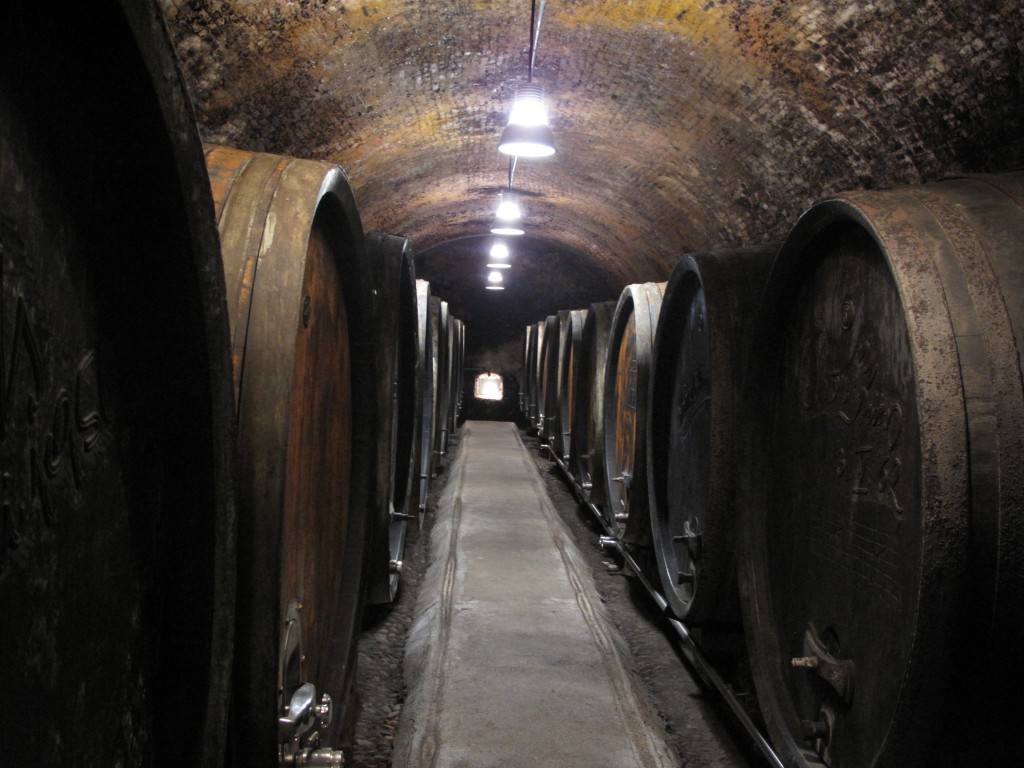
Photo is of ancient Oak barrels in the cellars of the Domane Wachau in Durnstein on the banks of the Danube. To see a photo of the ceiling of that cellar, click here.
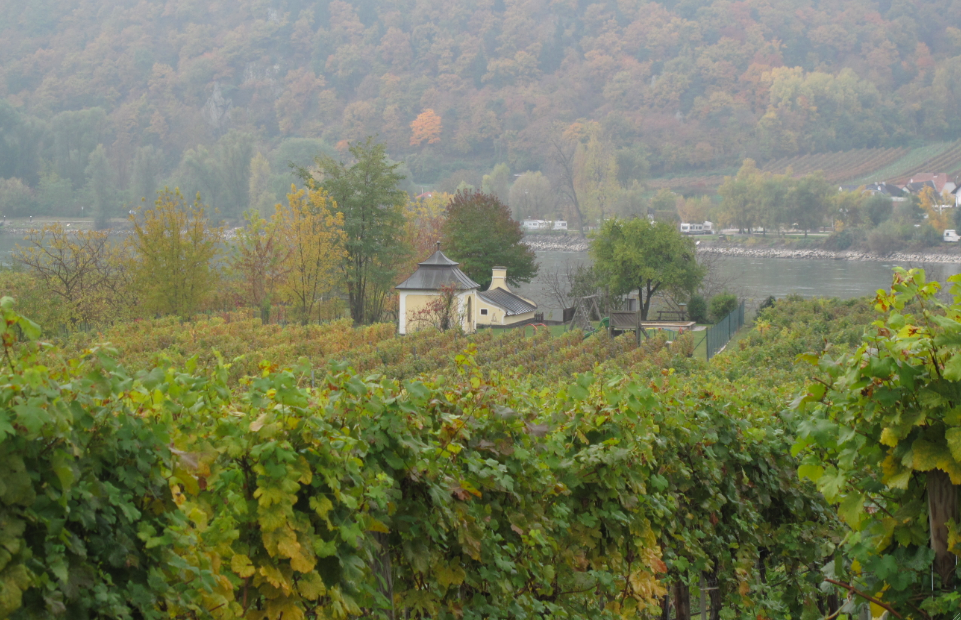
For three days last week, Vienna became the center of the wine world as 200 wine-impassioned bloggers turned the spotlight on Austrian wine culture through the lens of their wines and a new generation of winemakers.
The occasion was the European Wine Bloggers Convention sponsored by the Austrian Wine Marketing Board.
The result was a deep and remarkable plunge into the complex world of Austrian wines, wrapped in the stunning environment of Vienna and the Wachau Valley and a crash course in tasting and understanding this ancient wine culture.
It’s fair to state that for most of us in the US, Austria is not at the top of our favorite European wines nor wine travel locations. We simply don’t have access to these wines at home. With only 30% of Austrian wine exported, the US gets very little and what we do get is limited in variety. The big white wine duo of Gruner Veltliner and Riesling is the extent of most American’s exposure to Austria.
All the more reason to make the trip and see the wine world from Austria’s point of view.
Austrian wine culture, like Austrian history itself, is ancient. People have been producing wine in Austria for 4000 years. The best way to understand the wine of Austria–as with any new language and culture–is to submerge yourself. Just jump in.
Submersion started with a few days at the Schroenbrunn Palace in Vienna with the winemakers themselves, tasting some 50+ Austrian wines. We tasted at the Palace. At wine bars in the city. At restaurants serving local wine from the vineyards within Vienna city limits itself. We were literally awash in Austrian wine.
Taste and appreciation first. Then education and information as the natural next steps.
With the Austrian Wine Commission in partnership with the conference as the hosts, this was an edu-party, an Austrian bacchanalia with purpose. I emerged more literate and with a palate educated and open to scores of new wines, white and red. And a belief that I was let in on a secret: that wine, great wine at that, has been a defining part of this country’s culture…forever.
 Austria is a small country but with a large and complex vocabulary of vintages, regions, wines, classifications and rules. There are four main wine regions broken into 16 districts and covering some 30 varietals, cuvees (blends) added to the mix. I started to internalize this but certainly three days does not an expert make, especially a non-German speaking one.
I did however take a quick plunge into the following regions:
- Wien (Vienna) at the Schronnburn Palace
- Wachau by boat along the Danube
- Thermenregion at various vineyards, highlighted by the Klosterneuburg Winery and Academy
- Superficial nods to the Styria and Carnuntum regions (with remarkable red wines)
That’s a lot of swirling and tasting, traveling and internalizing the diversity of tastes and styles and terroirs.
See my Tasting Notes in the accompanying post (published tomorrow) for what stood out to my palate and what I recommend. There is some good stuff to search for.
Some thoughts on organic and biodynamic and Austrian wine
I have a bias towards organic and biodynamic wine.
Austrian wine culture, with its ancient roots, and its diverse and challenging terrain, naturally dictates small farms and an organic approach to farming and winemaking. But I found that organic and biodynamic are not marketed strongly enough in Austria. There were many vineyards that were organic producing remarkable wine, but I always had to ask. The same goes for biodynamic. This is an oversight and missed opportunity for the Austrian wine brand. Organic wine tradition is there–and strong–but hidden below the surface.
My suggestion to the winemakers who do the hard, anxious work of making wine the natural way, and the Austrian Wine Board who markets their brand, is to make it easier to identify and find Austria’s organic winemakers. I personally, and many wine lovers, are searching for quality organic wine and are willing to pay a premium for it as well.
“Does Austria only produce white Gruner Veltliner and Riesling?”
When I told friends I was going to taste in Austria, the constant refrain was “Do they make anything by Gruner and Riesling?” And “Are there any red wines at all?”
These are understandable questions from N. America where we see little wine from Austria, all white wines in my neighborhood with little diversity, and often not the best.
According to the Austrian Wine Marketing Board, there are 30 grapes of quality, 13 of which are red. But with Gruner Veltliner at 32% and Riesling at 4-8% of production; reds at less than 20%, the world’s perception of Austria being the land of Gruner Veltliner is both understandable and correct. But the numbers don’t tell the diversity story…great wines from the small regions do however.
Few of my wine local shops or wine friends know, have tasted, or recommended an Austrian red. This is certainly a matter of supply but also of intent. The quality and uniqueness of the reds I tasted most certainly warrant this. I would love to be able to buy a great organic St. Laurent or Blaufrankisch at my local wine shop in New York.
The key to appreciating Austrian wine is its true sense of terroir and local culture
Putting immersive education and speed tasting and cultural appreciation aside, the key to what makes Austria wine remarkably refreshing is its sense of being truly local. Of its unique taste of place. Of local culture and individual terroir which you just don’t get sitting in a wine bar down the street in TriBeCa drinking a random Riesling.
We don’t see a lot of wine outside of Austria because most vineyards are tiny and many produce wine mostly for their surrounding area. There is a tradition of drinking locally and drinking wine young. While difficult for us elsewhere, this is I believe one key part to why their wine and wine culture is so interesting.
In a global and flattened online world, we search hard for the unique and the local, the artisanal and that which rings true. Austrian wine, at its best, across its well known stars, with a focus on its indigenous grapes, its deep sense of terroir and its obscure and interesting reds has that in spades.
___________________________________
My sincere thanks to Gabriella and Ryan and Robert from EWBC for putting on a great event. To Willi Klinger and the incredible team that sponsored this event. And to all of my new friends for sharing this remarkable time with me.