Everyone is abuzz over GoogleTV creating a paradigm shift in entertainment…. myself included.
What could be bad? All digital. Surfing from the couch. Social check ins. An easy-to-use time-shifted TV viewing reality.
I’m ready…but for those of us willing to live in the small laptop screen or geeky enough to hardwire the pieces together we have not all…but most of the promised goodness on WebTV today.
WebTV is well beyond its early stage already. With movies, TV shows, great new web content like ThisWeekIn… The web is fast becoming a digital video and TV frontier.
Whether you are on your laptop, wired from your Mac Mini to your large screen with Boxee, using Hulu…this is no longer a small niche by any standard.
New numbers on WebTV and TV watching online from eMarketer are enlightening:
- 33% of the US Internet population watches full-length TV programs today; growing to 39% by years’ end
- Hulu alone has 38.7 million unique monthly visitors. Largest video streaming site on the internet after YouTube.
- 14.6 million-web devices that can run TV applications shipped in last 12 months, increasing to 83.4 million in 2014
- 50% of everyone who watches any video online, will watch a full-length TV show
Mind-boggling actually…in the US, one in three connected people watch network TV shows online and one in two who use video in any way do some portion of their TV watching from the web.
In Geoffrey Moore’s Crossing the Chasm way of thinking, we are just this side of an Early Majority position with WebTV and the chasm-crossing leap is only a holiday season away.
So with GoogleTV and the Boxee Box and every TV for sale with an HDMI plug, what’s the difference between now and…then, when these solutions launch?
The obvious changes will be:
- It will be easy and inexpensive to purchase and install for everyone
- More big screens will drive more content
- Some built in widgets (apps) like YouTube, maybe Facebook and IMDB
- Browsing and searching via Google from the couch position
Honestly, this is great but not a revolution. The iPad was a revolution, this is a big iteration pushing the web to the big screen WebTV experience. I like easy. I like larger displays. I like apps. We need search. But I want what I can’t imagine which is more than just the webification of the big screen.
Richard Kastelein, a friend, blogger and founder of AppMarket.TV believes that one of the big gaps to bridge is ‘lean back interactive in your living room’ versus ‘lean forward at your desk or laptop’. It’s the remote versus the keyboard and the mouse. Content will come. But seamless control of the web interactive elements of search, community and social are the mountains to scale.
Hmmm…So according the industry and folks a lot more in the know than I, the intersection of the widgets on the big screen (like an embedded app), a consistent interface for search, social attributes and some cool device like glidetv for surfing are the formula for the future.
I’m missing something here.
If interface and usability are the kingpins, then why not Apple rather than Google as the architect of the best solution? Steve Jobs, more than anyone gets usability and the mass market. Google is search but certainly they don’t understand GUI or social or consumers.
And I can’t imagine connected TV to be a single screen solution. We are all sitting on our couches with iPads and laptops and phones. This is not going to change. So why isn’t the input one of these devices, like an iPad as the control and with special social content?
Maybe an anecdote might clarify my uneasiness at settling with GoogleTV as the answer.
Recently I was watching ThisWeekInVentureCapital with Mark Suster and Mo Koyfman talking about efficiencies on the web. Mo made a statement that when you take an old industry and bring it online, you don’t just webify it or make it more efficient, you take the core of the old and its value and find something new…something better. This seems right on to me.
So…what is that leap to something new with connected TV?
Maybe it’s just more efficient. Maybe it’s a standard interface with some widgets and open access to a gazillion apps. Maybe it’s a perfect and closed and controlled Apple world of ease-of-use and locked down. Or maybe it’s just what we have today but bigger.
I don’t buy into this.
A year ago, I couldn’t have imagined riding on the subway or sitting in the coffee shop, watching TV and working and tweeting on my iPad. Or building distribution systems for my clients that connected their Facebook fan pages to their e-commerce storefronts.
I’m a video and movie aficionado and ever so ready for connected and social TV. See my post on this. But the web is still figuring out social video and socialization around WebTV. It’s not necessarily the model to copy. The jump from laptop to big screen is fraught with opportunities for new ways of entertainment and needs more than a redo of the current web reality, retooled for the digital living room.
You agree?
What will make you and the hundreds of millions yet to buy, do so and enjoy in a new and more interesting way?
—————————————————————————————–
Thanks to my friend Jennifer Fader for always finding interesting data before I do.
Everyone wants connected TV.
Whether it’s a Google or Apple solution or both, the upside to connected big screens in our living rooms hold enormous potential for everyone with a television and an internet connection….which is just about everyone, everywhere.
The time is overdue for this to happen. On the web side, video content and programming has exploded in quality and quantity, become easy to find and share, and mostly free to distribute and watch. Web video content is begging for more and larger displays.
On the broadcast TV side, we have great programming, thousands of channels on incredible displays that are locked inside of disconnected networks, frustratingly archaic search methods and a seemingly uncrossable gulf between the TV content on the screen and the laptops and iPads on our laps on the couch.
I’m really anxious and excited about impending connection between the big screen on the wall and the real-time web. It’s a game changer.
And I’m really curious about where social and community is going to play into this whole new TV paradigm.
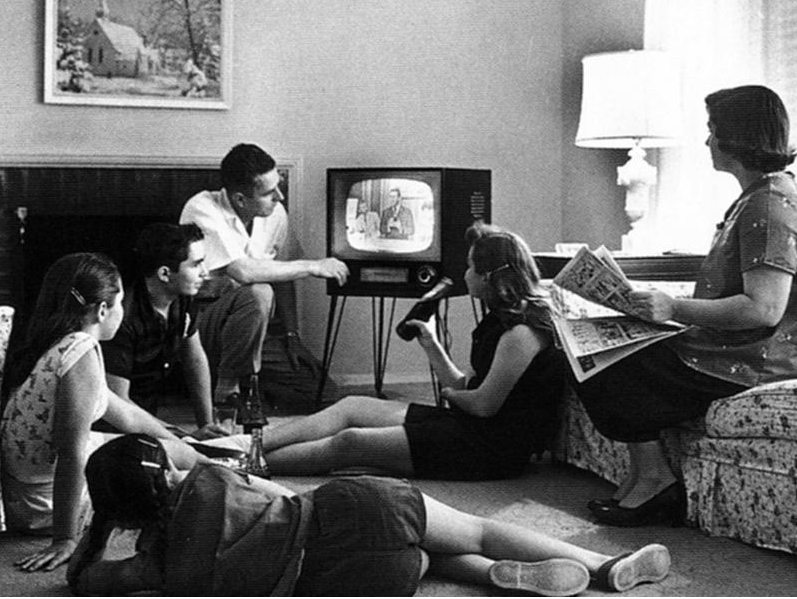
I remember early TV and it was distinctly a social experience. In fact, I recall my grandfather’s first TV set in our house. A very small screen with large groups gathering around to watch, chat and connect with each other in front of this early technology with funky programming. And this social activity went on for years!
Now with quality and varied TV programming, huge displays, HD and 3D…the immersion of viewing has gotten movie theatre quality but the experience, at least to me, more solitary and disconnected.
On the web, social platforms and community are the core of how we find and share information and ideas. Even commerce has become a referral-based economy and at its best, is social in nature. The social metaphor is predominant in entertainment, gaming, information networks and business.
So with the TV screen connected to the real-time web and content digitally distributed, at the very least we will be getting a flood of more content which is easier to find, and finally, friendly and seamless control over what we watch and when. At a minimum.
But will TV as a social experience come full circle? Will the connected TV experience mirror, with a modern twist, what it was at its outset way back in the 50s and 60s?
I’m thinking… yes, but in a totally new way of course.
It takes little imagination to see a Facebook iframe on the TV screen to share and chat with friends. And it’s easy to see social commerce with a click to purchase on the TV screen just like a click to purchase on your laptop or phone.
And why not sports book-like communal gambling over a basketball game? Or real-time video chat with friends across the country while watching an episode of True Blood? Or some yet-to-be-invented social game that let’s you Foursquare-like check in and find your friends watching the same show and connect with them?
Google and Apple and Sony won’t be the doers here. But game developers, social widget designers, and smart entrepreneurs will be rising everywhere to help us take connectivity from the couch and make it social for those around us in the living room and my friends across the globe.
Social platforms and online communities transformed information sharing on the social web. Connect it to the big screen and it has the potential to lend its dynamics to the connected TV platform and make watching more active, shopping a bit more collective and natural and entertainment just more fun….with friends.
Move over George Jetson! Your cartoon future may just have started to get real!
I spent most of last week in London at the Social Media World Forum talking about social video and Facebook as a platform for businesses and brands in Europe.
It was great fun actually sitting down with MPs, bank and music company executives, advertising and marketing consultants, writers and vbloggers from the Netherlands to Turkey.
For background see my post and my keynote on YouTube.
After endless conversations and two auditorium-sized keynotes, my thoughts sum up below.
Europeans just get video and collaborative communications
They really do.
The very issues that make doing business in Europe challenging and interesting, make them very open to new means of communications. Many corporations, advertising agencies and start-ups have people working from different countries. Communications and collaborative work tools are necessary parts of a distributed workforce.
Most everyone uses Skype and video Skype. Video conferencing is not the exception but the standard here.
In the U.S. when I was demonstrating my client’s social video application Live Broadcaster on Facebook, it was a ‘wow’ of something new and unexpected, like a hybrid car before they were convinced that the car was both environmental green and fun to drive.
In London, using video as a communications medium seemed like the normal thing to do. At the conference, they grabbed the spotlight and jumped in the broadcast window, invited their friends and started a video conversation. It was the natural thing to do. They culturally just get video, distance communications and the need for video as a collaboration tool.
Skype set the groundwork for video as a conversation to move quickly up the adoption curve in Europe and into Asia. Skype made video conversations a natural form of communications. Vpype takes it one step further and integrates it into the social graph. The Europeans understood this at a glance.
The reaction was very similar across the spectrum of businesses, from MPs, bank executives, ad agencies and social TV GMs from all over Eastern Europe.
Europeans, especially in the UK, haven’t embraced Facebook yet as a business platform
Facebook user growth in the UK is falling behind in Facebook adoption from the rest of Europe and into Asia. The data proves this. An estimated 30 meetings and many emails and DMs on Twitter confirmed this to me at the event and around London.
And the adoption of Facebook fan pages as a business platform appears to be lagging behind this. I can’t find a reliable source of fan page adoption numbers so please share if you know where to get them.
The big but here is that European businesses are looking for solutions and are amazingly practical and ready to leap when the solution works. I found myself being the evangelist for Facebook first; the demonstrator of social video second. Video conversations were an easy step; Facebook as a business community was a bigger leap.
Facebook themselves is the issue here. Not the video conversation format. Certainly not the community but the lack of education and marketing about privacy and specifically around how businesses and brands can use fan pages.
Facebook is the Wild West with no roadmaps. But the the power, the cost effectiveness and fact that the people, the fans are there makes this a natural place for the brands to move to. European businesses are lurking and looking. They are sharp and will leap when comfortable.
Facebook simply needs to help and provide information. And to focus on the small and large businesses alike. The market is here and lack of information and communications is holding the brands and businesses in Europe back.
Niche and private communities have traction in Europe, but this will change over time
Privacy. Trust in the integrity of the network. The interweaving of fans and brands on Facebook. These were large topics of conversation in my meetings in London. There is simply not enough work being done to make the population and the businesses comfortable.
The first questions from corporations about the Vpype solution on Facebook was “How can I get it on my website?” or “How can I get a secure link between Facebook and my database?”
Geographical and language diversity seemed to drive individualized networks more than a move towards shared platforms. The closed umbrella of multinational corporations in Europe, at least from my exposure last week, was very niche oriented. Consequently, a lot of small community platforms were being created for specialty groups and companies. And considerable interest in my client in exporting functionality to private communities.
In the U.S. I see platforms like Involver and scores of agencies and consultants focused on Facebook fan pages. And new platforms for teens and specialty groups seem driven by new requirements not available on Facebook.
In the UK especially, I saw private and closed and specialized as the first thought. Creativity in using technology to communicate in new ways but rigidity in moving businesses and brands onto open platforms with a business component. I believe that this will change as the economic practicality of Facebook and the fact that the populations are moving there make it a given over time.
Europe poses an interesting dichotomy around social media and Facebook. On one side there is a hesitancy to embrace the Facebook platform across companies and brands and sticking to the old niche community paradigm. On the other there is incredible flexibility and creativity in embracing video especially as a new way to have conversations on the Internet.
This is my snapshot after a deep dive into the social media scene in London last week.
__________
A personal thanks to all of my new friends in Europe for their time and input. The honestly and openness of the conversations were inspiring.
Keynote presentation at the Social Media World Forum, London, March 15, 2010.
Always a challenge with a big room, little interaction and no live demo. But this seemed to work out. Lots of tweets, posted videos and new contacts.
Was fun meeting MPs, brands and bloggers from across Euope. They are cautious about Facebook as a business platform but wildly innovative when it comes to using video as an online communications medium.
Check out the blog post on the show and my experiences in London.
Making video easy…is hard. But it is starting to happen and adding a new dimension to socialization on the Internet.
On the social web and on Facebook, the trend towards sending and sharing video is growing at enormous rates. Internet TV viewing in the US alone has increased more than 50% year over year. But there is a difference between sharing a video on YouTube, viewing a concert on Facebook through Ustream and what innovative startups are calling social video.
The social aspect of video is blurring the boundaries between real life and real experiences online. But more interesting, it is letting people connect with celebrities, brands, politicians and leaders in a powerful new way. This is the game changer.
The state of art for socialization around video today is in three buckets.
With YouTube, you capture a video moment, upload it and share it by sending it around. Fun stuff and we all feel good when we get comments like ”Looking good” or ”Great vacation” or “Can’t wait to see you.” Similar to a video post on your Facebook wall. While richer content than a photo, not really that different.
With the streaming companies like Ustream, Livestream and JustinTV, we are finally getting events and shows delivered digitally to us on our laptops and phones inside of Facebook. It’s cool to watch a show, comment on the wall, or Tweet out what your thinking to your friends. Similar to Social TV. Their goal is to create a virtual living room or concert hall around the shared experience. The event is streamed, the comments are to your friends via chat. This is less about changing socialization than about changing the delivery from analog to digital.
The third, more embryonic and more interesting is what is termed social video and is finding a home on Facebook. In the spirit of full disclosure, I am an Advisor to Vpype, a social video startup. Social video, from Vpype’s application, lets an individual or a brand or businesses create a video conversation with their friends or fans on Facebook. You use your Friends Lists and Event Manager to decide where and when, you broadcast live and share the broadcast channel with your audience who can ask questions, interact and shape the content of what you are presenting or talking about.
So social video is a two-way, one-to-many shared channel of communications where the broadcaster interacts live, unscripted with their audience. The entire event is saved, shareable and reviewable. The content of this video conversation is the combination of the broadcasters video and the viewers’ comments. The sum of both defines the experience. Think of a live TV show with an audience that interacts freely with the host.
OK…so we have a live two-way channel between brands and fans. It’s authentic because you can see the broadcaster. It’s real because it’s live and free flowing. And it’s more intimate and compelling because it’s personal. Yes, this is where real life and real conversations online start to come together.
But the game changing power of this comes from something special that is only available on the social web. And that is connecting with stars (from your local politician to a movie star) in real time in a personal way. Think for a second about Twitter and one of the many reasons why it’s so powerful. You can message Ashton Kutcher or John Mayer and potentially get a response back from them in seconds. For millions this is beyond a wow experience. This could also be Gavin Newsom, Mayor of San Francisco, your Senator, Yankee baseball slugger or your local celebrity chef.
With social video, this connection between brand and fan could become a video conversation on Facebook from a Fan Page or a personal profile. With these celebrities talking to their fans or customers through their Fan Pages directly.
Vpype’s Live Broadcaster is pioneering an interactive video conversation application for Facebook brands and businesses. I will do a follow-up blog post on early beta testers for Vpype as they come online, which include a Hollywood Screen Writers Pitch Contest, Evangelical Ministers, Auto shops, DJs, virtual online assistants and one public company planning on doing its Earnings Call via the social video product.
This is what is starting to happen on Facebook. Having a cloud-based architecture, a global massive audience that grows by 500,000 a day and a proven model for friending and socialization makes it a natural. Not to mention monetization from its advertising model. I’ve blogged on this here.
Today, social video is a conversation defined in a video and gravitar-based chat environment. Voice channels and split screen (Larry King-like) environments are being tested now. And with 4G networks within reach, the paradigm will go mobile for broadcasting as well as interactive video chatting.
It is still early days for this dream but it is really starting to happen. It’s empowering for all of us to be on the brink of another chasm-leaping breakthrough in technology and behavioral change.
As much as I’ve embraced the social web and Facebook today, this leap is really something to get excited about.
I’ll be online broadcasting and trying this one out.