I’ve been thinking a lot about my mother lately.
She’s 91 years old. Healthy. Spunky with a large extended family of kids, grand kids and great grand kids. There are people all around in her retirement community. In spite of this she appears lonely and bored…achingly so at times.
I sense she feels isolated from her past and trapped in an ever-shrinking present. Not abandoned certainly–but friendships and networks outside of immediate family that come to visit are just not there. And there is little productive to do.
Her communities, once very large, are evaporating. Connections outside of the family are gone mostly. And to someone whose father drove a horse drawn cab in NYC at her birth, computers are just not truly a part of who she is.
And she is not unique, but an example of many who live between the extended family structure of the immigrant family and the social reality of a networked world that many of us inhabit.
For most of us, social networks have flattened the world and community has taken on new forms, providing a huge umbrella of support. We have Facebook walls, niche interest groups, blog communities, and offline/online connections. We have numerous lingering touch points with contacts and friends in a way that my mother never had.
This is not about richness of life…my mother’s life has been very rich. It’s about something new and extraordinary that the social web has empowered. This ability to create community as a hedge against location, a hedge against aging to some degree and certainly…a hedge against isolation as it engenders friendships in new ways.
My mother’s world has been one of astonishing change…world wars, the great depression, air travel, empowered middle class, electric powered everything, but for her, it stopped at the networked world. We spring off where she stopped and nothing is more compelling or revolutionary that what the social web empowers around people and friendships and community.
My mother sends (some) emails. Plays computer solitaire…so it is not simply technology where we spring beyond her generation. It’s networks and the social possibilities that are the great chasm here. And while we understand intellectually the power of social and community, my sense is that it is just beginning and its power is just getting tapped.
Maybe when I’m my mother’s age…when the baby boomers succumb to old age…the body will not hold us back as much. And will not create isolation or lack of productivity as our physical reality becomes less limber and more confined.
Science has extended our lives and made the middle of life longer, more productive and not much different from the decades preceding. I’m thinking that a networked and community driven, intertwined off and online world, will extend that even further, enabling connections, productivity and support for an even longer, richer period.
Add the science of health aging to the empowerment of community and socialization in a connected world, and we have something new and powerful. Technology usually evolves from one thing to another. The social web and community is a revolution in how we live better…for far longer.
The game has changed obviously…but, it’s certainly not over.
Facebook is becoming what Microsoft used to be back in the 90s…essential to everyone, impossible to beat and feeling a bit like the platform bully.
They are smart to leverage what they have to the hilt. It’s just good business and I would have done the same, but like Microsoft, they will lose (if they have not already) the passion and commitment of those who have no choice but to use their platform, which today is everyone. This is starting to sound like Windows to me.
You can’t beat Facebook at their game…but you can build great companies that can win around them. Anyone in the gaming or multimedia or peripheral add-on space in the 90s will tell you the same. I have personal scars from this and am a veteran of the birth of coopetition.
The announcement (I watched the livestream on Facebook) was like a webcam in a frat house. Nonetheless, Facebook Places will certainly be a monster product and hugely successful based on the massive leverage of of the platform obviously. Their reach and numbers are poetic in their size.
And yes, I’m a power Facebook user, a fan, consult on how to best use fan pages to my clients… and am excited about Places even though underwhelmed by their lack of originality. I’ll certainly use it because the Facebook platform is core to how I live, but I’m still checking in on Foursquare for now.
I’m just a big believer in the check-in space and rooting for the underdog today. I believe in people who are inventive and I think the Foursquare guys are… and with spunk, smarts and yes, a good chunk of luck can potentially carve out something that makes sense, has value to the users and the merchants.
What’s the answer? I’m not certain but here’s Foursquare’s response in SAI today. We do need more of a answer from them though.
I like the intersection of the check-in and coupon space a lot. That’s where I’m looking for the next great explosion on the streets with check-in. I’m searching for apps that are at the intersection of these because I believe that the social commerce component is key…as it creates an open market and value potentially for user and businesses alike.
______________________
Postscript thought
I’m starting to think that Om Malik may have it right that Facebook is after the local merchants and Yelp. His post is here. Thanks to @PS 98 for surfacing this.
Even though I still believe that the check-in space is embryonic, and even if Facebook’s focus is Yelp, the swishing of the giant’s tail still makes it a difficult place for Foursquare and the other players.
With 45M internet-ready TVs shipping this year, there’s a minor land rush in process adapting the building blocks for community and social commerce from the web to the largescreen TV and communal setting in the living room.
There’s a lot of buzz around EBSNs (Event Based Social Networks), bridging web-proven viral loops and social commerce to live connected sporting events and network premieres. This is an obvious direction for flash community gatherings around live broadcasts but doesn’t address the majority of legacy media content available to viewers.
I visited with Scott Varlard (co-founder and CEO) and Philippe Pierre (CFO) of SocialBomb, a NY-based social technology company that is figuring out how to build community and bring social value to the mostly time-shifted reality of TV and webTV content. These guys are betting that brands and fans are both interested in social viewing and sharing around their favorite shows and movies.
SocialBomb, if you don’t know them, is the company that provided the community and technology platform for the HBO release of True Blood Season 2 Blu-ray DVD. This HBO release pioneered scene sharing, social incentives and on-big-screen controls for the Blue-ray release of the blockbuster hit series.
Scott and Pierre walked me through the demo…cool stuff to be able to easily pair your Blu-ray to Facebook and Twitter, share scenes and engage with a bunch of social incentivized activities. I’m a bit geeky and a huge True Blood fan so maybe I’m an easy sell for this but there is real potential here especially as this paradigm moves to streaming catalogs as well as DVD-based content.
This was a gutsy leap of faith for HBO to try this even as a ‘quiet launch’…big win for SocialBomb to pull it off so crisply. Connecting a DVD and TV to the Internet is still the domain of the few and DVDs, in my opinion, are a legacy format looking for some additional life. But…rumor is that fans liked it, scene sharing was very active (the coolest part) and both the fans and HBO have deemed this a success.
My take is that this is a small but important proof point on how to create community events around time-shifted content. DVDs are a second tier choice after streaming for many, but if this provides social proof in the small, hard-wired world of DVDs, it should work well for the mass market as a streamed, built in and easy to set up media in millions of living rooms this holiday season.
Let’s imagine the not so distant future.
Take what SocialBomb has done and apply it to streaming content and connected big screen TVs with, as well, 2nd and 3rd screens on the couch and mobile devices thrown in wherever they may be. And where every title on Netflix or Hulu or Boxee is able to connect to Facebook and Twitter with scene sharing, some social gaming and merchandizing built in. You can watch and rewatch and share media content in a social setting on any screen anytime.
This means that every time I view Godfather II or Hustle and Flow, or Entourage, I will be able to create a flash community event, share scenes and participate in extending my passion for movies, a particular movie or TV show down to the scene level. And most likely, this will inspire others to download and view and share as well.
I think there is something here…maybe not exactly as I’ve described it or precisely as SocialBomb is working with HBO. But something…significant.
People on the social graph, 500M on Facebook and millions on Twitter are hungry for content to share. On Facebook alone, an average user generates 90 pieces of shared content equaling 30B shared pieces monthly (mostly photos). With a tangible connected TV footprint coming and flash community capabilities being developed by SocialBomb and others, there will be a lot of scene sharing and social gaming around what we all do a lot of…that is watch TV. Scene clips could be the next step beyond photos as shareable objects. And everyone has movie and TV scenes that they would want to send as a video invitation to their friends and communities to join in the fun…or watch later.
This is also an innovative solution on how to take the real-time community of the social web and our social networks and connect it with time-shifted movies and TV and sports media that we love and watch and rewatch over and over again.
I can’t see this as any other than a win for everyone…including of course the content owners.
I’m very positive about a real-time social environment on the big screen around legacy content. Certainly more questions than answers exist today, but having all media content available all the time and platforms like Facebook or Twitter seamlessly tied into my ability to share…just makes sense.
Sharing in a Facebook-powered world is a common bond across all networks. Daily and by the billions of posts, we let each other know where we’ve checked in on Foursquare for the best expresso and where we are traveling to and the restaurants we frequent. It’s a natural (and significant) step forward to share movie and TV content we deeply identify with at a scene level, plugged into the social graph and shareable across all of our communities.
______________________________________________________
Thanks to my friend Jeff Blackman for introducing me to the SocialBomb team.
A lot has changed in 30 days.
A month ago, I searched the open web and Facebook for examples of social commerce where community activity drove measurable transactions. Outside of social buying, ala the Groupon phenomenon, there was little of interest. My post on that experience is here.
But things are changing quickly. Two global brands with innovative commerce initiatives are starting to get traction and attention.
Two examples of social commerce on Facebook fan pages that work
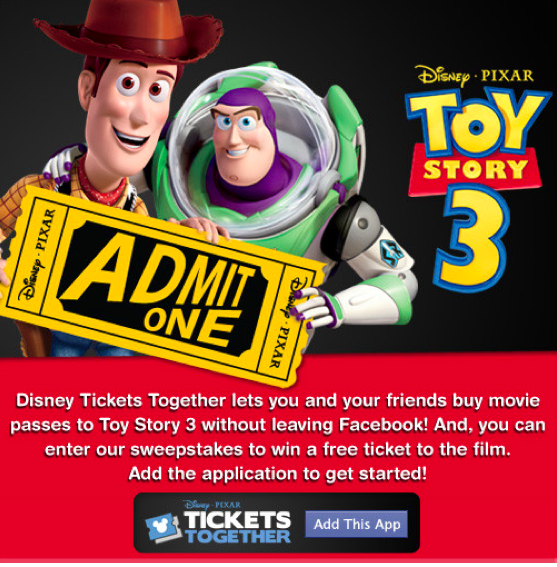
1. Disney Tickets Together Facebook application
The idea is built around sharing your movie going experience with your Facebook friends from the movie’s promotional fan page.
Tickets for Toy Story 3 are on sale only the Facebook fan page, weeks earlier than anywhere else. You let your friends know you are going and when, invite them to come along…and if you want, buy tickets as a group for the movie.
This provides a special incentive…and reward…to the movie’s Facebook fans as they can pre-buy early and participate in raffles for free tickets.
This is clever social selling and fun social buying wrapped into one. Reports of groups of 80 people buying this together indicate this is potentially the beginning of a trend that really works.
Tickets Together is the best example of social or community commerce I’ve seen. You are literally buying collectively with your friends on the Facebook fan page. Finally… something to do on a fan page that makes sense! And this is the first and best example of empowering a naturally social activity like shopping online in a community setting.
Disney’s market phrase for this is “…no friend gets left behind,” according to Oliver Luckett, general manager of DigiSynd, that manages Disney’s social networking presence.
It’s just social commerce to me, taking fan interest online and moving them to an offline event together, then back online to re-socialize it. An oft-repeated cycle of social proof.
2. Diesel-cam in-store Facebook runways
Live in Spain, Diesel has a fashion runway with a Facebook cam inside their stores.
Shopping is a core social activity, globally. You shop with friends and what your friends think influences what you buy. This is true for everyone; probably more true for teens and 20-30-somethings, the core audience for Diesel.
There is a Facebook runway just outside the dressing room. Customers try on jeans or an outfit, and stream a short video to their Facebook walls to show their friends what they are thinking of buying. Questions like…“Like it?” “Should I buy it?” are natural and this conversation drives sale’s decisions.
You can see a video of the Diesel-cam here.
Note that I’ve seen chatter online that the Diesel-cam is ‘stupid’ or ‘voyeuristic’. For Diesel and for the meaning of the brand, it couldn’t be more perfect.
It’s just smart commerce, matching brand to customer to commerce…and social and fun to boot.
Why I think social commerce is a solution for Facebook fan pages
- It just works. Disney is selling tickets while building community favor. My bet is Diesel will be successful as well.
- Shopping is what we do with friends offline. It’s logical, when done with intent and creativity that it will work online. Facebook fan pages are replete with community potential but are usually dull…maybe commerce is an answer.
- Social proof as a transaction based on the encouragement of your community is the first approach to social ROI that makes any sense to me.
Why Disney and Diesel as global brands are being socially astute
- They are taking commerce to where the fans are. Facebook becomes a channel.
- They are building commerce that matches the channel to the customer behavior…that is social commerce for a social platform.
- They understand that boring and dull doesn’t sell, and doesn’t fit their brand image. Fun and creative and social does.
I think that Disney and Diesel will benefit from a deeper connection with their fans, from a new strata of social proof to their image and, of course, from commerce.
How does Facebook benefit?
Having a fan page is free for brands and data storage and bandwidth cost real dollars. Maybe these brands will advertise more? Maybe not.
Facebook wins whenever anyone uses, returns, sticks around or invites friends to do anything at all on the platform. The more traffic they get, the more sharing happens and the more demographics are collected. And of course, then the value that Facebook can sell to advertisers and partners increases proportionately.
For Facebook and the brands and I think, the consumers…this is all a win.

I posted on Facebook and privacy the day after Facebook’s F8 Conference as a contrarian to the crowd hysteria.
Since then, I’ve been in numerous heated debates and found myself defending Facebook, then succumbing to annoyance over their adolescent behavior and momentarily siding with the crowd as the cavalier attitude of Facebook management became impossible to ignore.
But today, I still believe firmly as I did just post F8, that if you live in public, your life is just that…open to public record. And that acting responsibly is the coherent poise in a connected world. This responsibility is yours on the street, on Facebook, on blogs…everywhere
A BusinessWeek article lit up some interesting facts about Facebook worth thinking over:
- Traffic is 4.7% higher today than it was on May 1
- Facebook has 519.1M users, compared to 411M in September ‘09
- User activity level is still very high. An average user creates over 70 pcs of content each per month and connects to 60 pages or groups
- Facebook accounts for an astounding 8.5% of all Internet traffic
And as telling:
- The We’re Quiting Facebook campaign scheduled for mass cord cutting on May 31 has only 16,000 (out of 520M) people signed up
So what’s going on?
The blogosphere, the press and common knowledge all point to a semi-repentant Mark Zuckerberg who is hiding behind his youth and bowing to the pressure of US and European governments and a zillion hate posts.
Let’s be clear here…Facebook is acting irresponsibly and toying with its member’s feelings and trust. And there is a grating disconnect for a social network to have such anti-social and anti-transparent management.
So many ostensibly hate them but numbers and activities are increasing dramatically. Something is wrong or at least out-of-whack.
My take on why we can’t love Facebook but can’t imagine not having it
Facebook as the definition of ‘social’ just got it right.
It’s an almost perfect product because it filled a need no one knew they had. And created a situation, like we have today, where not having Facebook is an impossible thought for I bet, hundreds of millions of people. Including myself.
Most of the angst towards Facebook is expressed on Facebook itself. The news we read or videos we see about the privacy issues, rants, ‘how-to’s’ on setting privacy settings, and on and on are all done on our Facebook wall itself. Kind of like hometown politics on the only paper that people read about things that happen on Main Street.
While I support Diaspora and open social development, Facebook is not going away anytime soon. It is not going to stop growing or being an essential part of how we view the world and interact unless Zuckerberg does something truly stupid…and stupid he is most certainly not.
Or till whatever the next iteration of social, maybe unimaginable now, pops up and we migrate with our friends to somewhere else.
Our networks of friends from kindergarten playmates to people we met through our kids or worked with or dated or want to meet will never be erased. Migrated and moved perhaps, but we simply need that Facebook magic touch with friends is now natural and organic and isn’t going away. Thankfully.
What has happened is that we don’t and really can’t love Facebook like many did before. Like many loved Apple or the Mac as a solution or our smart phones when we first got them before they broke the second time.
Facebook, though brilliant and essential and integral to social life, has lost that love cause it trifled with our trust big time. It was like Bill Clinton…Oh so brilliant and oh so flawed as an individual. I would vote for him again in a heartbeat but never be surprised at enormous acts of personal stupidity. We aren’t breaking up but we are suspicious forever.
What’s inspiring to me is that Facebook added something to human social interaction. Yes, it really it has, and that is why from a mass of people in the know and early adopters who are rightfully miffed, there are hundreds of millions and hundreds of thousands joining daily around the world. Some know, some don’t. Some care, some don’t. Doesn’t matter.
And to be clear, I still hold that we need to be responsible for our own images and act responsibly. Facebook didn’t change that and that will grow as we do into a more connected social age. But, and I mean this seriously, Facebook did belittle the very attribute it created. We can forgive this but forget or trust completely…not at all.
What is great is that technology has enabled an extension of community. A new iteration of social for us all. It allowed me and everyone to connect and define relationships in new and fun and empowering and important ways.
Today Facebook is essential to multitudes. What it empowered and created is not going away but Facebook itself may when something new evolves that builds on it and really does respect what it created.
Who cares about Facebook? No one.
But everyone cares about friendship and community and platforms to build that on.
Today, that is Facebook for a global population of over half a billion people. Where those people are in 5 or 10 years, is up in the air. The fact that sharing in communities is important and will persist is undeniable.


![Reblog this post [with Zemanta]](http://img.zemanta.com/reblog_e.png?x-id=736ef278-1442-45d8-a6ff-561cc63378c7)