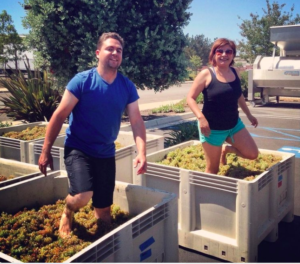
We are in the early days of a modern renaissance in the artisanal wine world.
A cross-generational melting pot of innovation spanning a dizzying array of grapes and tastes under the moniker of natural wine.
Alongside the early pioneers, there is a new generation showing up.
Less connected to tradition, defined as a group mostly through the individuality and strength of their diversity. Their unabashed vitality and optimism is layering into the wine world something fresh with a zest of personality all its own.
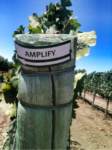 These qualities are singularly true for Cameron and Marlen Porter, co-winemakers and the couple behind Amplify Wines in Santa Barbara County.
I met them last year at a Chambers Street Wines tasting and was seriously smitten with their Carignane, a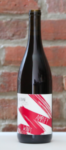 fresh and bright, light and brilliant bottle that drinks like an homage to my beloved Poulsard from the Jura.
It was this wine that started it for them as winemakers six years ago. It was the bottle that drew me to chronicle their story here.
They are young, both turning 34 this year. Musicians by background. Creative, expressive and thoughtful individuals by nature. Natives of Santa Barbara County by birth.
As they told their story, they grew up drinking the classic wines from Burgundy and Bordeaux but discovered that the wines they truly loved, the ones that drew them in and set their imaginations loose just happened to be natural wines.
In their early 20s, living in LA, dating and hanging out at Lou Amdur’s wine bar, Lou On Vine, they fell for those forgotten places like the Jura. Realized that natural wine is an approach, not a dogma. A platform for experimentation and creativity that they could personalize and make their own.
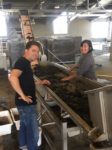 There is something original, honest, solidly earnest and focused about the two of them.
On one hand, they are truly driven by the creative expression that lets them as musicians and self-taught winemakers make wines of individual consequence reimagined through personal visions of music and art.
On the other, they are born and raised in rural Santa Barbara County, locals intimate with the details of this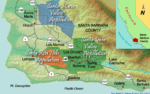 diverse terroir. Poetic as they describe how the transverse mountain ranges, opening to the pacific drive huge temperature shifts impacting the vines. How the uniqueness of the soil—serpentine and diatomaceous earth–is formative to the character of the place and the possibilities of the wine itself.
Amplify Wines was founded in 2013 when they scraped together savings to buy a ton of grapes, making 90 cases. Some of Carignane and a Viognier.
The mythos of their name comes from the song Amplify the Autumn from Cameron’s band Ten Teardrops. Their musical roots (he guitar player, she from a generational family of musicians from Mexico) inspired both the name of their domain and their core ethic–Wines of place, amplifying the voice of site.
They both come from the wine trade.
Cameron first in retail, then a Somm, now directing sales and hospitality for Presqui’ile Winery in Santa Maria where they make their wine. Marlen as a GM for local wineries till the birth of their son Miles in 2015.
They are self-taught artisans, learning the hard way, on a basic nuts and bolts level from working in local cellars, studying wines they fell in love with, pouring over tech sheets, winemaker interviews, old books.
They just did this. Few resources. No land owned. No vineyards leased. No facility they could call their own.
Increasing the original 90 cases in 2013 slowly to 1,000 in 2017, with the 2018 harvest, doubling to 2,000 cases while adding new varieties.
I discovered a key puzzle piece that helps me understand the narrative of their wines and the allure of their approach.
They start with an idea: For example, the love of Poulsard in the Jura from Overnoy and Puffeney and carbonic Carignan from the Roussillon.
Or the notion of removing time (vintage) from site expression tied to the idea of an endless loop from a favorite musician J. Dilla on his Donuts album.
They source maligned or obscure, late harvest grapes oozing with potential and acidity paying $2000/ton/avg. against the $25K a ton for Cab or $7-10K for Pinot in the county.
Partnering with small organic growers from Los Olivos District (Carignane, Counoise, Cabernet Sauvignon, Merlot, Riesling, Tempranillo). From Alisos Canyon (Viognier). From Santa Maria (Grenache Blanc, Refosco). (AVA map here.)
Discovering an expression that ties the idea to an approach, like partial carbonic for their Carignane or a reimagined Solera method (from Port) for their Merlot. Experiment, pull it all together and iterate over time.
Cameron and Marlen are building a wine label that represents their unique experience, expressed in singular, expertly-made and approachable wine that conveys the character of their birthplace, driven by the personality and perspective of their passion for music and art.
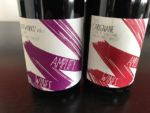 I can’t recommend these wines enough.
They are both equally delicious, soulful expressions of their grapes and the personalities of this quite lovely and self-effacing winemaking family wrapped in Santa Barbara County as a terroir unique unto itself.
Both the Carignane ($23/bottle) and the Solera Merlot ($25/bottle) are in stock at Chambers Street Wines.
 I so enjoyed getting to know the family and chronicling this story.
A heartfelt thanks to Cameron and Marlen for sharing so openly with me. To their beautiful son Miles who protested but tolerated me keeping him from dinner as I skyped with his parents.
To my friend Ariana Rolich and the Chambers Street team for their friendship and tolerance of my incessant questions. To Mike Foulk and the team at MFW Wines for bringing Amplify’s exceptional wines to market.
This quote from a shared hero of the three of us, Masanobu Fukuoka (One-Straw Revolution) speaks volumes to who they are and their unique take on wine.
“Natural, do nothing farming, leaves time to write a haiku, or a song.”
**All photos from Cameron and Marlen.
___________________
Winemaker Notes
2016 Carignane, Camp 4 Vineyard, Santa Ynez Valley
- The grape that started it all with 1 ton of fruit bought in ‘013, now in the seventh vintage
- Methodology:
- Semi-carbonic maceration
- Foot stomp bottom of bins with whole cluster, layer uncrushed whole cluster on top and seal, add CO2 once a day
- Carbonic varies between 1-2 weeks
- Press, finish in neutral wood, age undisturbed on lees for 5-6 months
- Racked for bottling adding 8-10ppm SO2
- Fruit is from Camp 4, planted in 1999, located on the Eastern end of the Santa Ynez Valley AVA, in the sub-AVA Los Olivos District. Hot and perfect for Carignane. Typically picked late September at potential alcohol of 13-13.5 and tons of acid (pH 3.2-3.3)
- Gravelly loam soil on VSP trellis
- Sustainably farmed. No herbicides, lots of owl and bat houses with cover crops
‘Lightworks’ Vol 1, Solera/for Dilla/For the endless loop, Santa Ynez Valley
- Evolved out of a love of old school Napa Merlot and Bordeaux
- A grape much maligned in SBC though naturally at home climate wise
- Driving idea is removing time from site expression and searching for raw material to translate the idea of an endless loop from their favorite musician J. Dilla on his Donuts album where Lightworks is the seminal track
- Solera Method: Must often thought of for port, reimagined for Merlot. Method for Vol 1—combined 15 gal from ‘015 with one barrel from ‘016 after malo was done, topped with ‘014 from bottle. Vol 2 is ‘016 and ‘017
- Fruit certified organic from Coquelicot Vineyard in the Los Olivos District near the Santa Ynez River
- Sandy loam soil with some gravel and clay, VSP trellised
- Methodology:
- Pick around 23-24 brix, when pH isreally low, like 3.3. De-stem but leave whole berry
- Fermentations are hot peaking around 92, punching down by hand 2-3 times a day
- Pumping over early on to prevent overly green or bitter flavors
- Fermented in small bins through 2016; in 2017 fermenting in concrete and love the results
- Aging is in neutral oak, adding sulfur to the Solera as needed. SO2 around 25ppm
Amplify Friends and Mentors
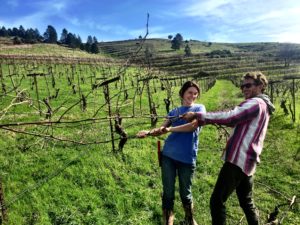
A new generation of young winemakers is surfacing on the artisanal fringes of the wine world.
As much farmers as winemakers, coming at the craft with a refreshingly new, unencumbered, and personal point of view.
A clean slate for the imagination driven to make wine not out of reaction to an industrialized farming heritage, but inspired by the pioneering work of the great natural winemakers in the States.
To Aaron and Cara of Frenchtown Farms, coming out of the NY area, this inspiration was no less than Gideon Beinstock of Clos Saron.
They told me the story of how they happened on a bottle of Gideon’s ’08 Black Pearl and were simply smitten. How they then ‘hunted him down, sought a lease on the old vines where his fruit came from, and likewise changed the direction of their lives and an understanding of what wine could be’.
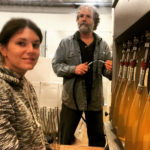
Cara and Gideon
They now live adjacent to their leased vines, and just down the road from Clos Saron where they interned with Gideon through two harvests and produced their first vintages at his winery.
If you are unfamiliar with the back story of Gideon and Clos Saron, this takes place in North Yuba County in the Sierras, some 2 hours north of Sacramento in the tiny town of Oregon House.
This off-the-grid-farming community is what a handful of resident winemakers consider the very center of a yet to be rediscovered, historic and unique high-altitude wine region.
During the Gold Rush days, vines were planted locally and the namesake of Aaron and Cara’s domain—Frenchtown Farms–comes from French immigrants founding a nearby town of that name. They planted this steep and challenging terrain (1700+ feet) where the winters are cold and rainy, the summers very dry and the cool, moist air of the high Sierras wafts down to the foothills in the evenings cooling the vines and the fruit.
These original vignerons by dint of instinct or knowledge must have known this was wine geography for the terroir inspired.
Aaron and Cara’s leased plot of vines it turns out, was none other than a portion of the famed Renaissance Winery. Planted in the late 70s/early 80s, noted for its ungrafted plantings, organic farming, deep minerality, tiny yields and intense fruit. Five years of drought demanded a focused reconstructive labor with the defining potential for this small and semi-forgotten piece of the North Yuba AVA as new hands and fresh ideas took over as custodians.
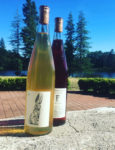 My road to discovering Aaron and Cara was through a bottle of their 2016 The Pearl Thief that I happened on at Chambers Street Wines in TriBeCa where I live. An intriguing Sauvignon Blanc/Viognier blend. (See all details in Deconstructing note at end.)
I fell for it hard. An unrepentant addict to the quiet murmur of restrained skin contact fermentation and overt minerality.
The bottle registers on that rare scale where natural wines can be at once both interesting and intellectual yet satisfying. A bit inscrutable to boot.
I kept going back to Chambers Street and buying another bottle, then another. Weighing it in my hands, staring at the unique label, and talking with friends at the shop. In awe of how it all works together so well.
As is often with new wine discoveries, I find a bottle with a big hidden aha, connect, write about it and get to know the producers. They, more than the variety or the vintage, become the center of gravity for grasping what I drink.
There is an old adage that wine is made by hand and the product of people with intent and restraint, not nature alone. So it is with Aaron and Cara.
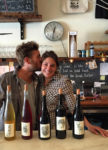 I just naturally liked them.
Young (he 36, she 29), smart, educated, opinionated without a hint of bravado. Urban East coasters who found each other in DC and wandered West to farm and discovered inspiration in a bottle of wine and the friendship of great producer along the way.
They are intuitive and open thinkers who embrace their youth while respecting the knowledge of those they are learning from. Admittedly lucky to have stumbled into a mentor like Gideon who has the soul of an artist, the work ethic of farmer, a minimalist sculptor’s point of view coaxing something personally unique in the face of such a distinctive and powerful terroir.
Aaron and Cara are just getting started with wine, on their third vintage, focused on the details of the year-round process and the bonds of their relationship as co-vigneronnes, farmers and life partners. Truely hard working, lovely folks.
They described their winemaking to me as a perpetual conversation between the two of them, a personal relationship to the vines, the joy of the backbreaking work in the vineyards, the lure of wine as a way to share their place with others and the openness to doing things in their own way.
By what just feels right and unafraid to fail.
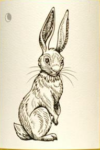 I was drawn to the poetic mythologizing of their journey through their choices–the why of their domaine name, the storied yarn behind each cuvee’s moniker, the elegance of the labels created by Kelly Patton, an artist friend with a plan to evolve the art as a project adding color to the line drawings as the wines develop over the years.
They are certainly natural winemakers with strong beliefs (and Olive Oil makers as well) but there is a lack of dogma here that leaves everything a bit down home. This is refreshing, as are their wines.
I just really enjoyed chronicling this story.
Getting to know them a bit. Having the depth of enjoyment of drinking a number of bottles of The Pearl Thief grow over the week of talking with them and writing this post.
I strongly recommend this bottle from this unique, out-of-the-way spot with awesome defining terroir made by this young and just unabashedly honest winemaking couple. Available from Chambers Street Wines for $30.99.
Their red cuvees and rose are in the market but a bit hard to find at times. Contact David Bowler Wines who distribute them into NY along with Clos Saron for assistance. Ask for Alex Miranda and tell him I sent you.
Big thanks to Aaron and Cara for sharing their story. To Ariana Rolich and the Chambers Street team who bear with me incessantly on a daily basis for years.
*Photos are from Cara and Aaron. The one at the top of the post is them on Slope 23.
————————-
Notes for the curious.
Frenchtown Farms Chronology
- 2014 Befriended Gideon after tasting his vintage ‘08 Black Pear
- 2015 Moved down the road from Clos Saron and made wine with him through three harvests
- Leased Renaissance Vineyards Slopes 23, 9 and 1
- Produced 1200 bottles, 3 red cuvees
- 2016 Produced 5000 bottles, added a white blend and a rose
- 2017 Produced 700 cases with the same 6 cuvees as 2016.
- The Pearl Thief this harvest is 75% Sauvignon Blanc, 25% Roussanne single vintage from Renaissance Lot 23
Deconstructing The Pearl Thief (2016)
- Grape mix in cuvee
- 60% Viognier, from Bokish Vineyard in Lodi.
- 40% Sauvignon Blanc, from Renaissance Slope 23
- Grapes stomped in open containers, macerated on skins till fermentation started (two days), pressed into neutral oak barrels
- Aged in a puncheon and half barrel for eight months
- 25ppm SO2 at bottling
- First Frenchtown Farms white, 60 cases made
- The Pearl Thief name refers to the wild hares that pilfered grapes overnight on Slope 23
- Wine is a beauty–Irresistibly fresh and flavorful. Tangy acidity. Layered acidity on finish
- 2017 vintage
- Approx.125 cases, still in barrels
- Single vineyard 75% Sauvignon Blanc and 25% Roussanne from Slope 23
I use the same headline every year for my Thanksgiving post.
And every year there are more quality natural wines, from more diverse places, made by producers I’ve never drank before, showing new innovations and at better prices.
There has simply never been a better time in history to be alive and be a lover of wine. We are so very lucky in this respect.
This year with the help of my good friends Ariana from Chambers Street Wines and Christy from Frankly Wines, I think I nailed it.
Truly outstanding wines from Oregon, Quebec, France, Sicily and Spain. With a splash of mead thrown in.
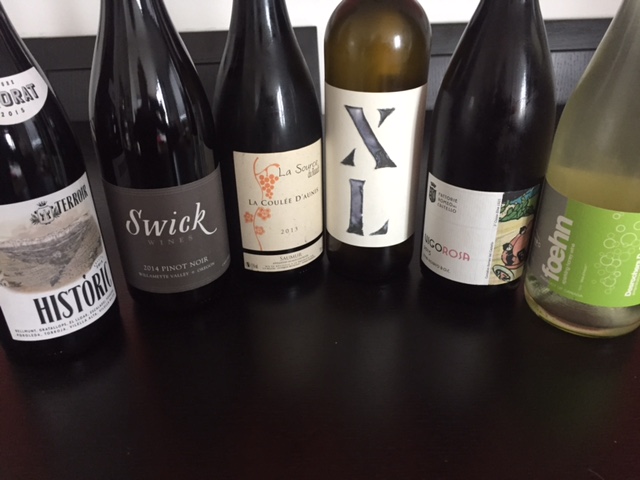
Here’s the selection:
Terroir Historic (Terroir Al Límit) 2015 Priorat Negre ($28.99)
The crowd favorite red this holiday.
Dominik Huber is a truly talented German winemaker making restrained natural reds and whites in the Priorat, in Spain.
Much less ripe that you’d expect, significantly reduced alcohol and making not a wine of place, but a wine of region. This bottle is a blend from a scattering of organic plots with telltale llicorella clay and alluvial soils of the Priorat.
Tightly wound acids, brambly herbal berries. As Ariana Rolich put it well, ‘a Priorat for minimalists’.
To me the bottle simply says Drink Me now!
Partida Creus 2015 Catalunya Massís de Bonastre Xarello ($29.99)
This was the crowd favorite white. Basically vanished in a moment.
We know the grape Xarello from Spanish Cavas, but was new2me as a still wine.
This is simply a head-nodding beautiful bottle–mineral rich, bright, citrus, nteresting and juicy at the same time.
This one is naturally a bit wild, no added SO2, and six months on the lees. Some time on the skins is obvious through the grip of the tannins and bouquet.
I’m buying a magnum for the Chanukah gathering of the same group.
Buy and try this if you can find it.
Swick Wines 2014 Willamette Valley Pinot Noir ($27.99)
Joe Swick and I have spoken in depth about natural wine. He is outspoken, so very wine savvy, an uncompromising purist and 5th generation Oregonian from Portland. And need I mention, a true talent.
This bottle is a silky, textured and brambly Pinot, sourced from several cooler Willamette Valley sites (Cancilla, Medici, and Fairsing vineyards). A light touch with a satisfying palate that leaves you with berries on the mouth, savory in the nose, and just satisfying all over.
I’ve been drinking this bottle over and over since its release.
Feels just right each time.
Joe nailed it with this one.
Romeo del Castello 2015 Etna Rosato Vigorosa ($28)
I had the pleasure of meeting Rosanna Romeo and her daughter Chiara Vigo when in Etna a number of years ago.
I remember well their story of how the eruption of Mt. Etna in 1981 reduce 60 hectares of vines to 14 and left huge lava beds on their property.
This wine speaks to me of my love of Etna and my pining to return.
That unique taste that even in a rose is vibrant and savory, bright and acidic with a crisp finish and a spice to the aftertaste that simply won’t end.
Delicious bottle that was a perfect complement to the others at the table. I kept this one near to me the entire meal.
Source du Ruault 2013 Saumur Blanc “La Coulee d’ Aunis” ($17)
I knew this wine the least prior to drinking it. Quite a discovery.
Comes from a tiny one-hectare parcel of Chenin Blanc of almost entirely Turounien Limestone in the Loire Valley.
Perfect pre-meal, hanging around nibbling while cooking and chatting. It is lean, mineral with a silky suppleness to it that that drew me in immediately.
A bit too austere for the group, but I grabbed and nursed this one myself.
A discovery and a huge bargain at $17.
I have another one in the fridge for for some saw goat cheese I picked up at the market today.
Desrochers–Foehn Ferme Apicole Honey Wine ($37)
This is a completely natural Pet Nat mead from Northern Quebec.
Unfiltered. Unfined. No added SO2 with the yeasts cultivated from the pollens collected from the same bees that brought in the honey for this bottle.
I met the winemaker and apiarist at my panel at the Raw Fair a few weeks ago and tracked this bottle down.
As intriguing as it is delicious. Clearly not a wine made from grapes and as a beekeeper years ago, I could taste the honey in the aftertaste though it is completely dry and magically satisfying.
Super natural in every way. Twelve months on the lees, non dosage, nothing added.
Not only does this winemaker have real talent but he is certainly part of a new generation that will I am certain redefine what natural means to all of us.
Try this or the other wines linked to in the post of my panel.
I guarantee you will not be disappointed.
To close
Been a while since I threw together a post on what I’ve been drinking, rather than spit out bottle pics on Instagram
This was more fun and more useful.
I hope you enjoyed it. I am certain you will enjoy the wine!
Few things can satisfy, connect and inspire, yet remain as inexplicable, as a bottle of wine.
Few things carry with them such an encyclopedia of scientific knowledge that is invariably trumped by the simple power of nature’s almanac.
And for all of the things we love and write about, we are always a bit speechless to communicate the nuance of how a bottle of wine, uniquely special with all its details, is really only about our experience of it.
This strikes home when you have one of those serendipitous wine experiences that open up a stream of connected remembrances.
The other evening, this bottle of Grillo was the Proustian trigger that kicked this off.
I was at an impromptu family gathering at Taboon on 10th Ave in Hells Kitchen. Last minute call to celebrate a birthday.
Mediterranean food was piled high on the table. Plates of hummus, bowls of salsa, chopped salads, Baba Ganoush, Tabouli, grilled Octopus, Tuna, tomatoes, squash and pita to die for.
The big aha was discovering this almost-never-seen-in-New York bottle of Grillo from Nino Barraco, an obscure and quite wonderful natural winemaker,
I know this bottle well as five years ago this September, I had visited the winemaker with a group of friends and remember the jolting ride down a long, bumpy and soggy road to his vineyard where the salt marshes outside of Marsala, Sicily touch the steep cliffs above the sea.
There was literally nothing there but the Mediterranean in front of you, breezes rolling cross the sea from Africa and windswept untrellised Grillo vines everywhere. Unplanted almost nowhere else. Indigenous to this part of Sicily but still a rarity.
The group of us (see pic in this post) were hanging around a makeshift shack with Nino, the winemaker, in the warm afternoon Sicilian sun, drinking the very first vintage of Vignammare, 100% Grillo, grown in the tiny vineyard where we stood.
He laid out the feast on a wood plank along with fresh sea urchin and shrimp that the his family had harvested for us that morning.
Picture of a truly joyous and perfect day.
The sea, the grapes, the purity of fermented juice made with such passion and intent. As natural and non-interventionist as can be– organic, spontaneous fermentation. Unfiltered, unclarified, unsulphured.
And very special to me in retrospect, as this was still an early taste of skin-fermented white wine—somewhat new to me then, an obsession to me now–adding the minerality of the soil, the salt of the sea, the bouquet of the marsh and the bite on the palate as a pinch to memorialize all this together.
I shared this story with the table in the very noisy corner of the restaurant, heads shook with appreciation as they emptied glass after glass, after bottle.
I had them look at the richly golden color of the wine, held up against the candle light, appreciating that this was white wine, made like red.
They listened to my over zealous spin on why skin is the human touch of winemaking, where people meet the true depth of place, and somehow, it becomes the epitome of connection, perfect as the fingerprint of time, place, people, weather under the overarching shades of our own thoughts that color everything we do.
They literally drank it in.
My enthusiastic story of Marsala and my community of blogger friends by the sea wedded to this gathering of family in Hell’s Kitchen on a steamy, raucous and joyous New York evening.
This is the good stuff of wine and life to me.
Proust may have had his madeleine to spur a long and meditative tale.
We had our bottle of Grillo to celebrate the evening and ourselves.
This is my idea of perfect.
_____
To experience my visit to Marsala, post here.

This is one delicious bottle of wine!
When I think of Pet-Nat, I think vivacious, fun and in the hands of most winemakers, gentle and soothing effervescence.
More something to accompany than to lead.
I think of easy afternoons and leaning back. I remember with a smile my friend Sophie Barret calling Pet-Nat some years back ‘a summer’s fling’ when comparing it to the perfection of Champagne.
This bottle is so much more.
It wraps the trifecta of an ancient plot of California Chenin Blanc, the simple methodology of Pétillant Nature with the light and minimalist touch of one of my favorite natural winemakers, Chris Brockway of Broc Cellars.
To the palate, this bottle of 2015 sparkling Chenin is alive and approachable, carrying a powerful balance of minerality and acidity.
To the nose, something floral in the oozing effervescence.
And to the body and soul, just satiation that wafts easily on a warm day, yet with the indelible mark of a unique place and specific winemaker.
To those who don’t know Chris’s work, consider yourself fortunate to have such discovery in front of you.
He is one of the new world natural winemakers who are all in on a non-interventionist approach, without being ostentatious or loud about it.
Just making wine naturally that carries his individual fingerprint as a winemaker be it this bottle, his Grenache, Syrah, white or red Zin.
He makes his wines in Berkeley, California sleuthing out the organic, the obscure, the said-they-couldn’t-be-found plots of grapes everywhere. His wines are by definition restrained, terroir-obsessed, naturally low in alcohol, residual sugar and SO2, yet strong and resilient in character.
His wine feels kindred in character to the remarkable Clairets from Domaine de la Tournelle in the Jura. Such a light yet studiously standoffish touch with such strength of conviction in the result.
Every bottle is unmistakably his.
From the often ethereal graphics on his labels to the undeniable take-away of satisfaction, this wine is not in your face, but in your head and on your palate in a memorable way.
I fell for Pétillant Naturel as a way of making sparkling wine years ago, from the very first time someone poured one. I think one from Philippe Bornard.
An ancient and simple method, basically bottling wine before it has finished fermenting. With the bubbles forming naturally as the wild yeasts digest sugar in the grape juice and release carbon dioxide that is trapped inside the bottle.
Often hand disgorged as the lots are small, and in this one, non-dosage (no added sugar) as well.
The conundrum here of course is that Chris made only 152 cases, and his wine disappears into the glasses of the community quickly.
 Try and find it. At $30, it is a true afternoon delight. If you do, check out the technical notes as they will deepen the story and your enjoyment along with it.
If you can’t find this one, try something else of Chris’s.
More and more I believe that vintage or even grape is somehow less important. That the wine we love comes from an emotional affair between a unique place in time and the intent and skill of each individual winemaker themselves.
I’ll consider this post a success if it spurred you to uncork one of his bottles, Pet-Nat or no.
And a huge from-the-heart thanks to my friend Arianna Rolich at Chambers Street Wines, who always saves bottles of the very best and most interesting for me to try.
She was so right on with this one!