Can a bottle of wine be described as just plain fun and joyful?
Yes is the answer and the bottle that epitomizes this for me lately is the unusual and awe inspiring Le Cousin Rouge from biodynamic winemaker, Olivier Cousin from the Loire Valley.
Everything about this wine falls to the natural side of the center:
- Certified biodynamic
- 100% Grolleau. Ancient almost extinct grape entirely used for rose wine
- Ancient vines, reportedly 80 years old
- Winemaker’s notes state no sulfites
And everything about this bottle speaks to accessibility, enjoyment, and suspending disbelief.
I love presenting the story behind the bottle as I serve and taste wine with friends. I’ve brought out this bottle, maybe six or more times since Thanksgiving to both wine geeks and infrequent wine drinkers alike. And every time I’ve held back the story at first and let the wine speak for itself.
The result has been unanimous! This is a taste test winner every time I’ve uncorked a bottle.
 This is just a terrific bottle of wine. Tastes pure and country and exuberantly buoyant and is strangely reminiscent of some the best Trousseaus from the Jura.
There is an earthy berry taste, ever so easy on the palate but focused and concentrated. You can taste the loamy minerality of the soil but it is crisp and silkily acidic.
Oliviere Cousin is an educator, mentor and coach of the biodynamic approach to wine making. He believes…and lives the belief that there is a harmony between man and nature and the intersection of that can be…and is to our benefit, his wine.
His vineyard is tiny, only 12 hectares in the village of Martigne-Briand in Anjou, in the Loire Valley. It is Demeter certified biodynamic. All work is done by hand with the help of his horse Joker. None or very limited added sulfites, no enzymes, no non-indigenous yeasts and no sugars added. And extended maceration period per the winemaker is the key to the character of the wine.
This bottle of Le Cousin Rouge Vielles Vignes Grolleau is not that easy to find. I purchased mine from Chambers Street Wines and they will have more coming in. Ping them and ask to be put on the list or search around online.
At $20 a bottle this is a treat. I would buy it at twice that and be content.
I incessantly lament that the best small production artisanal wines need to be remembered on the palate and in this blog as they are limited in production. What I do is set up alerts on Google by the winemakers name and buy the winemaker as he makes wine regardless of the vintage. So far, this strategy is working as while each vintage is different, its the place and the winemaker that are my trusted guides to something new.
Try and find wines by Olivier Cousin, imported by Jenny & Francois Selections. It’s worth the effort.
I and many of my guests have found this wine wonderful. Please do let me know what you think.
With natural wines, taste is the test.
The crisp clarity, earthy freshness and subtle richness of natural wines drive a glint of satisfaction from friends whenever I uncork a bottle from some wonderfully small vineyard tucked away down a country road in Arbois in the Jura or under the clouded, vertical terraces of Etna in southeastern Sicily.
But for all the wonder of natural wines and ties to traditional wine making, this is a hidden category, not easy to find nor marketed nor understood well. In New York, visionaries like Dan Lillie and Jamie Wolff of Chambers Street Wines and handful of others have been tasting and educating and selling these wines for a number of years to a growing but still small population of natural wine aficionados.
This is changing…and in New York, seemingly overnight.
And the change is coming from where wine shines to the broader wine loving population…in restaurants and bars paired with food.
On newly printed restaurant menus and drink lists, designations of ‘O’ for Organic, “B” for Biodynamic and the mysterious (to me) “S” for Sustainable are showing up everywhere. Definitions of what organic means may be squishy and waiters sheepish when pressed for information, but great natural wines are moving full blast into the food and beverage business. This is a tipping point for market appreciation that has long been coming.
I couldn’t be more delighted by this.
My take is there are two motivations for this…both working together.
Natural wine is food friendly by nature. Crisp with flavorful acidity. Unique tastes and soft finishes. And with lower alcohol content to sit ‘with’, not on top of the food. Natural wines are a true expression of place. A reflection of each particular vineyard so there are distinct, unique and seemingly endless pairings between food and individual wines. This is no longer, just have a Trousseau with that Israeli Hummus, there is a unique ability to paint by grape and place and vineyard and winemaker…and chef.
Local chefs in most every downtown neighborhood I visit have found new taste mates with their winemaking counterparts from France and Italy and Spain, with a sprinkling of new-to-me wines everywhere from Lebanon. Israel. From everywhere actually.
More subtle and less overt than the taste pairing of natural wines with fresh food, but key, is the ‘organic’ roots of the fruit–the grapes themselves. There is a dramatic move towards the healthy and natural in what we put on our skin, wash our hair with and certainly what we eat and drink. For myself, restaurants that have natural or local or organic food, prepared with an eye towards seasonal freshness and healthy components, along with scream-out-loud taste is what I want. Organic is not why you eat there. But it is certainly a bonus and the baseline for taste and talent of the chef’s to work with. The same is true for wine.
You pair wine with food for taste. But both wine and food, at their best and at their core are natural and healthy. Wine and food are tied at the hip because at their source, they are from the earth.
Wine of course, is complex…much more is involved than simply growing the grapes in a natural way. And there is some mushiness and much debate about what organic means for wine. Whether this applies to only what happens in the vineyard or the cave as well. Whether sulfites can be added. The importance of using only indigenous yeasts and whether chaptalization (adding sugar) to boost the alcohol content is ‘natural’ or not.
I agree that these categories are not perfect but I’m thrilled and optimistic that placing great natural wines in front of a larger wine and food-loving group is the right direction.
I’m less interested in perfection and more in progress. And seeing terrific natural wines from small artisanal vineyards in our local restaurants is a huge step forward for everyone. And a taste revolution whose time has finally arrived.
This year, I decided to forget about pairing with food and bring just great and interesting Organic wines to share. More tasting and information exchange than dinner planning.
I’m a big fan of natural wines. At their best, they each taste unique, are alive in the glass and speak to the story of place and grape and winemaker. I shortlisted wines from mostly old vines that oozed a sense of place with deep minerality and berried fruit. And are readily available for under $20!
Then I threw them in a very large sack and schlepped them to the assembled Waldstein clan on subway and bus from downtown NYC to Central Jersey.
In tasting order.
Cote-de-Beaune Rapet ’09 Bourgogne En Bully
Something easy and almost familiar to start with. A lite high-elevation French Pinot Noir with pure fruit to open up the palate and lighten up the atmosphere. Perfect opener. Lovely little aromatic fun Pinot. A crowd pleaser.
Olivier Cousin Le Cousin’09 Rouge Vielles Vignes Grolleau
Completely new to this group and to most of us. A really terrific Grolleau. And biodynamic as well. Tastes pure and rural and is reminiscent strangely of some Trousseau from Arbois. Unique. Almost effervescent.
Rich earthy dark berry taste from these 80 year-old Grolleau vines from the Loire Valley. A winner. The taste favorite.
Try this. It’s wonderful. I can guarantee that this one is being purchased this morning for holiday gifts.
Coudert (Clos de la Roilette) ’09 Fleurie Clos de la Roilette
Exceptional Beaujolais. From Fleurie and richer, deeper more layered than other Beujolais I’m familiar with. Mineral complexity that will get better as it ages although luscious today.
A great pairing with the meal even though that was not the overt intent. For $20, I put a case away for the holidays and ski vacations.
D. Ventura ’09 Viña do Burato
I’m a tireless fan of Ribeira Sacra and a follower of wine maker Ramon Losada. I brought this deep, concentrated and complex Mencia from 80 year-old wines from the terraces above the River Mino to satisfy the big red drinkers in the room.
Ramon is a rock star. He gets how to let the wine inherit the slate soils of Ribeira Sacra and portray a fresh honest vibrancy in a bold, medium bodied red. Great stuff with Turkey or just hanging around.
All the wines are available from Chambers Street Wines in TriBeCa in the store or online.
For my personal view on “Why drink organic wine?” you might check out this post.
Happy holidays to everyone and a special thanks to the team at Chambers Street Wines for introducing me to these and many more incredible organic wines.
Wine tells a tale of taste and place and people.
Nothing tells that story better, more individually and with more depth of passion then artisanal vineyards making great organic wine.
Is organic healthier? Certainly.
Is it better for the environment? Without a doubt.
Is it just the right thing to do? No question.
But this is not why we love it…
Wine is neither a cause, nor a medicine, nor an ethical act. But it is truly amazing, replete with passion, oozing stories and one of life’s great taste and storied pleasures.
What does organic have to do with any of this?
Organic wine is more than a choice to reject industrialized farming. It is a decision to focus on discovering the unique taste of each place. And with the decision, comes the concentration on the vineyard more than the cave, the characteristics of the place more than the chemistry of manipulating flavor.
An art critic, I believe talking about Brancusi, said that a truly great sculpture finds the image in the stone with the least number of chisel strokes. Great organic winemakers are sculptures doing just that with the land and the grape. Not painters starting with a blank canvas. The finished piece of sculpture is that unique taste of place in the bottle.
I’m not downplaying the very real complexities of defining and legislating organic, natural and biodynamic. The food industry is still in turmoil over this after a decade. I have ideas on this that I will share in another post, but first things first is to understand the ‘why’ for a market before getting stuck in the ‘how’ of it.
And taste and a deeper connection with the place and winemaker are the ‘why’ of organic wine to me…and I believe for the mass market as well.
Wine made in a natural way, in concert with the place is just more alive in the glass. More accessible and personal, more individualistic and more unique. That is not to say that all organic wine is good…far from it. All wine is neither equal nor good. Nor is all of anything.
An organic approach to wine turns the concept of regional terroir on its head. Certainly there are characteristics of Napa or Calistoga or Etna or Arbois, but in an artisanal world of natural winemaking, each place is unique, each vineyard a micro terroir in its own right.
Don’t take my word for this…taste it yourself.
Spend some time tasting both the Poulsard and the Trousseau from Evelyne and Pascal Clairet and their tiny vineyard, Domaine de la Tournelle in Arbois. You’ll find a fingerprint of taste that resides in the land itself across the differences in the grape.
Try the magnificent Trousseaus of Jacques Puffeney and Michel Gahier in Arbois. Tiny vineyards, adjacent to each other, each using an organic approach to tending the same grape varietal, yet each of these wines is uniquely different. This is the land speaking through the grape directly to us!
And the list of my most cherished organic vineyards, like dots on my world map of great taste goes through Spain, Italy, France, the Canary Islands and on and on.
So…what am I really trying to say?
Organic is the right way….in everyway, in life. There is no argument here as responsible informed people. But the real thing that matters and the point for vineyards and wine shops and wine drinkers…is that organic wine brings to your glass a taste, depth, richness and delight that has freshness, crispness and an overall sense of itself that is special.
Think about your local farmer’s market. When I head out to shop on Saturday, I ask each vendor the same question..”Do you spray or use synthetic fertilizer?” If no, I try it. If it tastes great, I’ll be back to buy more. I buy it and buy it again because it tastes great. I won’t buy it if it is sprayed…but I won’t return if it is not a taste delight.
Organic wines are invariably fresh and crisp and aromatic and unique to each spot…and vivacious at their best. They are not overextracted nor coerced into a preconceived taste mold. They are all about the vineyard.
When I started drinking the wines of Jacques Puffeney, he was referred to as the preeminent vigneron in Arbois. The definition of a vigneron as a winemaker who focuses on the importance of the land and vineyard over the craft of the cave, is I think, the key component of a natural and organic approach to winemaking.
I’m a fan of the organic wine iconoclast Salvo Foti of I Vigneri fame in the Mt. Etna area of Sicily. He believes that wine has its own composition that is created by the grape, the vine, the vineyard, the climatic conditions and the individual (vineyard worker and winemaker). I buy this. It doesn’t mean a total hands-off approach in the cave but it does mean that they are farmers first, curators of the process, second. Again, a true vigneron.
I am neither a purist nor an organic fundamentalist nor an orthodox biodynamic zealot. Sure, I certainly believe that natural food and wine is better for us and for the ecosystems of the world we are responsible for. Who doesn’t? But I start with what I like on my palate and I move on from there.
Great wine…organic or not is my passion and yes, the thought of opening my last bottle of 1990 Ugolaia Lisini Brunello di Montalcino that will melt my body and brain with pleasure…supersedes anything about how it was made. I’m human…obviously.
But when I go to my local wine shop, out to dinner with friends, or travel around the world to visit and taste…I’m drawn to the small artisanal organic wines and vineyards that embrace taste and passion for place first.
I relish the clarity that their dedication and passion for shepherding the vineyard with the goal of uncovering its natural taste brings to their wine, the wine world at large…and to my glass.
____________________________________________
My thanks to the team at Chambers Street Wines in Tribeca, NYC.
Especially Christopher Barnes and Sophie Barrett for leading me to incredible organic wines to taste. They may not agree with my conclusions in this post, but they are the best guides one could hope for.
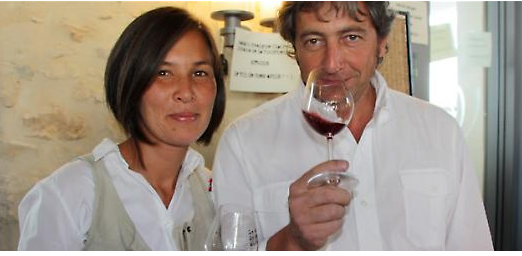
I’m a big fan of Evelyne and Pascal Clairet and their tiny vineyard, Domaine de la Tournelle, in the center of Arbois on the eastern border of France.
In the foothills of the Alps, they make quietly wonderful wine from the region’s indigenous grapes–Poulsard, Trousseau and Savagnin—and they’ve created a unique footprint of taste…quite delicious…and freshly their own when compared to the other top winemakers in Arbois.
Here’s what amazes me.
Arbois is a tiny place. High altitude vineyards and a cool foothills climate. Indigenous grapes are grown and mostly natural methods used. One would think that this creates a sameness of taste like one might describe a Napa Cabernet. Not so.
I’ve tasted many of the Trousseau and Poulsard wines from a handful of winemakers in Arbois. And while certainly the varietal and the winemaker drive the category…the place and the vineyards themselves seem to be the fingerprint of taste. It’s like a neighborhood that produces a number of musicians, each with a sense of place but with their own unique rhythm.
Terroir, that sense of place, vineyard to vineyard, is remarkably distinct and palpable here. Maybe it’s the natural approach to letting the wine takes its own form or these indigenous grapes themselves…I think its all of these under the signature of the vineyard and the plot of land itself.
This ’07 Trousseau de Corvees is light and alive in the glass, strongly floral in its bouquet. It is all berries on the nose and layered minerality on the palate. So very different from the Trousseau of Jacques Puffeney or Michel Gahier or Philippe Bornard.
Interestingly, when I tasted the Clairet’s Poulsard a while back, I found the overall character of the wine from the same vineyard reminiscent in some strange way to this Trousseau. The Clairet’s have a light touch, a crisp freshness that comes from an organic and a studied approach to letting the place define itself. For 20 years they have been working to let the vines find their own taste…and to my palate with a great deal of success.
If you are new to Arbois wines, I suggest you try the ’07 Tournelle Trouseau de Corvees as a counterpoint to other Trousseau wines from Arbois. They are all colors from the same rainbow and make the tasting process an interesting and nuanced experience.
I’m very optimistic that you’ll find Trousseau a taste that pleases…and each one of these wines will find a place on your wine rack. All affordable. All crisp and wonderful and natural. All a pleasure to drink.
Give this bottle of Tournelle ‘07 Arbois Trousseau des Corvees a try. It’s fresh and interesting and memorable with a taste that lingers.
From Chambers Street Wines in TriBeCa, NYC for $30 a bottle.